



What Does BIM Competency Look Like in Practice?
BIM competency is reflected in how confidently a professional applies construction technology to real project requirements. It involves creating accurate models, coordinating information, resolving issues and producing reliable project deliverables.
Strong employability skills also matter, as BIM professionals need to communicate clearly, work across disciplines and respond to changes throughout a project. In practice, competency means combining technical knowledge with sound judgement and collaboration, rather than simply knowing how to use BIM software.
Which Types of Evidence Best Prove BIM Competency?
Employers can assess BIM competency from several angles, from the quality of a BIM portfolio to how confidently a candidate handles practical tasks. Each type of evidence reveals a different aspect of their technical knowledge and professional readiness.
|
Evidence Type |
What Employers can Assess |
|
BIM Portfolio |
The quality of models, drawings and coordinated deliverables, along with attention to detail and modelling standards. |
|
Project Experience |
Familiarity with real project workflows, coordination challenges, deadlines and design requirements. |
|
Technical Assessments |
Ability to apply BIM tools, interpret project information and resolve modelling or coordination issues. |
|
Certifications |
Formal understanding of BIM concepts, processes, software and recognised industry standards. |
|
Work Samples |
Practical capability, consistency and the level of detail a candidate can bring to professional deliverables. |
How Does a BIM Portfolio Demonstrate Real-World Capability?

A strong BIM portfolio gives employers a practical view of how you approach project work. Rather than listing software you know, it can show how you apply BIM training to create accurate models, coordinate information and handle project requirements.
-
Model Quality: Well-structured models can reflect your understanding of modelling standards, accuracy, level of detail and discipline-specific requirements.
-
Project Workflow: A portfolio becomes more meaningful when it shows the journey from an initial brief through modelling, coordination and final deliverables. This gives employers context rather than isolated screenshots.
-
Clash Detection: Examples of identified and resolved clashes can show how you spot potential issues and think through practical solutions before they reach the site.
-
Clear Documentation: Drawings, schedules and sheets reveal whether you can turn model information into organised, usable project documentation.
-
Coordination Skills: Including coordinated models or multidisciplinary outputs highlights your ability to work with architectural, structural and MEP information without treating each model in isolation.
-
Individual Contribution: When working on team projects, clearly explaining your role helps employers understand which tasks, decisions and deliverables you were personally responsible for.
-
Professional Presentation: Consistent naming, organised sheets and concise project descriptions can make your work samples easier to review while reflecting the discipline expected in professional BIM environments.
Do BIM Certifications Prove Practical Competency?
KA BIM certification can validate your knowledge of specific software, workflows or industry practices, but it does not always reflect how confidently you can handle real project situations. Employers may therefore look beyond certificates when assessing technical skills.
-
Software certifications can confirm your familiarity with tools such as Autodesk Revit, Graphisoft Archicad or other BIM platforms.
-
Industry credentials can demonstrate knowledge of recognised processes, standards and information management practices.
-
Hands-on evidence provides a clearer view of how you apply that knowledge through modelling, coordination, documentation and problem-solving.
-
Real-life project work adds context by showing how you respond to changing requirements and multidisciplinary challenges.
Why Does Real Project Experience Carry More Weight in BIM Hiring?
For BIM professionals, real project experience can reveal how well someone applies practical skills when working with project information, deadlines and multiple disciplines. This also shows how technical knowledge translates into decisions and deliverables.
|
Project Experience |
What It Tells Employers |
|
Live Project Exposure |
Experience with actual project requirements helps candidates understand how BIM processes operate under deadlines, design changes and delivery expectations. |
|
Multidisciplinary Coordination |
Working across architectural, structural and MEP models highlights the ability to communicate, review information and resolve coordination issues. |
|
CDE Workflows |
Using a Common Data Environment (CDE) demonstrates familiarity with structured information sharing, document control, revisions and collaborative project delivery. |
|
BEP Implementation |
Working with a BIM Execution Plan (BEP) shows that a candidate can follow agreed project standards, responsibilities, workflows and information requirements. |
|
Information Management |
Handling model data, naming conventions, revisions and shared information reflects the discipline needed to maintain reliable project information throughout delivery. |
|
Problem-Solving |
Real projects rarely follow a fixed path. Responding to clashes, design changes or incomplete information can reveal judgement that software knowledge alone cannot demonstrate. |
|
Project Deliverables |
Completed models, drawings, schedules and coordination outputs give employers tangible evidence of how a candidate contributes to project outcomes. |
|
Professional Collaboration |
Working with different stakeholders builds communication and coordination habits that are essential when BIM workflows extend across teams and organisations. |
How Do Technical Assessments Validate BIM Skills?
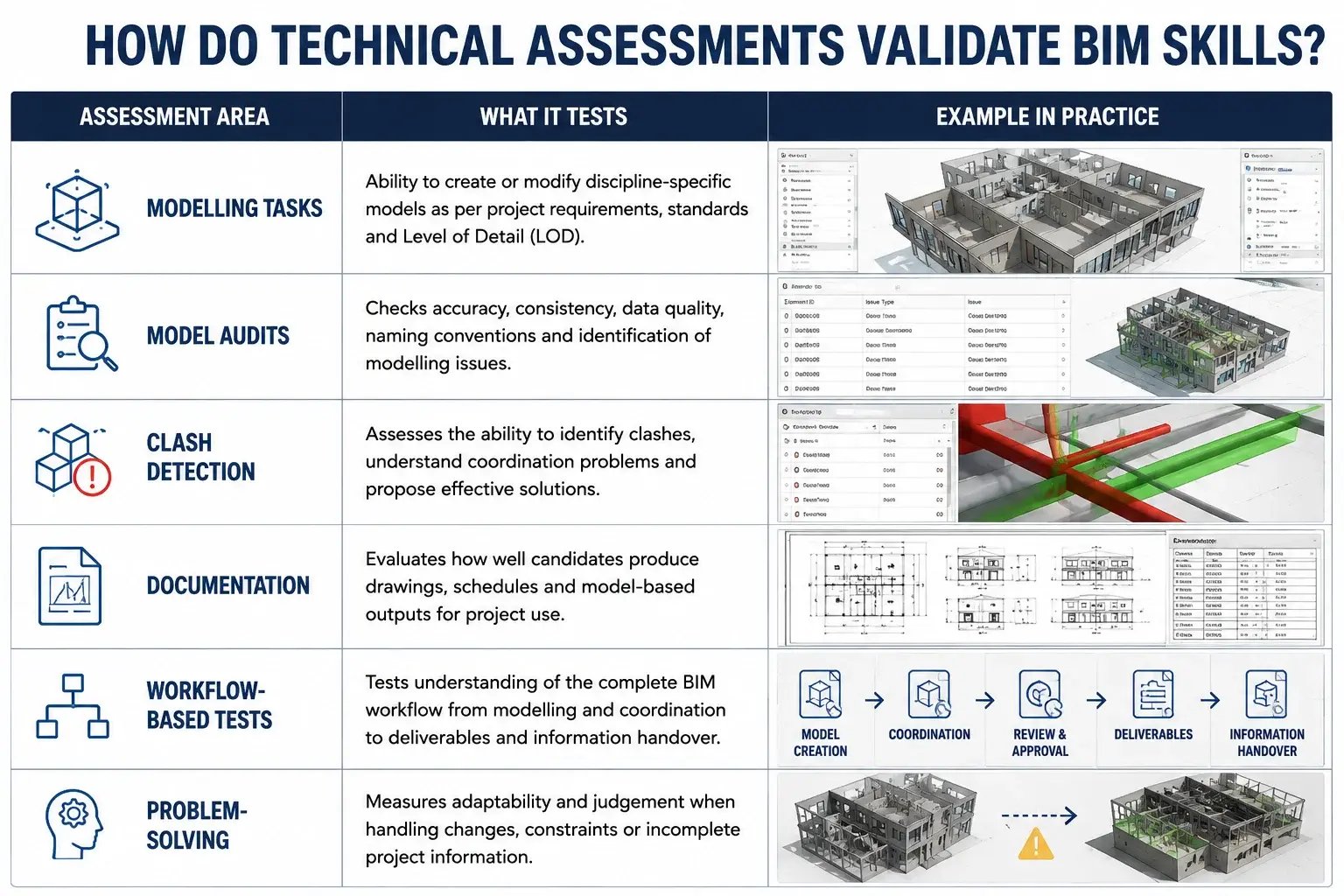
A BIM assessment can reveal how well a candidate applies their knowledge when faced with practical project tasks. While BIM qualifications confirm learning or training, an assessment can show whether that knowledge translates into accurate models, coordinated information and reliable deliverables.
-
Modelling Tasks: Candidates may be asked to create or modify discipline-specific models while following project requirements, standards and levels of detail.
-
Model Audits: Reviewing an existing model tests attention to accuracy, consistency, data quality, naming conventions and potential modelling issues.
-
Clash Detection: Identifying and reviewing clashes helps assess whether candidates can recognise coordination problems and suggest workable solutions.
-
Documentation: Producing drawings, schedules or model-based outputs checks how effectively candidates convert model information into usable project documentation.
-
Workflow-Based Tests: Tasks that follow a complete BIM workflow can assess how candidates manage information from modelling and coordination through to final project deliverables.
-
Problem-Solving: Unexpected changes or project constraints can reveal how confidently candidates adapt their approach rather than simply follow predefined instructions.
How Can You Build Strong Evidence of BIM Competency?
Building credible evidence of BIM competency comes from showing what you can deliver in a project setting. A focused portfolio, meaningful project experience and the ability to explain your decisions can give employers a clearer view of your BIM skills and readiness for BIM jobs. Professionals who want to build this evidence through structured practice, Novatr’s BIM Professional Program uses real-world projects, expert guidance and portfolio-focused learning. Here is how this course can help you build strong BIM competency:
-
Work on 40+ real-world projects to create tangible evidence of your modelling, coordination and project-delivery skills.
-
Follow a structured learning path covering BIM fundamentals, coordinated projects, documentation and project immersion, rather than learning individual tools in isolation.
-
Learn from 400+ industry practitioners, giving you exposure to professional approaches and expectations.
-
Build towards portfolio-ready project work that demonstrates how you apply BIM skills to defined project requirements.
-
Gain relevant credentials, including Autodesk Revit and Navisworks certifications, alongside project-based evidence of your capabilities.
-
Access career-focused support to help you present your experience and prepare for the expectations associated with BIM jobs.