---
title: What If You Don’t Crack ESE? Best Career Options for Engineers
description: Explore best career options for civil engineers after ESE, including PSUs, private jobs, BIM careers, and high-growth paths for engineers.
image: https://blog.novatr.com/hubfs/What%20are%20the%20alternatives%20to%20Cracking%20ESE_%20Best%20Career%20Options%20for%20Engineers.jpg
---
[Blogs](https://www.novatr.com/learning-hub)
- [Architecture & Construction](https://www.novatr.com/learning-hub?category=Architecture+%26+Construction)
- [BIM](https://www.novatr.com/learning-hub?category=BIM)
- [Computational Design](https://www.novatr.com/learning-hub?category=Computational+Design)
- [Company News](https://www.novatr.com/learning-hub?category=Company+News)
- [Expert Talks](https://www.novatr.com/learning-hub?category=Expert+Talks)
Explore Courses
[Just Launched  BIM Professional Program v.2026 Take your career to the next level by mastering the real-world application of BIM. Know More](https://www.novatr.com/courses/bim-professional-program)
[ Master Computational Design Course Break into an advanced career by learning to apply the power of computation to the art of design. Know More](https://www.novatr.com/courses/computational-design)
[Blogs](https://www.novatr.com/learning-hub)
Explore Blogs
- [Architecture & Construction](https://www.novatr.com/learning-hub?category=Architecture+%26+Construction)
- [BIM](https://www.novatr.com/learning-hub?category=BIM)
- [Computational Design](https://www.novatr.com/learning-hub?category=Computational+Design)
- [Company News](https://www.novatr.com/learning-hub?category=Company+News)
- [Expert Talks](https://www.novatr.com/learning-hub?category=Expert+Talks)
Courses
- [BIM Professional Program v.2026](https://www.novatr.com/courses/bim-professional-program)
- [Master Computational Design](https://www.novatr.com/courses/computational-design)
- [CIVIL/](https://www.novatr.com/learning-hub?category=BIM)
Featured Article
# What If You Don’t Crack ESE? Best Career Options for Engineers

Deependra Dobriyal
June 11, 2026
9 min read


The Engineering Services Examination (ESE) is one of the challenging tests for Civil Engineers in India. There are hundreds of thousands of candidates applying every year, but only a few make it through. For instance, in the year 2024, more than [5 lakh](https://www.dikshantias.com/blogs/how-many-students-appeared-for-upsc) candidates appeared for the UPSC ESE preliminary examination, and only a few hundred got the top rank. It’s actually a pretty clear sign of how competitive the whole thing is.
Not passing ESE doesn't mean the end of your engineering journey, though. In fact, there is a wealth of **career opportunities after civil engineering**, and they are growing rapidly in both the public and private sectors and are stable and lucrative.
Read this article to understand the top career paths for civil engineers, skills required and how to secure a bright future even if you do not have an ESE.
Unlock High-Paying Careers With BIM
Master BIM workflows, software and skills on real projects.
Apply Now
\*Limited seats available
## **The Harsh Reality of ESE Competition**
ESE is a competitive course due to:
- Limited number of vacancies in government departments
- High level Technical and aptitude questions
- This took a number of years to prepare.
- Increasing competition every year
So many students prepare for 2-3 years but still fail to pass it. This results in job stress and anxiety for civil engineers about their **career after civil engineering**.
The industry, however, is much larger and growing at a more rapid rate than it ever has been outside ESE.
## **Top Career Options After ESE (Private Jobs, PSUs Options & BIM Careers)**
There are good alternate routes if you fail to pass ESE.
### **Private Sector Jobs**
- Construction companies (L&T, Shapoorji, Tata Projects)
- Design consultancy firms
- Infrastructure developers
- Project management companies
These positions have more rapid career progression and are directly involved in work.
### **PSU Opportunities**
You can make an application even if you do not have ESE through:
- GATE exam
- Direct PSU Recruitment drives
Engineers are recruited by PSUs such as ONGC, BHEL and IOCL on a regular basis.
### **BIM and Digital Construction Careers**
BIM is one of the fastest-growing areas in today's market.
- Work on digital building models
- Learn to use tools such as Revit and Navisworks
- Understand automation and coordinating workflows
That's why it's a good choice for civil engineers as a career.
**BIM career in India** is increasing with the projects of smart cities and outsourcing jobs in the world.
## **High Growth Careers for Civil Engineers**
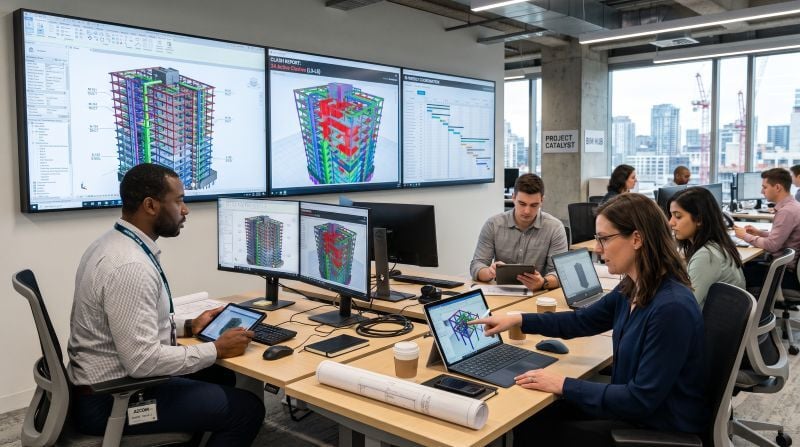
In addition to the regular jobs, new-age jobs are rapidly expanding.
### **1. BIM Engineer / Coordinator**
- Integrate digital construction models.
- Improve project coordination
- Should have good **BIM coordinator skills**
### **2. BIM Automation Specialist**
- Scripting and [BIM tools](https://www.novatr.com/blog/essential-software-for-bim-automation-specialist) for efficiency
- Works with data-driven workflows
- Needs to be a very good BIM user
### **3. Project Planner**
- Accurately manages timelines and cost planning
- Is able to work on big infrastructure initiatives
### **4. Quantity Surveyor**
- Concentrates on the costing of the process
- Construction companies have a high demand.
These are some of the top jobs available for civil engineers in today's market.
## **Skills Needed**
You'll need to have more than your academic credentials to make it in today's engineering jobs.
### **Technical Skills**
- AutoCAD and Revit
- Basic understanding of structural design
- **BIM skills**
- Handling data and Excel
### **Digital Skills**
- Understanding of automation tools
- Basic scripting (Dynamo or Python)
- Understanding of building information modelling workflows
### **Soft Skills**
- Problem-solving ability
- Communication with teams
- Time management
- Attention to detail
These skills are directly applicable to career prospects in civil engineering in every industry.
## Comparsion of Career Paths
Here is your content formatted properly into a clean table:
| **Career Path** | **Entry Difficulty** | **Salary Growth** | **Stability** | **Skill Requirement** |
| --- | --- | --- | --- | --- |
| ESE / Govt Jobs | Very High | High (slow growth) | Very High | Strong core engineering |
| PSU via GATE | High | High | High | Technical + exam prep |
| Private Construction | Medium | Medium–High | Medium | Site + project skills |
| BIM Careers | Medium | High | High | Digital + BIM tools |
| Project Management | Medium | High | High | Planning + communication |
This indicates that civil engineering is not just for government exams; there are career opportunities in civil engineering.
## Mistakes to Avoid After UPSC ESE
The following points will help to avoid mistakes and enhance career prospects after civil engineering.
1. Making ESE the sole focus for too long
2. Likely to overlook opportunities in the private sector
3. Failure to improve technical skills
4. Not using digital tools such as BIM
5. Failing to develop a hands-on portfolio
6. Simply copying someone else's career path without doing any research
7. Postponing work experience for exams
## **How to Build a Strong Career Without ESE?**
In order to develop the BIM skills, learners must be provided with structured project-based learning with real tools, workflows and standards. Courses such as Novatr's BIM course help engineers get hands-on experience and get ready for modern-day construction careers.
Take your civil engineering career to the next level with Novatr’s [BIM Professional Course for Civil Engineers](https://www.novatr.com/us/courses/bim-for-civil-engineers), a project-based program that prepares you to plan, design, and manage construction projects using 12+ industry software and essential BIM plugins.
Learn how to work with Autodesk Revit, Navisworks, construction cloud and key plugins like DiRoots.One, pyRevit, EF-Tools, ProSheets, Issue and Model Checker for Revit to improve automation, accuracy, and project efficiency.
**Here’s what you’ll gain:**
- End-to-end understanding of BIM workflows — modeling, estimation, coordination, sequencing, and documentation.
- Hands-on training aligned with ISO 19650 standards and real residential + commercial projects.
- **Globally recognized certifications**:
After completing the core modules, learners can also choose 2 additional specializations, including:
- **Visual Programming with Dynamo** – for automation and parametric workflows
- **4D, 5D & 6D with BIM** – for time, cost, and facility integration
- **Tekla for RCC Modeling** – for detailed steel and concrete modeling
- **Civil 3D for Infrastructure** – for roadways, railways, and utilities
- **Project Strategy & Optimization with Plannerly -** Plan, structure, and audit BIM execution plans.
This structured approach really does help professionals to build solid BIM skills and then use them in actual projects, not just in theory.
Master BIM and Get Hired Faster
Join a community of 8500+ Architects and Engineers.
Explore Now
\*Limited seats available
## Conclusion
Not clearing ESE is no reason not to be an engineer. Indeed, it may be the first step in a more practical and industry-oriented path. Nowadays, civil engineers have options such as private construction work, PSUs via alternative examinations, and digital jobs such as BIM. Strong growth and stability of these roles.
It’s more important to build your skills and also get real project experience, than just pass exams or focus only on tests. Other fields like BIM, project management, and planning are becoming some of the best career options for civil engineers, with strong demand and a really good learning curve, too.
The [BIM Professional Course for Civil Engineers](https://www.novatr.com/courses/bim-for-civil-engineers)by[Novatr](https://www.novatr.com/) is recommended if you want structured learning. It helps engineers to step into the modern world of Digital Construction with more confidence and less guesswork.
Visit our [resource page](https://www.novatr.com/learning-hub) for additional resources and career guides to help plan for your next step.
Was this content helpful to you
Like Yes
Dislike No

TABLE OF CONTENTS
BIM Is The New Standard. Are You Certified?
Get Certified in BIM
SHARE ON YOUR SOCIALS
Link Copied Successfully
Related articles
[ BIM Civil UPSC ESE vs GATE vs Private Jobs: Which Career Path is Better? 11 June 2026 9 min read](https://blog.novatr.com/blog/upsc-ese-vs-gate-vs-private-jobs-which-career-path-is-better) [ BIM Civil UPSC ESE Salary, Job Roles & Career Growth Explained 11 June 2026 7 min read](https://blog.novatr.com/blog/upsc-ese-salary-job-roles-career-growth-explained) [ BIM Civil What is UPSC ESE Exam? & Everything Civil Engineers Need to Know 11 June 2026 6 min read](https://blog.novatr.com/blog/what-is-upsc-ese-exam-everything-civil-engineers-need-to-know) [ BIM Civil How to Prepare for UPSC ESE: Syllabus, Strategy & Books 11 June 2026 5 min read](https://blog.novatr.com/blog/how-to-prepare-for-upsc-ese-syllabus-strategy-books)
Download Syllabus
## BIM Professional Program
Next Cohort
June 2026
Program Duration
7 Months
Premium Program benefits
8 Credentials from Autodesk, NSDC, Novatr
1 program. 10 career paths. Infinite Growth.
40+ ISO 19650 & RIBA real-world projects to practice
1-on-1 guidance. Access 400+ industry experts.
Access the biggest AEC-Tech community on the planet. 8500+ and counting
Curated for you by 100+ global BIM leaders.
Lifelong access to course content
Enter your details to download the program syllabus.
##### BIM Professional Program
June 2026, 7 Months
Your Name Invalid name.
Phone Number Enter a valid phone number
Email Please enter a valid email address.
Select years of experience\* Currently studying 0-1 years 1-2 years 2-4 years 4-8 years 8-10 years 10-12 years 12+ years Invalid selection.
Specialisation Select your background\* Architecture Civil Engineering Mechanical Engineering Electrical Engineering Invalid selection.
Are you professionally trained in interior design?
Yes
No
I agree to the [Terms of Use](https://www.novatr.com/terms-and-conditions) and [Privacy Policy](https://www.novatr.com/privacy-policy), and consent to be contacted by Email, Call, WhatsApp, or SMS.
Submit
Ready to skyrocket your career?
Begin your next chapter in AEC
with Novatr!
We are here to help you take the industry by storm with advanced, tech-first skills.
[Explore Courses](https://www.novatr.com/#courses)
Join our newsletter
Submit
Thank you for signing up.
We’ll send you a nice letter once per week. No spam.

Dare to Disrupt.
Join thousands of people who organise
work and life with Novatr.
Company
- [About Us](https://www.novatr.com/about)
- [BIM Professional Program v.2026](https://www.novatr.com/courses/bim-professional-program)
- [Masters Computational Design](https://www.novatr.com/courses/computational-design)
- [Become a Mentor](https://www.novatr.com/apply-as-mentor)
- [Hiring from Us](https://www.novatr.com/hire-from-us)
- [Careers at Novatr](https://www.novatr.com/career)
Resources
- [Blog](https://www.novatr.com/learning-hub)
- [Media Room](https://www.novatr.com/media-room-home-page)
- [Career Builder](https://www.novatr.com/career-navigator)
- [Events & Webinars](https://www.novatr.com/webinars)
- [FAQs & Support Center](https://www.novatr.com/contact-us)
- [Contact Us](https://www.novatr.com/contact-us)
- [Privacy Policy](https://www.novatr.com/privacy-policy)
- [Terms of Use](https://www.novatr.com/terms-and-conditions)
©2023 Oneistox Network Pvt. Ltd.
All Rights Reserved
```json
{
"@context" : "https://schema.org",
"@type" : "BlogPosting",
"author" : {
"@type" : "Person",
"name" : "Deependra Dobriyal",
"url" : "https://blog.novatr.com/blog/author/deependra-dobriyal"
},
"dateModified" : "2026-06-22T11:56:34.288Z",
"datePublished" : "2026-06-11T08:45:04.000Z",
"headline" : "What If You Don’t Crack ESE? Best Career Options for Engineers",
"image" : [ "https://blog.novatr.com/hubfs/What%20are%20the%20alternatives%20to%20Cracking%20ESE_%20Best%20Career%20Options%20for%20Engineers.jpg" ],
"mainEntityOfPage" : {
"@id" : "https://blog.novatr.com/blog/what-if-you-dont-crack-ese-best-career-options-for-engineers",
"@type" : "WebPage"
},
"publisher" : {
"@type" : "Organization",
"logo" : {
"@type" : "ImageObject",
"url" : "https://blog.novatr.com/hubfs/Novatr%20Prev%20OX-2.svg"
}
}
}
```