---
title: "BIM Certification vs Degree: Best Choice for Your Career 2026"
description: Discover the difference between BIM certification and degree programmes. Compare skills, practical training, career growth, and employer expectations.
image: https://blog.novatr.com/hubfs/BIM%20Certification%20VS%20Degree%20Programs.png
---
[Blogs](https://www.novatr.com/learning-hub)
- [Architecture & Construction](https://www.novatr.com/learning-hub?category=Architecture+%26+Construction)
- [BIM](https://www.novatr.com/learning-hub?category=BIM)
- [Computational Design](https://www.novatr.com/learning-hub?category=Computational+Design)
- [Company News](https://www.novatr.com/learning-hub?category=Company+News)
- [Expert Talks](https://www.novatr.com/learning-hub?category=Expert+Talks)
Explore Courses
[Just Launched  BIM Professional Program v.2026 Take your career to the next level by mastering the real-world application of BIM. Know More](https://www.novatr.com/courses/bim-professional-program)
[ Master Computational Design Course Break into an advanced career by learning to apply the power of computation to the art of design. Know More](https://www.novatr.com/courses/computational-design)
[Blogs](https://www.novatr.com/learning-hub)
Explore Blogs
- [Architecture & Construction](https://www.novatr.com/learning-hub?category=Architecture+%26+Construction)
- [BIM](https://www.novatr.com/learning-hub?category=BIM)
- [Computational Design](https://www.novatr.com/learning-hub?category=Computational+Design)
- [Company News](https://www.novatr.com/learning-hub?category=Company+News)
- [Expert Talks](https://www.novatr.com/learning-hub?category=Expert+Talks)
Courses
- [BIM Professional Program v.2026](https://www.novatr.com/courses/bim-professional-program)
- [Master Computational Design](https://www.novatr.com/courses/computational-design)
- [BIM/](https://www.novatr.com/learning-hub?category=BIM)
Featured Article
# BIM Certification vs Degree Programs: What Should You Choose?

Bandana Singh
June 29, 2026
10 min read

The construction industry is growing really fast, and BIM is just right at the centre of it. According to the [Grand View Research](https://www.grandviewresearch.com/industry-analysis/building-information-modeling-bim-market), the total BIM market value is $8.5 billion in 2024, and it is projected to rise up to $23.74 billion in 2033. This does not just represent the number, but also how seriously employers are considering BIM expertise.
So, if you are planning to build your BIM technical skills or advance your career in this space, a question comes to mind: Do I get myself enrolled in a full-fledged degree program, or do I enroll myself in an online BIM course?
Both are equally important, and neither is a one-size-fits-all answer, as they come with their own advantages. Your decisions entirely depend on where you currently stand, your aims, and how quickly you want to get there. In this blog, we will discuss everything you need to know regarding BIM certification and degree programs.
## **Key Takeaways**
- BIM certifications build practical skills, while degree programmes offer broader academic knowledge.
- Hands-on BIM software training and real projects improve job readiness.
- Employers value practical [BIM skills](https://www.novatr.com/blog/13-bim-skills-to-learn-beyond-revit), project experience, and industry-standard software knowledge.
- Choose a learning path based on your career goals and preferred learning approach.
- Industry-led BIM programs with mentorship and career support can strengthen employability.
Unlock High-Paying Careers With BIM
Master BIM workflows, software and skills on real projects.
Apply Now
\*Limited seats available
## **What’s the Difference Between BIM Certifications and Degree Programs?**
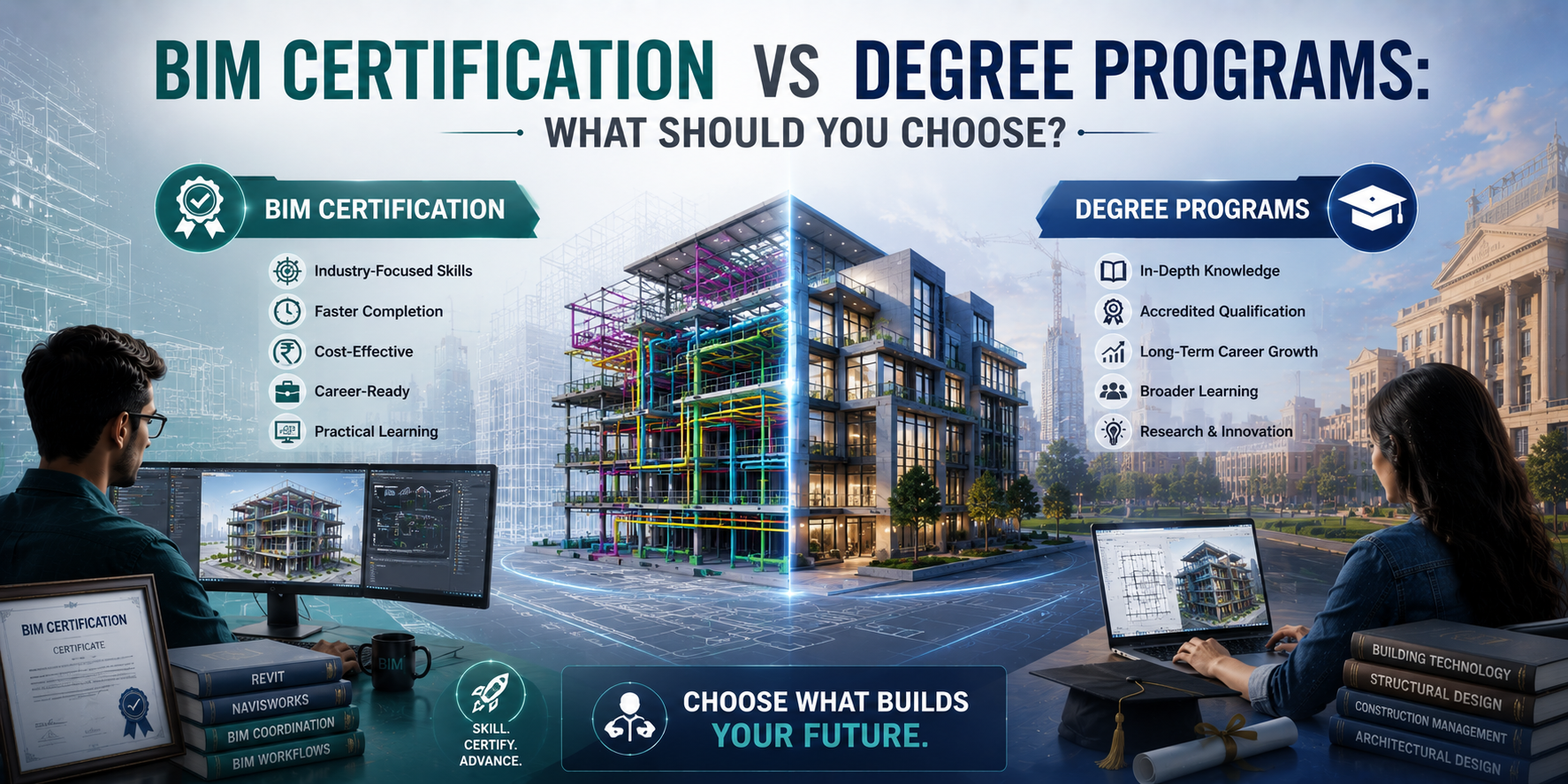
Both BIM certifications and a BIM degree can help you build a career in the AEC industry, but they serve different purposes. While degree programmes provide a broad architecture education, [BIM certification courses](https://www.novatr.com/blog/are-bim-certification-courses-worth-it) focus on developing practical, job-ready skills in a shorter period.
| **Aspect** | **BIM Certification** | **BIM Degree Program** |
| --- | --- | --- |
| **Focus** | Practical BIM skills and software training | Broad architecture education with BIM as one subject |
| **Duration** | Typically 3 to 12 months | Usually 3 to 5 years |
| **Learning Approach** | Hands-on projects and industry workflows | Academic coursework with theoretical concepts |
| **Software Training** | Extensive training in industry-standard BIM tools | Basic to moderate exposure, depending on the curriculum |
| **Career Outcome** | Prepares learners for entry-level BIM and senior digital construction roles | Builds a foundation for architecture, engineering, and construction careers |
| **Best For** | Students and professionals looking to upskill quickly | Learners seeking a full-time academic BIM degree or architecture qualification |
## **Which Option Builds More Practical BIM Skills?**
Choosing the right BIM course depends on your career goals. Degree programmes provide academic foundations, while certification courses focus on software training, industry workflows, and [real-life BIM projects](https://www.novatr.com/blog/top-bim-projects-in-india) that prepare learners for BIM roles.
| **Programme** | **Type** | **What You Learn** | **Practical Exposure** |
| --- | --- | --- | --- |
| **Novatr BIM Professional Program** | Professional Certification | Learn BIM execution planning, interdisciplinary coordination, BIM documentation, automation with Dynamo, project collaboration, BIM standards, and portfolio development using tools such as Revit, Navisworks, Autodesk Construction Cloud, and Forma. | High - Includes mentor-led learning, capstone projects, real-life projects, industry case studies, portfolio building, and career support. |
| **Autodesk Certified Professional (ACP) -Revit** | Software Certification | Focuses on advanced Revit modelling, documentation, project setup, and validating software proficiency. | Primarily software-focused with certification-based assessments. |
| **Bachelor of Architecture (B.Arch)** | Degree Programme | Covers architectural design, building construction, structures, history of architecture, environmental planning, and introduces BIM concepts in some institutions. | Studio projects with limited exposure to professional BIM workflows. |
| **Bachelor of Construction Technology** | Degree Programme | Covers construction methods, surveying, building materials, quantity estimation, project planning, construction management, and digital construction fundamentals. | Practical site training, but software-specific BIM exposure varies by university. |
| **RICS School of Built Environment / Similar BIM Certification Courses** | Professional Certification | Covers BIM fundamentals, digital collaboration, model coordination, and BIM implementation aligned with industry practices. | Includes assignments and software exposure but generally less project-intensive than immersive professional programmes. |
## **What Do Employers Value More in BIM Hiring?**
**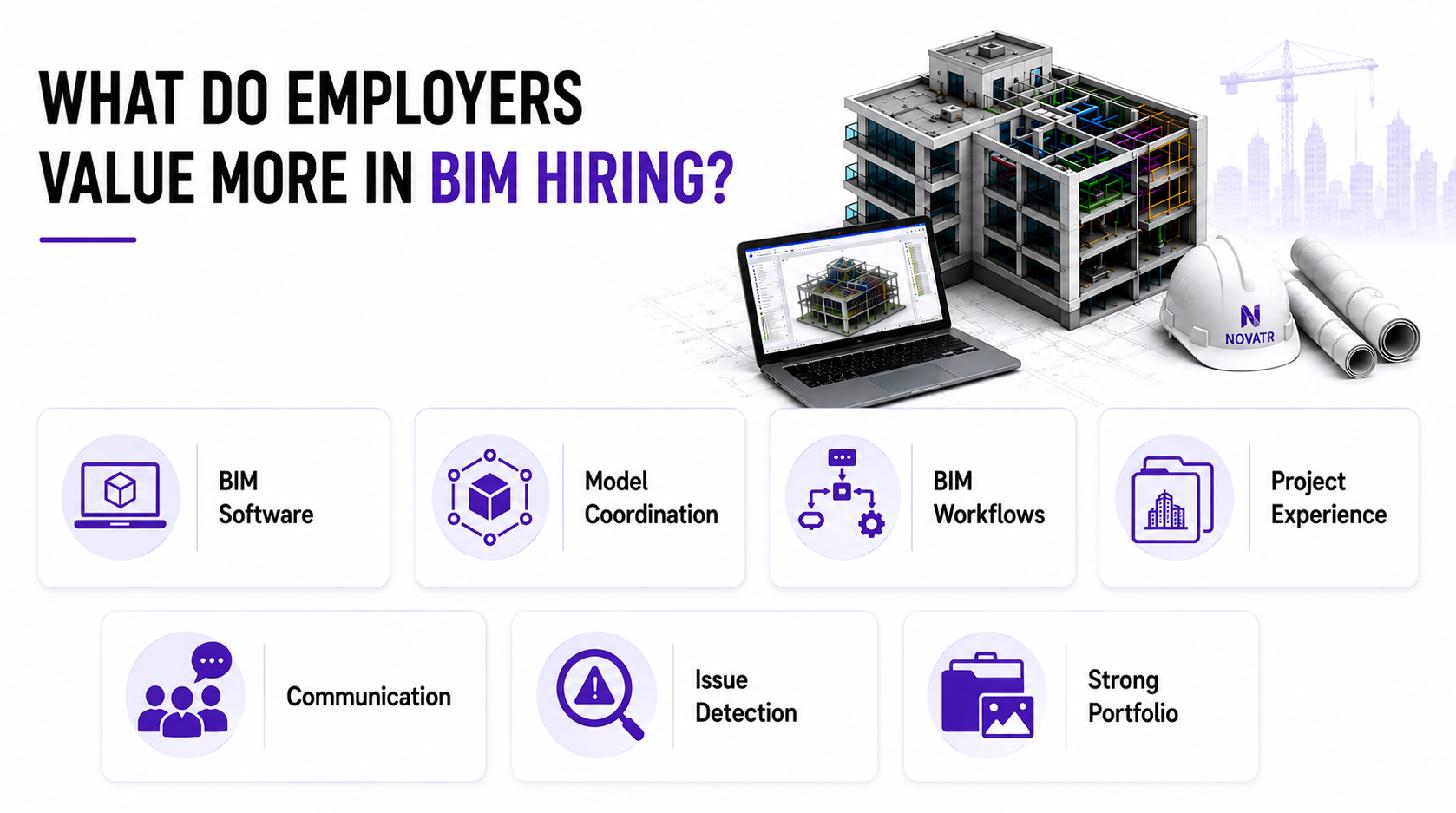**
Employers look beyond qualifications when hiring BIM professionals. They prefer candidates who can apply their knowledge to real projects, work with industry-standard tools, and understand modern construction technology practices.
- Hands-on experience with BIM software such as Revit, [Navisworks](https://www.novatr.com/blog/what-is-navisworks-and-why-architects-use-it) SketchUp Studio, Autodesk Forma, Graphisoft Archicad and many more.
- The ability to coordinate architectural, structural, and MEP models.
- A strong understanding of BIM workflows and digital project delivery.
- Experience working on practical or industry-based projects rather than only academic assignments.
- Good communication and collaboration skills for working with multidisciplinary teams.
- The ability to identify design issues early and support efficient project coordination.
- A portfolio that demonstrates practical BIM skills and real project outcomes.
## **How Do Career Growth and Learning Outcomes Compare?**
Choosing the right learning path can influence both your career progression and the practical skills you develop. While degree programmes provide academic knowledge, specialised BIM training helps learners build job-ready expertise with industry workflows and BIM software.
| **Learning Path** | **Learning Outcomes** | **Career Growth** |
| --- | --- | --- |
| **Novatr BIM Professional Program** | Develops practical skills in BIM execution planning, multidisciplinary coordination, documentation, BIM standards, Autodesk Construction Cloud, Dynamo, and portfolio development through mentor-led projects. | Prepares learners for BIM Modeler, BIM Coordinator, and other digital construction roles with career support and industry exposure. |
| **Architecture or Engineering Degree** | Builds a strong academic foundation in design, engineering, and construction principles, with limited BIM exposure depending on the institution. | Opens opportunities in architecture and engineering, with additional BIM skills often required for specialised digital roles. |
| **Postgraduate Construction Management Programmes** | Covers planning, project management, contracts, scheduling, and BIM-enabled construction practices. | Supports progression into project management and senior construction roles while strengthening technical expertise. |
## **What Should Students and Professionals Choose Based on Their Goals?**
The right learning path depends on your current experience, career aspirations, and the type of skills you want to build. Understanding your objectives can help you choose a programme that best supports your long-term growth.
- ### **For Students Starting Their Careers**
Students aiming to enter [BIM jobs](https://www.novatr.com/blog/bim-career-path-for-architects-after-bim-certification) should consider certification programmes that combine software training, practical assignments, and portfolio development. These courses help build industry-ready skills in a shorter time.
- ### **For Working Professionals**
Professionals looking to switch roles or advance their careers can benefit from [advanced BIM programmes](https://www.novatr.com/blog/novatr-bim-mep-program-to-become-bim-expert) that strengthen technical expertise and prepare them for specialised digital construction roles.
- ### **For Academic and Long-Term Learning**
If your goal is to pursue higher education or build a strong theoretical foundation, a degree programme with BIM integrated into the curriculum can provide broader knowledge of architecture and construction.
Master BIM and Get Hired Faster
Join a community of 8500+ Architects and Engineers.
Explore Now
\*Limited seats available
## **Conclusion**
Choosing between a BIM certification and a degree programme depends on your career goals, learning preferences, and the skills you want to develop. If your priority is gaining practical experience with industry-standard tools and becoming job-ready sooner, a specialised programme can be a valuable choice.
The [BIM Professional Program](https://www.novatr.com/courses/bim-professional-program?utm_source=organic_search&utm_medium=blog&utm_campaign=) by [Novatr](https://www.novatr.com/) combines hands-on projects, expert mentorship, and industry-relevant workflows to help learners build practical BIM expertise.
For more industry updates, join us on our [**WhatsApp channel**](https://whatsapp.com/channel/0029Vb7Gy2LBFLgMx79j7B1b) or head to our [**resource page**](https://www.novatr.com/learning-hub).
## FAQs
### **1. Is a BIM certification enough to get hired?**
The certification is beneficial in improving your profile; however, an employer looks at hands-on skills, project experience, and expertise in standard BIM software.
### **2. What skills do BIM certification courses focus on?**
Most of the BIM certification programs offer lessons that include skills related to 3D modeling, project coordination, clash detection, construction documentation, information management, and collaboration.
### **3. Do BIM certifications provide practical training?**
Yes, many BIM certification courses include practical projects and training on software and real workflows to enhance their skills in professional settings.
Was this content helpful to you
Like Yes
Dislike No

TABLE OF CONTENTS
BIM Is The New Standard. Are You Certified?
Get Certified in BIM
SHARE ON YOUR SOCIALS
Link Copied Successfully
Related articles
[.png) BIM Why BIM Has Become Essential for Career Growth Of Architects? 22 June 2026 5 min read](https://blog.novatr.com/blog/bim-courses-for-architects-career-growth) [.png) BIM Archi Best Features of Autodesk Construction Cloud Architects Should Be Using This Year 11 May 2026 5 min read](https://blog.novatr.com/blog/best-autodesk-construction-cloud-features-for-architects) [.png) BIM Archi Best YouTube Channels, Courses & Communities to Learn SketchUp 30 April 2026 5 min read](https://blog.novatr.com/blog/best-resources-to-learn-sketchup) [ BIM Civil How BIM is Used in Metro Projects (Nagpur, Chennai, Ahmedabad)? 28 May 2026 6 min read](https://blog.novatr.com/blog/bim-in-mеtro-projеcts-dеsign-bеnеfits-construction-usе)
Download Syllabus
## BIM Professional Program
Next Cohort
June 2026
Program Duration
7 Months
Premium Program benefits
8 Credentials from Autodesk, NSDC, Novatr
1 program. 10 career paths. Infinite Growth.
40+ ISO 19650 & RIBA real-world projects to practice
1-on-1 guidance. Access 400+ industry experts.
Access the biggest AEC-Tech community on the planet. 8500+ and counting
Curated for you by 100+ global BIM leaders.
Lifelong access to course content
Enter your details to download the program syllabus.
##### BIM Professional Program
June 2026, 7 Months
Your Name Invalid name.
Phone Number Enter a valid phone number
Email Please enter a valid email address.
Select years of experience\* Currently studying 0-1 years 1-2 years 2-4 years 4-8 years 8-10 years 10-12 years 12+ years Invalid selection.
Specialisation Select your background\* Architecture Civil Engineering Mechanical Engineering Electrical Engineering Invalid selection.
Are you professionally trained in interior design?
Yes
No
I agree to the [Terms of Use](https://www.novatr.com/terms-and-conditions) and [Privacy Policy](https://www.novatr.com/privacy-policy), and consent to be contacted by Email, Call, WhatsApp, or SMS.
Submit
Ready to skyrocket your career?
Begin your next chapter in AEC
with Novatr!
We are here to help you take the industry by storm with advanced, tech-first skills.
[Explore Courses](https://www.novatr.com/#courses)
Join our newsletter
Submit
Thank you for signing up.
We’ll send you a nice letter once per week. No spam.

Dare to Disrupt.
Join thousands of people who organise
work and life with Novatr.
Company
- [About Us](https://www.novatr.com/about)
- [BIM Professional Program v.2026](https://www.novatr.com/courses/bim-professional-program)
- [Masters Computational Design](https://www.novatr.com/courses/computational-design)
- [Become a Mentor](https://www.novatr.com/apply-as-mentor)
- [Hiring from Us](https://www.novatr.com/hire-from-us)
- [Careers at Novatr](https://www.novatr.com/career)
Resources
- [Blog](https://www.novatr.com/learning-hub)
- [Media Room](https://www.novatr.com/media-room-home-page)
- [Career Builder](https://www.novatr.com/career-navigator)
- [Events & Webinars](https://www.novatr.com/webinars)
- [FAQs & Support Center](https://www.novatr.com/contact-us)
- [Contact Us](https://www.novatr.com/contact-us)
- [Privacy Policy](https://www.novatr.com/privacy-policy)
- [Terms of Use](https://www.novatr.com/terms-and-conditions)
©2023 Oneistox Network Pvt. Ltd.
All Rights Reserved
```json
{
"@context" : "https://schema.org",
"@type" : "BlogPosting",
"author" : {
"@type" : "Person",
"name" : "Bandana Singh",
"url" : "https://blog.novatr.com/blog/author/bandana-singh"
},
"dateModified" : "2026-06-29T11:30:51.314Z",
"datePublished" : "2026-06-29T11:16:51.000Z",
"headline" : "BIM Certification vs Degree: Best Choice for Your Career {{year}}",
"image" : [ "https://blog.novatr.com/hubfs/BIM%20Certification%20VS%20Degree%20Programs.png" ],
"mainEntityOfPage" : {
"@id" : "https://blog.novatr.com/blog/bim-certification-vs-degree-programs",
"@type" : "WebPage"
},
"publisher" : {
"@type" : "Organization",
"logo" : {
"@type" : "ImageObject",
"url" : "https://blog.novatr.com/hubfs/Novatr%20Prev%20OX-2.svg"
}
}
}
```