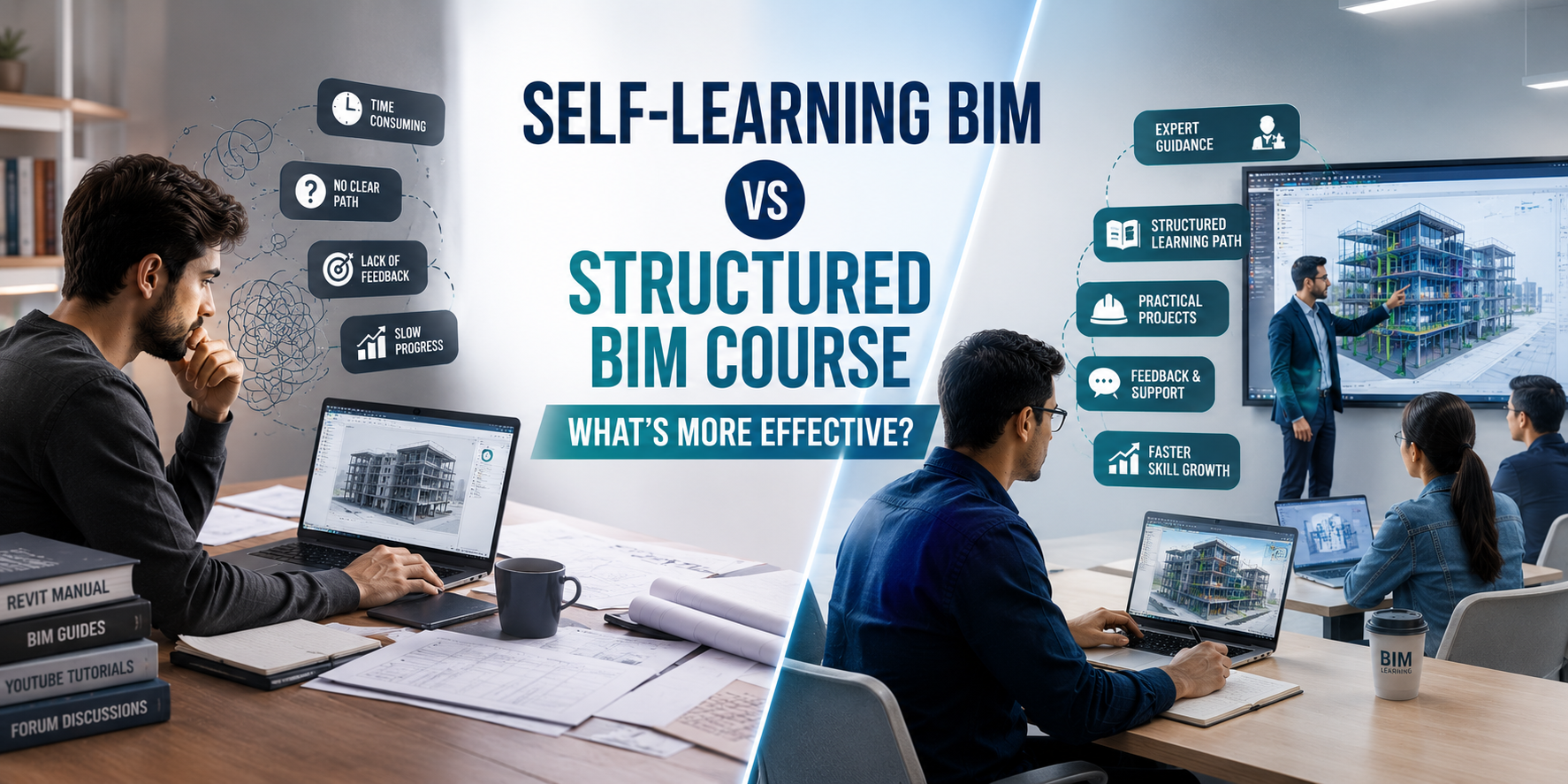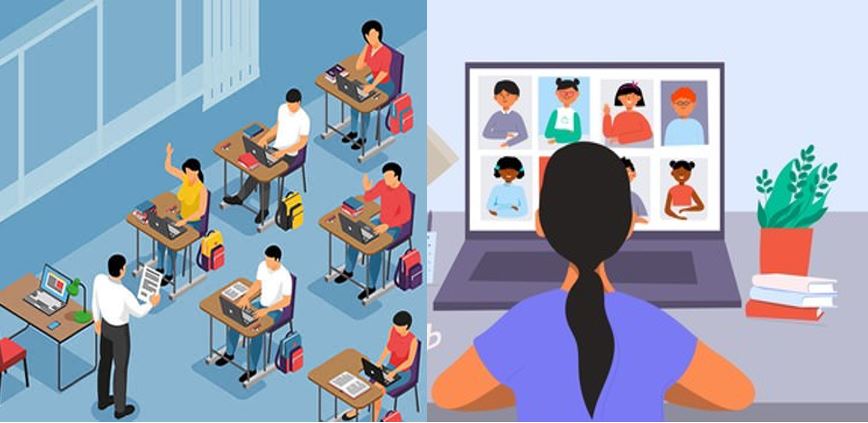




How do online BIM courses compare to in-person training?
The difference between online and in-person BIM education lies mainly in delivery, accessibility, and interaction. Online learning blends live vs recorded BIM sessions, giving learners the flexibility to revisit lessons and practice complex workflows in Revit for architects or collaborative BIM for architects projects. In-person training, by contrast, offers direct feedback, peer collaboration, and hands-on exposure to BIM tools. With well-structured interactive BIM training online, learners now access realistic simulations and cloud-based teamwork that closely mirror classroom experiences.
Key Comparisons
-
Flexibility – Online formats mix live vs recorded BIM sessions for self-paced practice.
-
Focused Workflows – Online courses provide guided exercises and project-based tasks to create and coordinate 3D models in Revit for architects using BIM for architects workflows.
-
Immediate Feedback – In-person formats allow real-time collaboration and troubleshooting with BIM tools.
-
Interactive Learning – Quality interactive BIM training online replicates practical studio environments.
Success depends more on course quality, interactivity, and curriculum relevance than on the delivery medium.
What are the pros and cons of learning BIM online?
Below is a clear comparison of the pros and cons of learning BIM online to help you weigh your options.
|
Pros of Online BIM Courses |
Cons of Online BIM Courses |
|
Flexible scheduling accommodates working professionals and students |
Less spontaneous, face-to-face interaction with instructors |
|
Both live vs recorded BIM sessions for engagement and review |
Requires strong self-discipline and time management |
|
Lower cost due to no travel or facility expenses |
May lack tactile experience with specialized hardware |
|
Access to global experts and peer networks |
Potential for weaker networking compared to physical classrooms |
|
Replayable lessons for reinforcing difficult concepts |
Collaboration may feel less organic than in-person teamwork |
|
Easy access from any location with internet connectivity |
Technical issues or poor internet can disrupt learning |
|
Ability to learn at your own pace |
Limited opportunities for immediate hands-on troubleshooting |
|
Often updated with the latest software versions and industry trends |
Possible feelings of isolation without in-person peer interaction |
|
Opportunity to learn BIM while balancing it with full-time work or study |
Less motivation for some learners without a physical classroom setting |
|
Access to a wider variety of course offerings and instructors globally |
Difficulty in building strong professional relationships online |
The advantages make online BIM study appealing for those balancing multiple commitments. However, the challenges, especially in maintaining motivation and replicating physical interaction, should be weighed carefully before enrolling.
Can online courses offer the same level of hands-on experience?

Practical application is a critical component of any BIM training program, and online formats have made significant strides in this area.
Modern platforms deliver realistic, project-based learning through:
-
Interactive BIM training online modules where learners manipulate 3D models, conduct clash detection, and coordinate project data.
-
Cloud-hosted environments enable version control, collaborative editing, and multidisciplinary integration similar to real-world workflows.
-
Screen-sharing and live critique sessions that provide direct feedback during modeling exercises.
-
Hybrid BIM learning options that integrate occasional in-person sessions, site visits, or VR-based studio simulations.
While physical model handling is unique to in-person programs, digital simulations now replicate many tactile processes. For instance, advanced BIM for architects courses often require producing full project documentation in Revit, with collaborative reviews that mirror industry practice. This combination enables online learners to graduate with both conceptual understanding and applied capability.
What features make an online BIM course truly effective?

Not all online BIM courses are created equal. The most effective programs share several core characteristics:
- Structured, standards-aligned curriculum ensuring mastery of essential BIM skills and compliance with frameworks such as ISO 19650.
- Balanced delivery using live vs recorded BIM sessions, blending interactivity with flexibility.
- A rich virtual learning environment for BIM offering real-time modeling, annotations, and cloud-based collaboration.
- Hands-on exercises with BIM tools, including clash detection, quantity take-offs, 4D scheduling, and parametric modeling.
- Dedicated support channels, forums, peer review systems, and instructor office hours.
- Workflow-specific training for Revit for architects and BIM for architects to ensure industry readiness.
Novatr’s BIM Professional Course for Architects is an example of a platform integrating these features. The program combines interactive BIM training online with guided mentorship, hands-on projects, and exposure to 12+ industry tools. Learners work on ISO 19650-compliant simulations, receive certifications from Autodesk and Novatr, and build job-ready portfolios, all while being supported by a global network of BIM professionals.
Key USPs of the Course
-
Practical Learning – Go beyond theory with 80+ hours of live sessions and practical assignments that mirror real project workflows.
-
Master Industry Tools – Get hands-on experience with more than 12 leading BIM software applications used worldwide.
-
Global Expertise – Learn directly from 200+ industry mentors working with top AEC firms across the world.
-
Lifetime Learning Access – Keep coming back to your lessons and resources even after completing the program.
-
Proven Track Record – Trusted by 6,000+ learners worldwide and consistently rated 4.6/5 for quality and outcomes.
A well-designed course can provide the flexibility to learn BIM online while delivering the depth and rigor of studio-based training.