


Why is BIM Hiring Changing Across the AEC Industry?
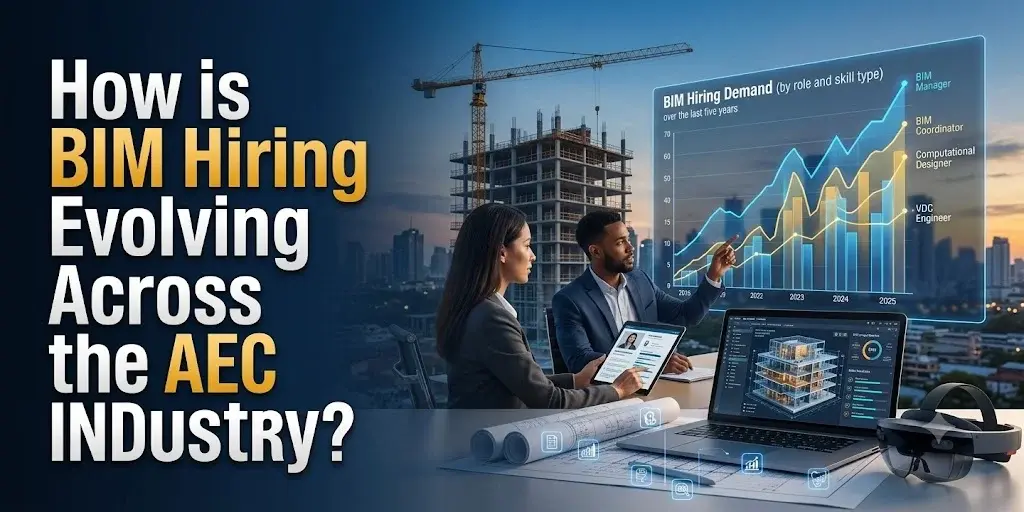
BIM hiring is shifting as AEC firms move towards connected project delivery, stronger information management and digital workflows. Employers increasingly seek professionals who can apply building information modeling to practical project requirements rather than rely on software knowledge alone.
-
Demand for BIM jobs in India and the world is expanding beyond modelling into coordination, information management and digital construction roles.
-
Employers increasingly value practical project experience alongside software proficiency.
-
Knowledge of multidisciplinary coordination helps professionals work effectively across architecture, engineering and construction teams.
-
Understanding CDE workflows and information standards is becoming more relevant to project-based roles.
-
Automation and emerging digital tools are creating demand for professionals with broader technical capabilities.
-
Developing practical BIM expertise can support long-term career growth as AEC organisations continue to digitise project delivery.
Which BIM Roles and Skills Are Driving the Changing Demand?
As BIM becomes more integrated into project delivery, employers are looking for professionals who can combine technical expertise with coordination, information management and practical project knowledge. Different roles now require specialised skills that support efficient and collaborative AEC workflows.
|
Role |
Skills and Capabilities Employers Value |
|
BIM Modeler |
Strong modelling skills, knowledge of relevant software and an understanding of project standards, documentation and model accuracy. These capabilities are valuable across architecture jobs and engineering projects. |
|
Expertise in coordination, clash detection and multidisciplinary collaboration. Professionals should be able to review models across disciplines, identify conflicts and support practical resolutions. |
|
|
BIM Manager |
Knowledge of project standards, information requirements, team management and delivery processes. Familiarity with ISO 19650, CDE workflows and BIM execution planning is increasingly important. |
|
BIM Consultant |
A combination of technical knowledge, process understanding and communication skills. Consultants may help organisations improve BIM implementation, standards, workflows and technology adoption. |
|
Digital Construction Specialist |
Understanding of digital workflows, automation, data exchange and construction technologies. These professionals connect BIM processes with wider digital engineering practices to improve project delivery. |
|
Information Manager |
Knowledge of information requirements, structured data and information exchange. Understanding how information is created, reviewed, shared and delivered through a CDE is essential. |
|
BIM Architect |
Architectural expertise combined with digital modelling, coordination and documentation capabilities. This role connects design intent with coordinated project information across different stages. |
|
Engineering knowledge supported by modelling, technical coordination and problem-solving abilities. Professionals work across disciplines to develop coordinated models and address technical issues. |
|
|
Automation Specialist |
Ability to identify repetitive tasks and improve them through automation, scripting or digital tools. This can help teams increase efficiency and streamline model-related processes. |
How are Employer Expectations and Emerging Technologies Reshaping BIM Recruitment?

BIM recruitment is increasingly focused on how professionals apply their knowledge to real project situations rather than simply the number of software tools they know. At the same time, emerging technologies are expanding the capabilities expected from BIM professionals across design, construction and project management.
-
Demonstrated Project Experience
Employers increasingly value candidates who can show how they have applied BIM on real or realistic projects. Experience with multidisciplinary coordination, model development, documentation and issue resolution demonstrates an understanding of how BIM supports actual project delivery. Exposure to real-world BIM workflows can therefore make a candidate more job-ready than software knowledge alone.
-
A Portfolio That Shows Practical Capability
A strong portfolio gives employers evidence of what a candidate can actually deliver. Instead of showcasing only finished models, it should highlight project context, coordination decisions, problem-solving and the outcomes achieved. A well-presented portfolio can help demonstrate technical ability while showing how BIM contributes to construction management and project execution.
-
Problem-Solving and Communication Skills
BIM professionals often work between multiple disciplines and project stakeholders, making communication an important part of the role. Employers look for people who can identify coordination issues, understand their impact and communicate practical solutions clearly. These skills become particularly valuable when BIM teams need to resolve conflicts between architectural, structural and MEP requirements.
-
AI and Automation Are Expanding BIM Capabilities
AI and automation are changing how repetitive modelling, documentation, data processing and analysis tasks can be approached. Employers are increasingly interested in professionals who understand where these technologies can improve efficiency and reduce manual work. BIM candidates do not necessarily need advanced programming skills, but familiarity with automation-driven workflows can strengthen their adaptability.
-
Digital Twins and Reality Capture Are Connecting BIM With the Physical World
The use of Digital Twins and reality capture is extending BIM beyond conventional design coordination. Reality capture technologies can provide accurate information about existing or completed conditions, while Digital Twins can connect models with operational and performance data. Professionals who understand how these technologies support project monitoring, verification and asset management can contribute to broader digital construction initiatives.
-
Cloud Collaboration and Data-Driven Construction
Cloud-based platforms are enabling project teams to access, share and coordinate information across locations and disciplines. This makes familiarity with collaborative digital environments increasingly relevant to BIM roles. Simultaneously, data-driven construction is creating demand for professionals who can work with structured project information and use it to support better decisions. Understanding how information flows through a project can therefore become as important as creating the model itself.
How Can BIM Professionals Stay Competitive in the Evolving Job Market?
As BIM workflows continue to evolve, professionals need to keep their BIM skills aligned with changing project requirements and construction technology. A strong BIM portfolio and the ability to apply knowledge to real project challenges can improve opportunities across architecture, construction, and engineering jobs and support long-term workforce development.
For professionals looking to build these capabilities, Novatr’s 7-month BIM Professional Program offers structured learning focused on practical BIM workflows and industry-relevant applications. The programme helps learners strengthen technical and project-based skills through hands-on work, while developing a work portfolio that demonstrates their capabilities.
In this course, you also learn industry-relevant BIM tools, making it suitable for BIM professionals looking to strengthen their technical capabilities, take on greater responsibilities and prepare for evolving roles across the AEC industry.