


The field of civil engineering is changing fast, and software skills have become essential for career growth. Learning civil engineering software courses in India helps professionals design, plan, and manage projects with greater accuracy and efficiency. As technology continues to shape the AEC industry, civil engineers who master digital tools can stand out, solve complex problems, and access better job opportunities.
From drafting tools to advanced 3D modeling and structural analysis platforms, these software programs make design easier, improve teamwork, and support better project outcomes. This guide highlights the top software courses you can take to build strong technical skills and stay competitive in the industry.
What are the Benefits of Software for Civil Engineers?
By integrating software into civil engineering practices, professionals can effectively and comprehensively visualise and simulate their designs. This not only fosters creativity but also ensures that potential design flaws are detected and rectified before any construction begins. Such precision in design minimises the likelihood of errors, ultimately leading to safer and more durable infrastructures.
Additionally, the use of software streamlines the collaboration process among multidisciplinary teams. With cloud-based project management tools and collaborative platforms, civil engineers, architects, and contractors can seamlessly communicate and share vital information in real time. This instant exchange of data reduces miscommunications and accelerates project timelines.
What are the Various Civil Engineering Software?
The field of civil engineering is constantly evolving and so are the associated software. So, there is software for everything from the stage of planning to construction and project management. Let’s have a look at the various software for civil engineers below.
- Softwares For Drafting
1. AutoCAD
Developed by Autodesk, AutoCAD is a computer-aided design (CAD) software program that has firmly established itself in the AEC (Architecture, Engineering, and Construction) industry. All the stakeholders in a project can rely on AutoCAD to create anything and everything, ranging from infrastructure designs and 3D models to base maps and architectural plans.
2. Civil 3D
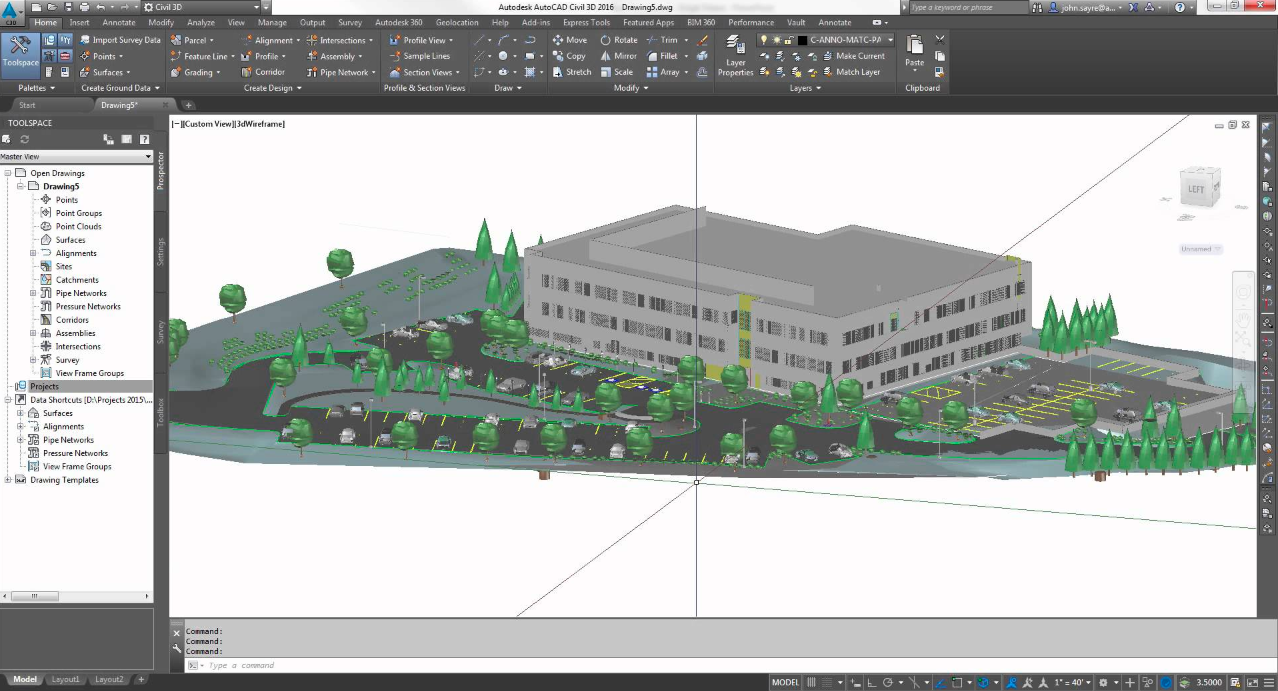
Similar to AutoCAD, Civil 3D also falls under AutoDesk's CAD software umbrella. Mainly used to create three-dimensional models of buildings, bridges, roads, and other infrastructure, the software is also very useful for creating two-dimensional drawings. Its ability to extend beyond the third dimension makes it more adept at producing detailed sections and elevations.
- Software for 3D Modelling
1. Revit
Revit is a Building Information Modeling (BIM) software that acts as the cumulation of the whole dataset of a project. It allows its users to design, analyse, model, and document in real time on one single easily accessible file. This helps maintain a consistent quality of work from design up to completion.
2. 3Ds Max
3Ds Max is a software based on the fundamentals of polygonal modelling that uses vertices, edges, and faces to create detailed and complex structures with ease. This software empowers architects and civil engineers to better understand the project planning process through its immersive visualisation abilities.
Also Read : Top 20 FAQs on BIM for Civil Engineers
- Software for Structural Analysis
1. STAAD Pro
Structural Analysis and Designing Program (STAAD Pro) is one of the most popular and widely used software for conducting structural analysis across the globe. It allows civil engineers to design and analyse different combinations of structures, helping them find the best layout by automating the tasks and removing the need for the tedious process of long manual labour.
2. SAP 2000
Structural Analysis Program (SAP2000) is a comprehensive civil engineering software used for conducting the analysis and improving the design efficiency of structural systems. It performs both static and dynamic analyses, supporting linear or nonlinear approaches, to design structures using AASHTO, ACI, and AISC building codes.
- Software For Project Management
1. Wrike
Wrike is a customizable project management software-as-a-service (SaaS) product, that helps guide the completion of a project by keeping track of all schedules, submissions, deadlines, and other systems in check. The best part about the software is the ease with which it can be accessed while allowing project stakeholders to collaborate on the cloud.
2. Smartsheet
Smartsheet is another software-as-a-service (SaaS) product that eases collaboration, helps assign tasks, tracks progress, and manages calendars, all within the tabular user interface that could be easily customised and automated to scale projects on one single platform.
Top 10 Civil Engineering Software Courses in 2026
Learning software can help civil engineers gain a competitive edge over their peers, positioning them better in the job market. It can also allow them to be proficient at their work and create a versatile portfolio that helps grow their career. So, let’s have a look at the most promising civil engineering software courses that professionals can enrol for.
1. BIM Professional Course for Civil Engineers by Novatr
Duration: 7 months
Fee: INR 2,75,000
Certification: Yes
Placement Assistance: Yes
Mode of Learning: Online
Novatr’s BIM Professional Course for Civil Engineers is one of the most immersive civil engineering software courses. It is designed to equip professionals with the skills and knowledge needed to effectively use BIM throughout a project.
Take your civil engineering career to the next level with Novatr’s BIM Professional Course for Civil Engineers — a project-based program that prepares you to plan, design, and manage construction projects using 12+ industry software and essential BIM plugins.
Learn how to work with Autodesk Revit, Navisworks, construction cloud and key plugins like DiRoots.One, pyRevit, EF-Tools, ProSheets, Issue and Model Checker for Revit to improve automation, accuracy, and project efficiency.
Here’s what you’ll gain:
- End-to-end understanding of BIM workflows — modeling, estimation, coordination, sequencing, and documentation.
- Hands-on training aligned with ISO 19650 standards and real residential + commercial projects.
- Get Globally recognized certifications:
- Novatr Course Certificate
- Autodesk User Certification
- NSDC Skill Certificate
- Novatr Specialization Certificate, if opted
- Novatr Course Certificate
After completing the core modules, learners can also choose 2 additional specializations, including:
- Visual Programming with Dynamo – for automation and parametric workflows
- 4D, 5D & 6D with BIM – for time, cost, and facility integration
- Tekla for RCC Modeling – for detailed steel and concrete modeling
- Civil 3D for Infrastructure – for roadways, railways, and utilities
- Project Strategy & Optimization with Plannerly - Plan, structure, and audit BIM execution plans.
Equip yourself with practical BIM skills and become job-ready for global infrastructure and construction opportunities.
2. AutoCAD for Civil Engineers by Udemy
Duration: 8.5 hours
Fee: INR 499
Certification: Yes
Placement Assistance: No
Mode of Learning: Online
This AutoCAD course is specifically designed to cater to civil and structural engineers. Designed by an experienced civil engineer, this beginner-friendly course covers AutoCAD's working environment, file handling, object creation, editing, and many more such features. As one of the most insightful civil engineering software courses, this program teaches the real-time application of AutoCAD by demonstrating through case studies and projects. This hands-on approach ensures that students not only understand the software but also know how to use it effectively in the profession.
Also Read : Civil Engineer to BIM Modeller: An Expert's Guide to Boost Career Growth
3. AutoDesk Civil 3D by LinkedIn Learning
Duration: 10 hours
Fee: INR. 1,850
Certification: Yes
Placement Assistance: No
Mode of Learning: Online
As one of the most comprehensive civil engineering software courses by Udemy, this program covers essential tools and features required to streamline the design and documentation of construction projects. From learning how to model precise design surfaces to efficiently managing pipe networks, this course covers it all. Participants can discover the tips, tricks, and data shortcuts of Civil 3D as they learn how to design a new residential development during the course. With real-world examples and practical insights, learners will gain the necessary skills to elevate their proficiency in AutoDesk Civil 3D, enhancing their career prospects.
4. Fusion 360 Essential Training by LinkedIn Learning
Duration: 5 hours
Fee: INR 1,850
Certification: Yes
Placement Assistance: No
Mode of Learning: Online
This Fusion 360 Essential course is taught by an industry expert and is touted as one of the most rewarding civil engineering software courses. It empowers beginners and practitioners alike, to turn their ideas into digital models that are ready to be 3D printed. While aiming to cover essential Fusion 360 features like sketching, modelling, and sculpting, the course also includes a segment on how to work with sketches, meshes, and surfaces. The educators here, try to simplify complex Fusion 360 techniques, while also crafting photorealistic renders and captivating animations.
Read: AutoCAD v/s Fusion 360: Which software should you learn in 2026?
5. AutoDesk 3Ds Max by IFS Academy
Duration: 60 hours
Fee: INR 17,000
Certification: Yes
Placement Assistance: Yes
Mode of Learning: Online and Offline
Crafted by industry experts, this tailor-made program focuses on offering a unique opportunity for the participants to excel in the world of 3D design. As a one-of-its-kind civil engineering software course, its program delivers in-depth knowledge about the workings of 3Ds Max, helping them master 3D modelling, texturing, rendering, and animation techniques. With a rich array of modules, live sessions, and hands-on projects, this project also prepares the candidates for the Autodesk Certified User (ACU) and Autodesk Certified Professional (ACP) exams, giving them an edge over others in the industry.
6. Primavera P6 by CMTI
Duration: N/A
Fee: INR 2,500
Certification: Yes
Placement Assistance: Yes
Mode of Learning: Online
The Construction Management Training Institute (CMTI) offers one of the most inclusive civil engineering software courses on Primavera P6 as a part of their Construction eLearn Course. With a focus on practical skills and industry relevance, the course consists of 52+ lessons, each of which provides a step-by-step guide to becoming proficient in this industry-standard project management software. Participants will gain a solid foundation in project planning, scheduling, and resource management. The course integrates real-world scenarios and hands-on exercises, ensuring that students can immediately apply what they learn to their projects.
Also Read : The Growing Demand for BIM Civil Engineers in Multinational Companies
7. Bentley STAAD Pro by IFS Academy
Duration: 60 hours
Fee: INR 35,000
Certification: Yes
Placement Assistance: Yes
Mode of Learning: Both
A third one on the list for IFS Academy, this time collaborating with Bentley Institute in India to offer an extensive STAAD.Pro Online Training Program. Guided by industry experts and Bentley Systems, this course equips learners with the skills needed to excel in using Bentley STAAD.Pro software. The curriculum covers a wide range of STAAD.Pro functions, from basic navigation to intricate structural design and analysis. It includes instructor-led sessions, practical assignments, real-life case studies, and hands-on projects, catering to undergraduate civil engineering students, recent engineering graduates, and those aspiring to specialise in structural engineering.
8. Revit for Structural Design by Autodesk
Duration: 23 hours
Fee: RS. 2398
Certification: Yes
Placement Assistance: No
Mode of Learning: Online
As one of the most industry-relevant civil engineering software courses, this training program helps professionals, including civil engineers, students, and technicians, learn how to analyse and design different structures. The course comprises 2 modules, covering both aspects of the software- 3D modelling and documentation. Its curriculum closely aligns with the ACU/ACP Design program. By the end of the course, participants gain a holistic understanding of structural analysis and design principles, making the courses valuable for both beginners and experienced practitioners in the field.
Also Read : How Can BIM Help Civil Engineering Firm Owners Owners
9. BIM in AEC Industry Using Revit by Skill Lync
Duration: 3 months
Fee: RS. 40,000
Certification: Yes
Placement Assistance: Yes
Mode of Learning: Online
As one of the most unique civil engineering software courses, this one offers students a solid theoretical foundation in Building Information Modeling (BIM) software as an operative tool. The project focuses on Revit as a key tool for digital modelling, focusing on architectural, structural, and MEP (mechanical, electrical, and plumbing) elements. The course integrates practical assignments and case studies to create a thoughtfully crafted syllabus with industry-aligned objectives and challenges in mind.
10. BIM-Ready + by Techno Struct Academy
Duration: 4.5 months
Fee: INR 1,70,000
Certification: Yes
Placement Assistance: Yes
Mode of Learning: Online
TechnoStruct Academy’s BIM Ready+ course is one of the most well-rounded civil engineering software courses designed to equip civil engineers with the skills needed to effectively use Building Information Modeling (BIM). The course covers a wide range of topics, including architectural and structural aspects of BIM, and uses industry-standard software tools. Learners also get the opportunity to experience end-to-end project workflows by working on real-world projects. Participants will also gain exposure to globally acceptable documentation procedures through the course.
Also Read : What Kind of BIM Skills Companies are looking in Civil Engineers
Why Learning Civil Engineering Software Matters Today?
Learning civil engineering software has become essential as projects demand faster delivery, higher accuracy, and better coordination. These tools help engineers work more efficiently, reduce errors, and create clear digital models that match real construction requirements. Strong software skills also make it easier to grow in your career and stay relevant in a competitive job market.
Why software skills matter today:
- Better accuracy and planning: Tools like AutoCAD, Revit, and STAAD.Pro help engineers create precise drawings and models, reducing the chances of mistakes during construction.
- Faster project execution: Digital workflows allow teams to complete tasks quickly, improving productivity on large and complex infrastructure projects.
- Improved collaboration: Software makes it easier for architects, engineers, and contractors to share updates in real time and work together smoothly.
- Higher employability: Most companies now expect civil engineers to know industry software, which directly improves job prospects and earning potential.
- Stronger problem-solving: Simulation and analysis tools help engineers test ideas, study designs, and fix issues before construction starts.
Having solid software skills helps civil engineers stay prepared for modern infrastructure needs and industry expectations. These tools make daily work easier, open doors to better roles, and support long-term career growth in India and abroad.
In Conclusion
With the introduction of cutting-edge technologies such as 3D printing, digital fabrication, and BIM, the field of civil engineering is fast-evolving. Therefore, staying relevant in the industry requires mastering the latest software tools and technologies. This can be achieved by signing up for civil engineering software courses that allow you to elevate your professional growth.
If you want to future-proof your career, we strongly recommend you enrol for a BIM course. It will allow you to become more collaborative, efficient, and desirable as a professional across the global market. We suggest you check out the BIM Professional Course for Civil Engineers by Novatr and start your journey of upskilling today!
Frequently Asked Questions:
1. Which software is most useful for civil engineers in India?
Software like AutoCAD, Revit, STAAD.Pro, Civil 3D, and Primavera are widely used in the Indian construction industry. They help engineers with drafting, modeling, analysis, and project scheduling, making them valuable for both beginners and experienced professionals.
2. What is the best civil engineering software course in 2026?
The BIM Professional Course for Civil Engineers by Novatr is one of the most in-demand options. It covers multiple BIM tools, real-world projects, and job-ready training, making it suitable for engineers looking to upgrade their digital skills.
3. How can learning AutoCAD or STAAD.Pro benefit civil engineers?
AutoCAD helps engineers draft accurate 2D and 3D designs, while STAAD.Pro supports structural analysis and design. Together, they improve project precision, save time, and build stronger technical confidence for field and office roles.
4. Are online civil engineering software courses effective?
Yes, online courses are effective when they include hands-on projects, tool-based practice, and guided lessons. Many platforms offer interactive modules that help engineers learn at their own pace while gaining practical, job-relevant skills.
5. Which institutes offer BIM or Revit courses for civil engineers?
Novatr, Autodesk, Skill-Lync, TechnoStruct Academy, and IFS Academy offer well-structured BIM and Revit courses. These programs cover modeling, coordination, workflows, and real project simulations to help engineers build industry-ready portfolios.
Was this content helpful to you