


How Are Advanced BIM Capabilities Changing the Way AEC Projects Are Delivered?
BIM technology is simplifying the way AEC projects operate. Let’s explore how:
Faster Design Development: BIM allows architects and engineers to create, test, and modify detailed building models within a coordinated digital environment. Tools such as parametric modelling, and generative workflows can further speed up iterations and help teams evaluate multiple design possibilities.
Multidisciplinary Coordination: Using BIM, structural, architectural, MEP, and other disciplines can work with shared project information. This makes it easier to identify design conflicts before construction begins. It also reduces coordination gaps and helps teams resolve issues earlier in the project lifecycle.
Smarter Construction Planning: BIM models can be connected with scheduling, quantity, and construction data to improve planning. So, professionals can visualise construction sequences, track project requirements, and identify potential bottlenecks before they affect on-site work.
Efficient Project Management: Teams can use BIM to bring all project information together in a CDE (Common Data Environment). This gives them structured visibility into project details, schedules, and work progress. It enables stakeholders make informed decisions throughout the project.
Greater Use of Automation: Repetitive tasks such as model checking, documentation, quantity take-offs, and data extraction can be automated using BIM capabilities. This lets professionals to spend more time on design, analysis, and problem-solving.
Which BIM Capabilities Are Driving Demand and Creating Opportunities Across AEC Sectors?
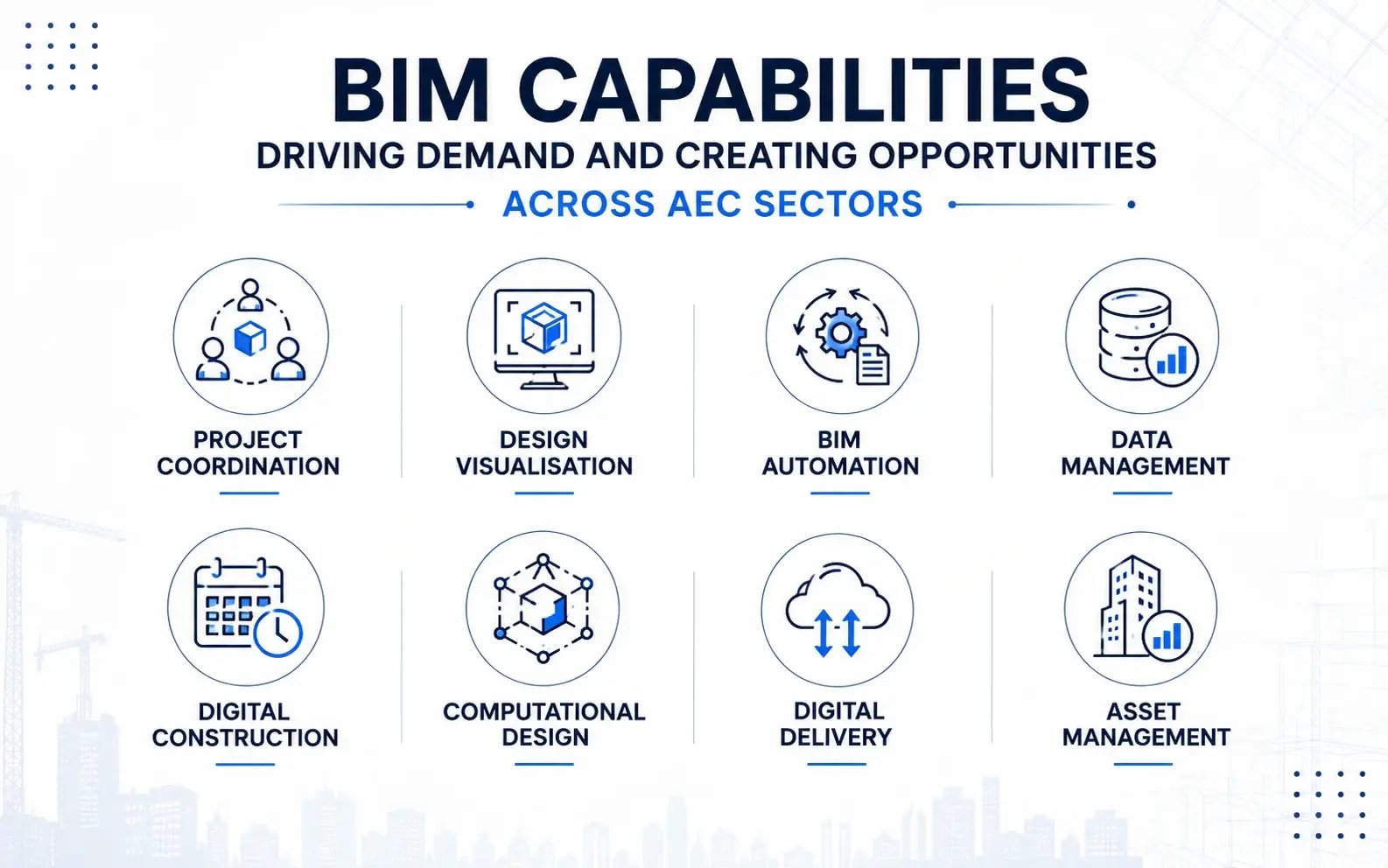
When combinted with state-of-the-art technologies such as Digital Twins, or digital engineering, BIM finds wider application across the AEC sector. Here are most lucrative opportunities it has created:
Project Coordination: BIM enables architects, engineers, contractors, and other stakeholders to work with coordinated project information. Clash detection and model-based coordination help identify conflicts early, reducing errors and rework during construction.
Design Visualisation: BIM projects let professionals to visualise buildings as 3D models and understand how different design elements come together. When combined with VR, AR, and real-time rendering, these models can also make design reviews and client presentations more interactive.
BIM Automation: Redundant tasks like documentation, quantity take-offs, model checking, and data extraction can be automated using BIM-based workflows. This minimizes manual effort and allows professionals to focus on more complex design and problem-solving tasks.
Data Management: BIM models contain a large amount of structured project information such as materials, quantities, specifications and building performance. Professionals with the ability to organise, manage, and extract this data can help teams make profitable decisions.
Digital Construction: Today, BIM capabilities are also being linked with construction planning, scheduling, and site operations. Using 4D and 5D BIM workflows allow teams to link models with time and cost information. This improves BIM coordination, planning, and monitoring.
Computational Design: BIM can work alongside computational design tools such as Revit and SketchUp to help professionals explore multiple design options. This is particularly useful for projects that involve complex geometries, performance analysis, or duplicative design elements.
Digital Delivery: BIM supports the creation and exchange of digital information throughout the project lifecycle. As the industry move towards integrated digital delivery, professionals who understand BIM automation, standards, and workflows will become more valuable.
Asset Management: When connected with Digital Twins and operational data, BIM models can support facility management, predictive maintenance, and building performance monitoring throughout an structure’s lifespan.
Which Emerging BIM Capabilities and Skills Are Shaping Future Career Opportunities?
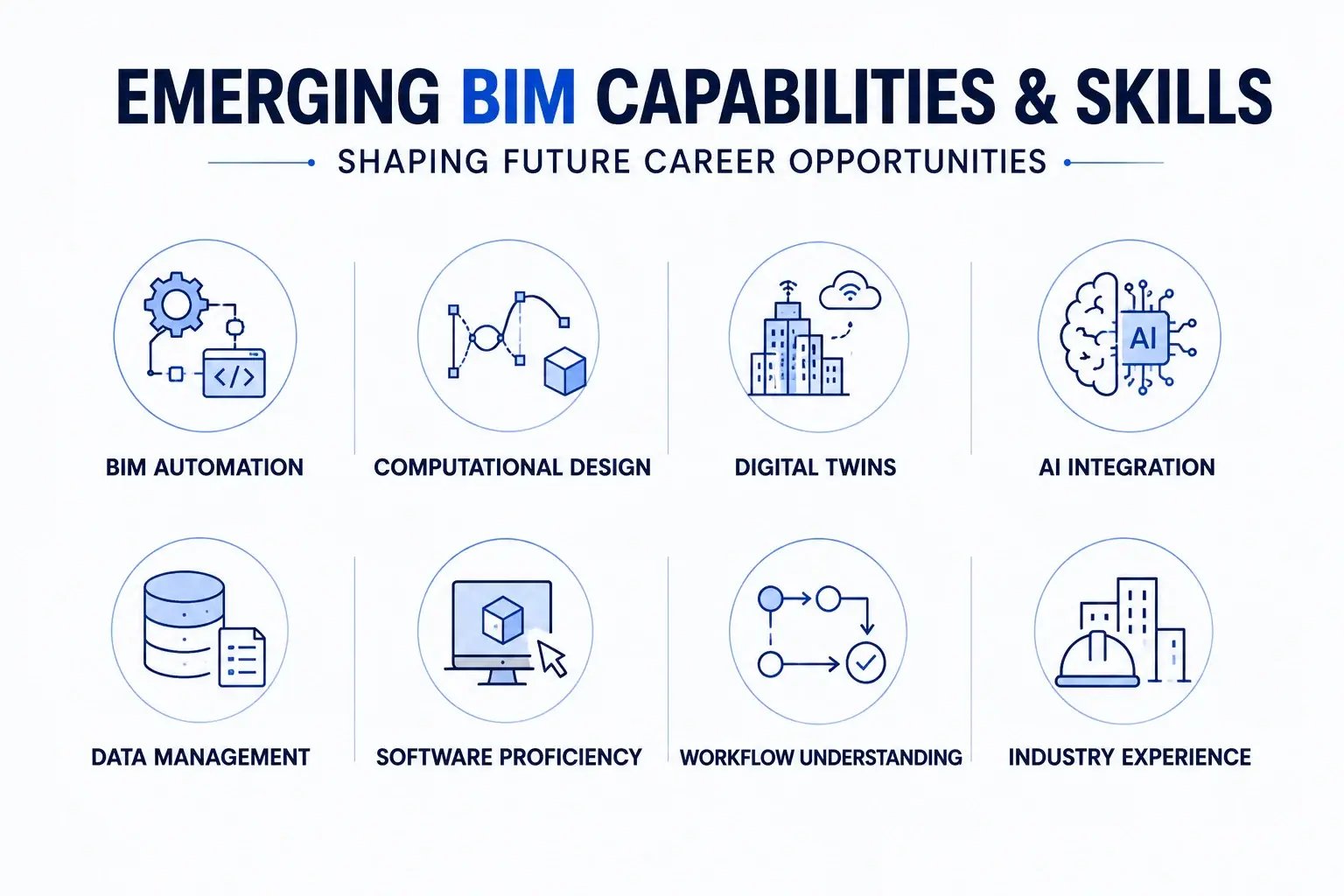
Design and construction technology such as digital fabrication, robotics, and AI are shaping a new generation of BIM capabilities. Let’s explore the technologies steering this change:
BIM Automation: Repetitive processes such as model creation, documentation, quantity extraction, and quality checks can be automated using visual programming and scripting tools such as Dynamo. This allows professionals to improve productivity while handling larger and more complex projects.
Computational Design: Parametric tools allow designers to create rules and relationships that automatically respond to changes in the design. This makes it easier to explore multiple design iterations, work with complex geometries, and create performance-driven solutions with diverse BIM capabilities.
Digital Twins: BIM models can be connected with real-time data from sensors, building systems, and other sources to create Digital Twins. Professionals who understand this connection can contribute to building operations, maintenance, and lifecycle management.
AI Integration: AI can analyse large volumes of project information, identify patterns, and support tasks such as design optimisation and decision-making. Learning how to use AI alongside existing BIM tools can help professionals adapt to intelligent workflows.
Data Management: BIM generates and stores information related to geometry, materials, quantities, specifications, and building performance. The ability to structure, manage, and interpret this information is becoming highly important as AEC workflows become more data-driven.
Software Proficiency: BIM projects involve multiple platforms for modelling, coordination, analysis, visualisation, and documentation. Developing proficiency in relevant tools can help professionals move beyond basic modelling and contribute across different project stages.
Workflow Understanding: BIM requires more than knowing how to operate individual software tools. Understanding how information moves between design, engineering, construction, and facility management helps professionals apply technology where it can create the most value.
Industry Experience: Real-world projects expose professionals to constraints, coordination challenges, construction requirements, and client expectations. This practical understanding allows them to apply emerging BIM capabilities to solve actual project problems rather than using technology in isolation.
How Can AEC Professionals Develop Future-Ready BIM Capabilities?
-
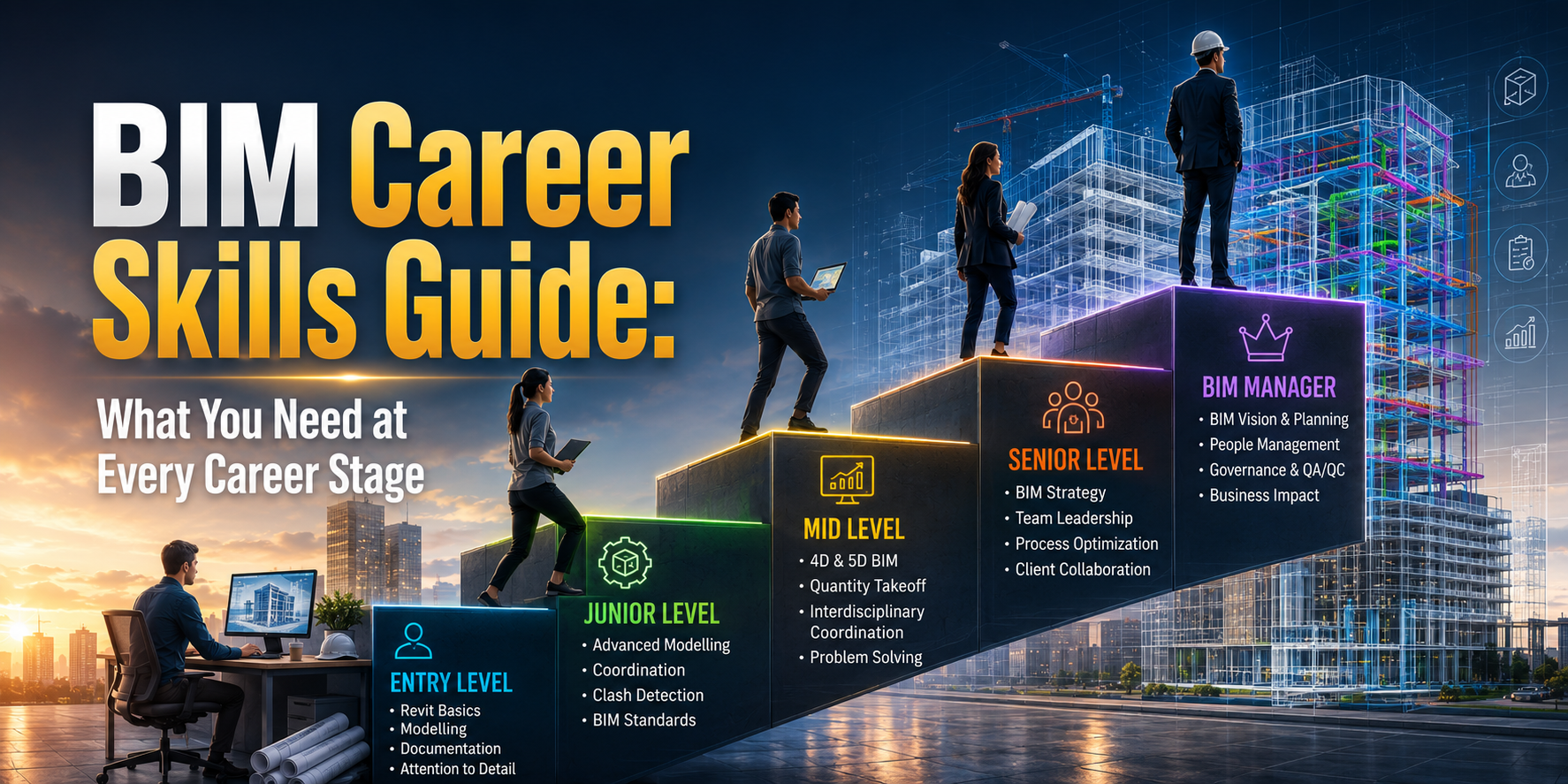
Instead of limiting your knowledge to BIM software, learn the fundamentals of BIM workflows, coordination, BIM management, and digital project delivery.
-
Deep dive into the subject with specialisations such as BIM automation, computational design, VDC, or Digital Twins, and gradually expand your skill set.
-
Online courses, certifications, workshops, and industry-led training can help individuals learn emerging technologies without having to step away from their existing careers.
-
Build sample projects, work on case studies, or take up live project responsibilities to understand how your new skills perform in real situations.
-
Do not treat upskilling as a one-time activity. BIM tools and workflows continue to evolve, so regularly updating your knowledge can help you stay relevant for changing industry needs.
-
Once you have developed technical expertise, combine it with soft skills such as project management, communication, and problem-solving. This can help you move from executing BIM tasks to taking ownership of workflows and progressing into senior roles.
For comprehensively elevating your BIM capabilities we recommend you check out the BIM Professional Program by Novatr. The course offers a thorough knowledge of BIM while also covering the integration of AI and automation in AEC. This makes it an all-encompassing program for individuals who seek to become well-rounded professionals.
.png)