---
title: Why Tier-2 Cities Are India’s Next BIM Growth Hubs 2026?
description: Explore why Tier-2 cities in India are emerging as key BIM hubs in 2026, driven by infrastructure growth, regional firms, and lower operating costs.
image: https://blog.novatr.com/hubfs/Why%20Tier-2%20Cities%20Are%20Becoming%20India%E2%80%99s%20Next%20BIM%20Growth%20Hubs.png
---
[Blogs](https://www.novatr.com/learning-hub)
- [Architecture & Construction](https://www.novatr.com/learning-hub?category=Architecture+%26+Construction)
- [BIM](https://www.novatr.com/learning-hub?category=BIM)
- [Computational Design](https://www.novatr.com/learning-hub?category=Computational+Design)
- [Company News](https://www.novatr.com/learning-hub?category=Company+News)
- [Expert Talks](https://www.novatr.com/learning-hub?category=Expert+Talks)
Explore Courses
[Just Launched  BIM Professional Program v.2026 Take your career to the next level by mastering the real-world application of BIM. Know More](https://www.novatr.com/courses/bim-professional-program)
[ Master Computational Design Course Break into an advanced career by learning to apply the power of computation to the art of design. Know More](https://www.novatr.com/courses/computational-design)
[Blogs](https://www.novatr.com/learning-hub)
Explore Blogs
- [Architecture & Construction](https://www.novatr.com/learning-hub?category=Architecture+%26+Construction)
- [BIM](https://www.novatr.com/learning-hub?category=BIM)
- [Computational Design](https://www.novatr.com/learning-hub?category=Computational+Design)
- [Company News](https://www.novatr.com/learning-hub?category=Company+News)
- [Expert Talks](https://www.novatr.com/learning-hub?category=Expert+Talks)
Courses
- [BIM Professional Program v.2026](https://www.novatr.com/courses/bim-professional-program)
- [Master Computational Design](https://www.novatr.com/courses/computational-design)
- [Archi/](https://www.novatr.com/learning-hub?category=BIM)
Featured Article
# Why Tier-2 Cities Are Becoming India’s Next BIM Growth Hubs in 2026

Neha Singh
March 23, 2026
12 min read
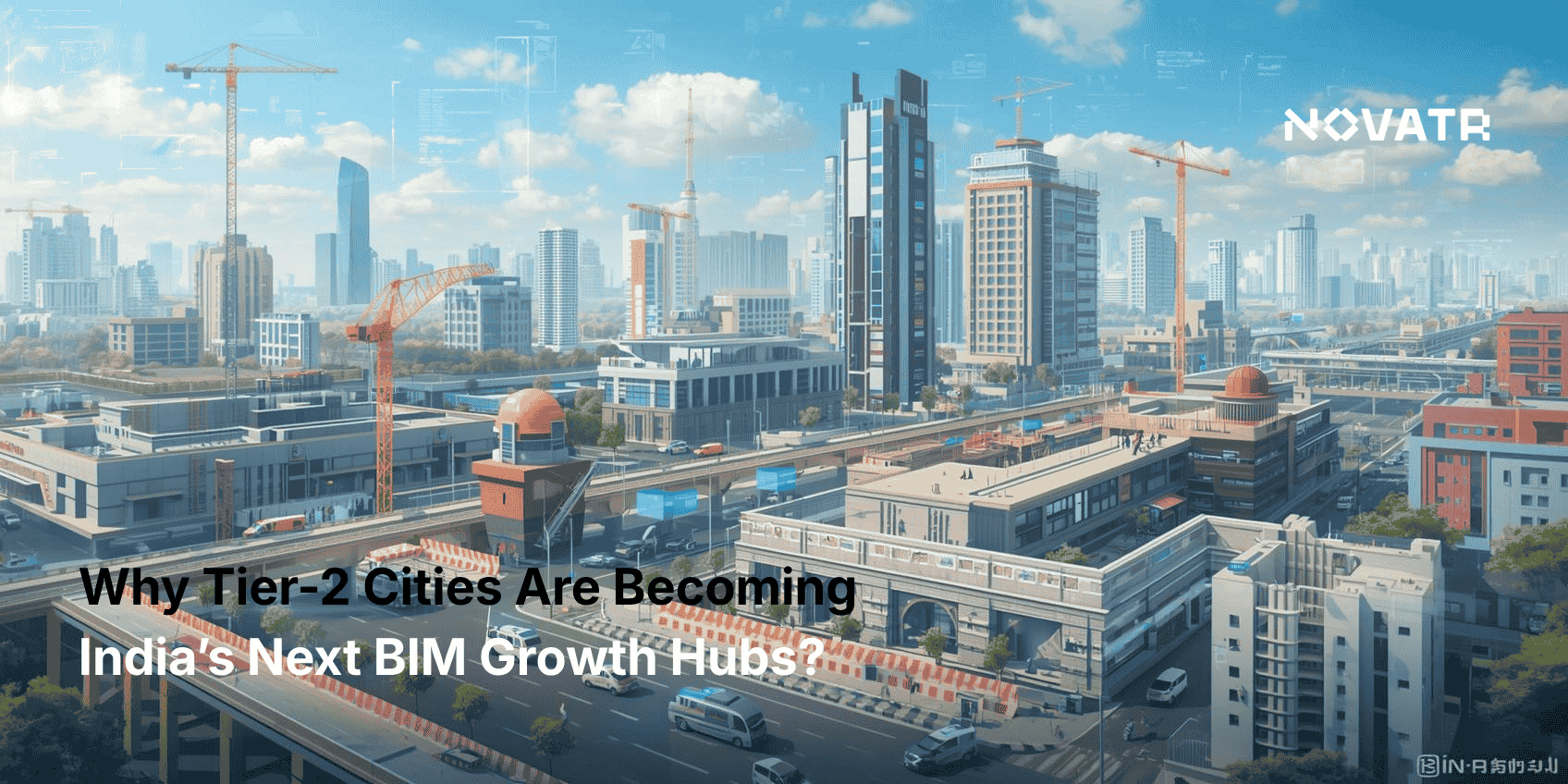

Building Information Modeling (BIM) in India is increasingly moving beyond major metro centers. Growing infrastructure projects, regional development, and expanding local AEC firms are creating higher demand for digital design and modeling in smaller urban areas. To handle increasing workloads, many companies are now distributing BIM tasks across multiple cities, optimizing delivery timelines and project management.
This trend is supported by a ready workforce and cost efficiencies. Engineering graduates from regional institutions are joining BIM teams outside metro hubs, and the average BIM modeler salary in India is around [₹419,857](https://www.payscale.com/research/IN/Job=Building_Information_Modeling_(BIM)_Modeler/Salary) per year. These factors make smaller cities increasingly attractive for BIM operations, establishing them as emerging growth centers in 2026.
Unlock High-Paying Careers With BIM
Master BIM workflows, software and skills on real projects.
Apply Now
\*Limited seats available
## **What Is Driving BIM Demand Beyond Metro Cities?**
BIM demand is steadily expanding in smaller urban centers due to multiple economic and operational factors. Companies are exploring alternatives to congested metro hubs, leveraging cost efficiencies and local talent availability. Combined with regional project growth, these factors are creating an environment where BIM adoption outside major cities is increasingly viable and sustainable.
Factors driving BIM demand beyond metro cities:
- **Shift in Infrastructure Investments:** Government and privately owned projects are moving to smaller cities, which are prompting local BIM demands.
- **Growth of Regional AEC Firms:** Local architecture, engineering, and construction firms are starting to use BIM to manage projects more efficiently.
- **Cost Arbitrage:** Tier-2 cities have lower operational costs, which allow firms to remain profitable as they scale BIM services.
- **Talent Decentralization:** More engineers and designers are working outside metro cities, giving firms access to skilled BIM professionals.
- **Remote And Hybrid Project Models:** Online collaboration tools help BIM teams work together even when they are in different locations.
- **Rising Local Project Complexity:** The industrial real estate and urban development sectors require cities to produce extensive BIM documents that go beyond standard requirements for all their projects.
## **How Infrastructure Expansion Is Fueling Tier-2 Growth**

Infrastructure development in Tier-2 cities is driving BIM adoption by creating new opportunities across urban, industrial, and residential projects. Smart city extensions, industrial corridors, and real estate developments are generating higher demand for digital modeling and coordinated planning. These initiatives are making Tier-2 cities key hubs for architecture, engineering, and construction operations.
Several infrastructure developments are driving this expansion:
- Modern smart city extensions introduce infrastructure requiring precise digital planning.
- The new industrial corridors and logistic parks demand the coordination of building processes.
- The local BIM adoption is being accelerated by the growing real estate and urban housing developments.
- Modernized road, utility and transport systems demand digital modeling in order to be efficient.
- Infrastructure projects in the region enable firms to de-centralize the operations of the metro centers and still ensure quality of the project.
## **The Rise of Regional BIM Service Providers**
Regional BIM service providers are becoming more common in smaller cities. These firms provide digital modeling and project coordination services that were earlier concentrated in metro areas. Their growth shows that architecture, engineering, and construction work is spreading beyond large cities as regional firms start handling more BIM-related project tasks.
The following points illustrate this trend:
- Firms like Telge Projects Limited are expanding operations to reach regional clients.
- Outsourcing demand from global markets drives investment in smaller urban centers.
- Offshore BIM delivery centers help companies manage international BIM projects from these locations.
- Regional providers work on different project types, including housing, commercial buildings, and industrial facilities.
- Local BIM firms help train professionals and increase skill availability in these regions.
- Working with local consultants and contractors improves coordination during project execution.
## **Talent Availability and Lower Operating Costs**
Tier-2 cities offer a combination of accessible skilled professionals and lower business expenses. Companies benefit from regional workforce availability while spending less on office space, utilities, and salaries compared with metro areas. This balance allows organizations to operate efficiently and manage resources effectively without being limited by high local costs or insufficient talent.
Key aspects of talent availability and cost advantages:
- Engineering colleges provide a steady supply of trained professionals ready for deployment.
- Teams can work in hybrid or remote setups to optimize resource allocation.
- Salary differences allow companies to employ qualified staff at lower expense than metro centers.
- Reduced office and infrastructure costs help control operational budgets.
- Local talent pools give organizations flexibility in staffing without increasing overhead.
## **How BIM Training Institutes Are Expanding in Tier-2 India**
BIM training institutes are increasingly establishing a presence in Tier-2 cities to meet growing interest in digital design skills. Local programs provide accessible education and practical exposure for engineering and architecture students. These initiatives create regional skill ecosystems that make technical training more reachable without requiring learners to relocate to larger metro areas.
This expansion is evident through several focused developments:
- Certification courses are seeing higher enrollment from students in smaller cities.
- Institutes are partnering with local colleges to provide practical BIM training.
- Short-term workshops and online programs make learning more flexible.
- Local training centers develop talent pipelines for regional AEC firms.
- Industry-academia collaborations help align training with professional requirements.
## **Challenges Slowing Down Tier-2 BIM Adoption**
Adopting BIM in Tier-2 cities involves navigating several obstacles that affect how projects are planned, coordinated, and executed. Regional firms face differences in processes, awareness levels, and available resources compared with larger urban centers. Understanding these barriers is essential to grasp why BIM integration progresses unevenly across smaller cities.
The main obstacles which prevent Tier-2 cities from adopting BIM technology are:
- Standardization gaps in BIM processes make collaboration across firms more difficult.
- The market for digital modeling services which uses advanced technology remains restricted because clients lack understanding of these services.
- Technology investment barriers prevent firms from upgrading hardware and software.
- Smaller budgets restrict continuous training for local BIM teams.
- The adoption rate and quality of implementation work suffer because organizations lack knowledge about international project standards.
## **What This Means for Architects & BIM Professionals in 2026**
Architects and BIM professionals in 2026 will operate in a changing landscape where project distribution, team structures, and workflows are increasingly decentralized. They will encounter diverse project requirements, regional operational practices, and evolving digital tools. Understanding these broader shifts helps professionals anticipate how their roles, responsibilities, and collaboration methods may adapt in smaller urban centers.
Here are the main considerations for professionals:
- Architects may engage more with regional projects requiring localized coordination and planning.
- BIM professionals will increasingly collaborate with hybrid or remote teams across locations.
- Salary structures and cost advantages in smaller cities may influence career decisions.
- Training and upskilling opportunities are expanding to meet regional talent demand.
- Exposure to diverse project types enhances skills and broadens professional experience.
Master BIM and Get Hired Faster
Join a community of 8500+ Architects and Engineers.
Explore Now
\*Limited seats available
## **Future Outlook: Will Tier-2 Cities Overtake Metros in BIM Delivery?**
Tier-2 cities are positioned to play a larger role in BIM delivery as infrastructure projects, regional AEC firms, and local talent expand. While metro cities still hold advanced resources and global client connections, the increasing capabilities of smaller urban centers are enabling them to manage complex projects and deliver quality outcomes in a decentralized work environment.
The coming years may see Tier-2 cities complementing metro hubs rather than replacing them entirely. Cost efficiencies, growing local expertise, and flexible team models will allow firms to balance workloads across locations. Professionals and organizations adopting this approach can leverage regional advantages while maintaining project standards and timelines, shaping a more distributed and resilient BIM delivery ecosystem.
Was this content helpful to you
Like Yes
Dislike No

TABLE OF CONTENTS
BIM Is The New Standard. Are You Certified?
Get Certified in BIM
SHARE ON YOUR SOCIALS
Link Copied Successfully
Related articles
[ Infrastructure Push 2026: Why BIM Will Be Central to India’s Construction Growth 23 March 2026 5 min read](https://blog.novatr.com/blog/bim-driving-indias-infrastructure-growth) [ ₹12.2 Lakh Crore CapEx: How Budget 2026 Is Accelerating BIM Adoption in India 23 March 2026 12 min read](https://blog.novatr.com/blog/budget-2026-driving-bim-adoption-in-india) [.png) Top MEP Consultants in India 2026 10 September 2025 5 min read](https://blog.novatr.com/blog/top-mep-consultants-in-india) [ CIVIL Top BIM Projects in India 2026 27 March 2026 6 min read](https://blog.novatr.com/blog/top-bim-projects-in-india)
Download Syllabus
## BIM Professional Program
Next Cohort
June 2026
Program Duration
7 Months
Premium Program benefits
8 Credentials from Autodesk, NSDC, Novatr
1 program. 10 career paths. Infinite Growth.
40+ ISO 19650 & RIBA real-world projects to practice
1-on-1 guidance. Access 400+ industry experts.
Access the biggest AEC-Tech community on the planet. 8500+ and counting
Curated for you by 100+ global BIM leaders.
Lifelong access to course content
Enter your details to download the program syllabus.
##### BIM Professional Program
June 2026, 7 Months
Your Name Invalid name.
Phone Number Enter a valid phone number
Email Please enter a valid email address.
Select years of experience\* Currently studying 0-1 years 1-2 years 2-4 years 4-8 years 8-10 years 10-12 years 12+ years Invalid selection.
Specialisation Select your background\* Architecture Civil Engineering Mechanical Engineering Electrical Engineering Invalid selection.
Are you professionally trained in interior design?
Yes
No
I agree to the [Terms of Use](https://www.novatr.com/terms-and-conditions) and [Privacy Policy](https://www.novatr.com/privacy-policy), and consent to be contacted by Email, Call, WhatsApp, or SMS.
Submit
Ready to skyrocket your career?
Begin your next chapter in AEC
with Novatr!
We are here to help you take the industry by storm with advanced, tech-first skills.
[Explore Courses](https://www.novatr.com/#courses)
Join our newsletter
Submit
Thank you for signing up.
We’ll send you a nice letter once per week. No spam.

Dare to Disrupt.
Join thousands of people who organise
work and life with Novatr.
Company
- [About Us](https://www.novatr.com/about)
- [BIM Professional Program v.2026](https://www.novatr.com/courses/bim-professional-program)
- [Masters Computational Design](https://www.novatr.com/courses/computational-design)
- [Become a Mentor](https://www.novatr.com/apply-as-mentor)
- [Hiring from Us](https://www.novatr.com/hire-from-us)
- [Careers at Novatr](https://www.novatr.com/career)
Resources
- [Blog](https://www.novatr.com/learning-hub)
- [Media Room](https://www.novatr.com/media-room-home-page)
- [Career Builder](https://www.novatr.com/career-navigator)
- [Events & Webinars](https://www.novatr.com/webinars)
- [FAQs & Support Center](https://www.novatr.com/contact-us)
- [Contact Us](https://www.novatr.com/contact-us)
- [Privacy Policy](https://www.novatr.com/privacy-policy)
- [Terms of Use](https://www.novatr.com/terms-and-conditions)
©2023 Oneistox Network Pvt. Ltd.
All Rights Reserved
```json
{
"@context" : "https://schema.org",
"@type" : "BlogPosting",
"author" : {
"@type" : "Person",
"name" : "Neha Singh",
"url" : "https://blog.novatr.com/blog/author/neha-singh"
},
"dateModified" : "2026-03-23T06:42:45.999Z",
"datePublished" : "2026-03-23T06:19:52.000Z",
"headline" : "Why Tier-2 Cities Are India’s Next BIM Growth Hubs {{year}}?",
"image" : [ "https://blog.novatr.com/hubfs/Why%20Tier-2%20Cities%20Are%20Becoming%20India%E2%80%99s%20Next%20BIM%20Growth%20Hubs.png" ],
"mainEntityOfPage" : {
"@id" : "https://blog.novatr.com/blog/why-tier-2-cities-are-indias-next-bim-growth-hubs",
"@type" : "WebPage"
},
"publisher" : {
"@type" : "Organization",
"logo" : {
"@type" : "ImageObject",
"url" : "https://blog.novatr.com/hubfs/Novatr%20Prev%20OX-2.svg"
}
}
}
```