---
title: What Do BIM Professionals Look for in an AEC Company? 2026
description: Discover what BIM professionals look for in an AEC company, from project exposure to workplace culture, career growth and learning opportunities.
image: https://blog.novatr.com/hubfs/BIM%20Companies%20in%20India.webp
---
[Blogs](https://www.novatr.com/learning-hub)
- [Architecture & Construction](https://www.novatr.com/learning-hub?category=Architecture+%26+Construction)
- [BIM](https://www.novatr.com/learning-hub?category=BIM)
- [Computational Design](https://www.novatr.com/learning-hub?category=Computational+Design)
- [Company News](https://www.novatr.com/learning-hub?category=Company+News)
- [Expert Talks](https://www.novatr.com/learning-hub?category=Expert+Talks)
Explore Courses
[Just Launched  BIM Professional Program v.2026 Take your career to the next level by mastering the real-world application of BIM. Know More](https://www.novatr.com/courses/bim-professional-program)
[ Master Computational Design Course Break into an advanced career by learning to apply the power of computation to the art of design. Know More](https://www.novatr.com/courses/computational-design)
[Blogs](https://www.novatr.com/learning-hub)
Explore Blogs
- [Architecture & Construction](https://www.novatr.com/learning-hub?category=Architecture+%26+Construction)
- [BIM](https://www.novatr.com/learning-hub?category=BIM)
- [Computational Design](https://www.novatr.com/learning-hub?category=Computational+Design)
- [Company News](https://www.novatr.com/learning-hub?category=Company+News)
- [Expert Talks](https://www.novatr.com/learning-hub?category=Expert+Talks)
Courses
- [BIM Professional Program v.2026](https://www.novatr.com/courses/bim-professional-program)
- [Master Computational Design](https://www.novatr.com/courses/computational-design)
- [BIM/](https://www.novatr.com/learning-hub?category=BIM)
Featured Article
# What Do BIM Professionals Look for in an AEC Company?

Bandana Singh
August 26, 2026
8 min read
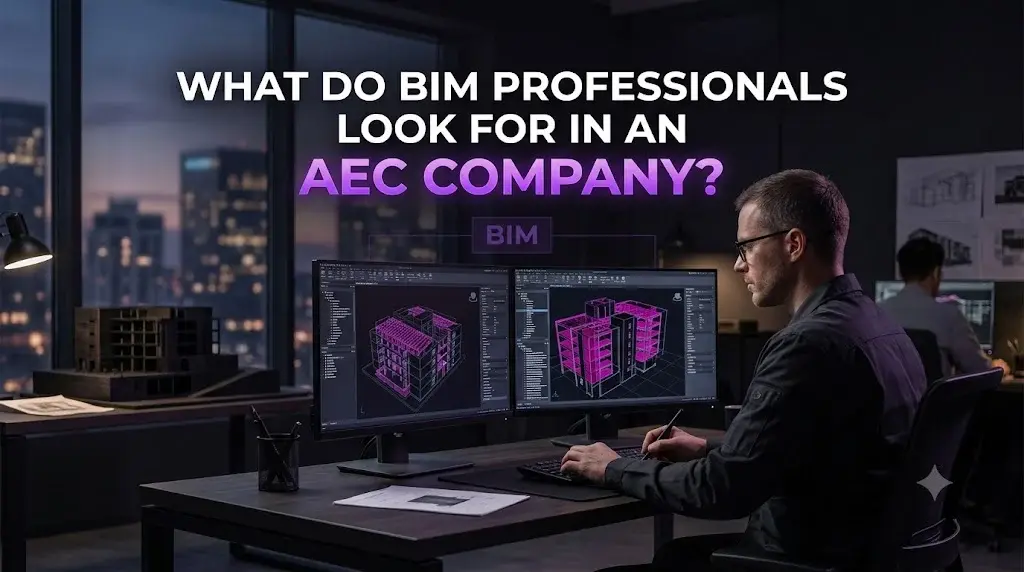

Choosing an employer is one of the most important decisions you can make when building a career in BIM. A job title may look promising on paper, but the real value of a role depends on the projects you work on, the technology you use, the people you learn from and the opportunities available to grow. This matters as digital skills become increasingly important across construction. [Deloitte](https://www.deloitte.com/us/en/insights/industry/engineering-and-construction/ec-workforce-development-strategy.html?utm_source=chatgpt.com) reports that 91% of construction industry respondents believe employees increasingly need digital skills to succeed in their firms.
For BIM professionals, this makes the choice of employer about more than salary. The right AEC company can provide exposure to better workflows, stronger mentorship and a clearer path towards long-term career growth.
## **Key Takeaways**
- The right employer can significantly influence aspiring professionals' BIM careers trajectory, skills and professional exposure.
- Look for companies with BIM adoption, structured workflows, strong leadership and defined learning opportunities.
- Project scale and technology exposure can shape how quickly you [develop practical BIM skills](https://www.novatr.com/blog/top-bim-skills-for-career-growth).
- Before accepting an offer, ask about workflows, software, project sectors, mentorship and career progression.
- A good employer should offer a balance of technical growth, collaboration, recognition and a healthy workplace culture.
Master BIM Before You Fall Behind
Join 8500+ AEC professionals building BIM careers.
Explore the Program
## **Why Does Choosing the Right AEC Employer Matter for BIM Career Growth?**
Your choice of employer can have a direct impact on how quickly your BIM career develops. The right workplace gives you opportunities to apply your skills across [real architecture projects](https://www.novatr.com/blog/impressive-architecture-mega-projects), collaborate with different disciplines and learn from experienced professionals. It also determines how much exposure you get to modern workflows, standards and technologies.
Look beyond the job title and assess what the role actually offers. A strong AEC employer can provide:
- Exposure to complex BIM projects, multidisciplinary coordination, information management and structured workflows.
- Practical experience with recognised BIM standards, project requirements and international client expectations.
- Opportunities to learn from experienced BIM professionals while developing stronger technical, coordination and communication skills.
- Hands-on experience with emerging construction technology, digital delivery tools and evolving project workflows.
- A clearer path for career growth, supported by established BIM management practices and opportunities to progress into coordination, management or specialist roles.

## **What Signs Show That an AEC Company Offers a Strong BIM Career Environment?**
A company does not become a good BIM employer simply because it mentions BIM on its website. Look for structure that digital processes are actually embedded into project delivery. Here are some of the common signs to consider:
- ### **BIM is Part of the Project Workflow**
Ask whether BIM is used from design development through coordination, construction and handover, or whether it is mainly used for producing models and drawings. A reputed organisation will usually have defined processes for model creation, reviews, coordination, information exchange and approvals.
- ### **The Company Understands BIM Standards**
Exposure to [recognised BIM standards](https://www.novatr.com/blog/bim-standards-and-best-practices-for-architects) can add significant value to your professional development. Find out whether the company works with ISO 19650 principles, project-specific information requirements or structured BIM Execution Plans. This experience can make your skills more transferable across projects and markets.
- ### **CDE Workflows are Taken Seriously**
A Common Data Environment should be more than a shared folder. If the company has clear processes for uploading, reviewing, approving, sharing and managing information, you are more likely to learn how professional information management works in practice.
- ### **Mentorship is Part of the Culture**
Formal training is useful, but day-to-day guidance can be even more valuable. Working alongside experienced BIM professionals allows you to understand why decisions are made, how issues are resolved and how project requirements change modelling and coordination decisions.
- ### **Career Paths are Clearly Defined**
Ask what typically is the scope after the first two or three years. Can a modeller progress into coordination? Can a coordinator move into management or information management? Does the company support specialist paths in automation, digital delivery or digital twins?
A company that can explain these pathways is more likely to have thought seriously about employee development.
- ### **There is Visible BIM Leadership**
Look at who is leading digital delivery within the organisation. Are there [BIM Managers](https://www.novatr.com/blog/guide-to-become-bim-manager), Digital Delivery Managers or Information Managers? Do they participate in project meetings and strategic decisions? Strong BIM leadership usually indicates that digital delivery is treated as a project function rather than an isolated technical service.
- ### **Internal Training is Consistent**
Good employers invest in keeping their teams current. Look for internal workshops, software training, knowledge-sharing sessions, certification support or opportunities to attend industry events.
Training should not stop at Revit. Depending on the role, development could include Navisworks, ACC, automation, information management, computational workflows or emerging digital tools.
- ### **Cross-Disciplinary Exposure is Encouraged**
A strong BIM environment allows professionals to understand how architecture, structure, MEP, civil engineering and construction interact. This broader exposure helps you become more than a software operator. It develops your ability to understand design intent, identify coordination risks and communicate with different project teams.

## **How Do Projects, Technology, and Workplace Culture Shape the BIM Employee Experience?**
The quality of your experience depends heavily on what you actually get to work on. Here are some factors to keep in mind.
| **Factor** | **What to Look For** | **Why It Matters for BIM Professionals** |
| --- | --- | --- |
| **Project Scale and Sector** | Look for exposure to complex projects involving multiple consultants, disciplines and structured information workflows. Consider sectors such as residential, healthcare, commercial, infrastructure, industrial and data-centre projects. | Project variety helps you understand different technical requirements and develop broader BIM skills. A smaller firm may sometimes provide wider exposure to design, coordination, client meetings and reviews than a large organisation with highly specialised roles. |
| **Technology Stack** | Assess the software and platforms used in day-to-day projects. This may include Revit, Navisworks, Autodesk Construction Cloud (ACC), Digital Twins, Dynamo, reality capture, point clouds, scan-to-BIM, data visualisation, computational design and AI-assisted workflows. | The goal is not to learn as many tools as possible, but to understand how technology supports BIM workflow, coordination, information management and project delivery. |
| **Collaboration and Knowledge Sharing** | Look for regular model reviews, coordination meetings, design discussions, peer learning and communication between disciplines. | A collaborative workplace helps you learn from experienced BIM professionals, understand different perspectives and develop stronger coordination and communication abilities. |
| **Feedback and Recognition** | Find out how performance is reviewed, whether employees receive regular feedback, how goals are discussed and whether good work is recognised. | Constructive feedback helps identify skill gaps, track improvement and create a clearer direction for career growth and professional development. |
| **Work-Life Balance** | Consider how the organisation manages deadlines, workload, communication and project pressure, particularly when teams work across different time zones. | Sustainable working practices allow professionals to develop their skills without constant burnout. A supportive workplace can contribute to stronger long-term performance and job satisfaction. |
| **Innovation** | Look for employers that encourage experimentation, training and the adoption of new technologies and processes. | Organisations that invest in innovation can provide greater exposure to evolving construction technology, digital delivery methods and [emerging BIM practices](https://www.novatr.com/blog/bim-trends-2025), helping professionals remain adaptable as the industry changes. |
## **Which Questions Should BIM Professionals Ask Before Accepting an Offer?**
An interview should not only be about whether the company wants you. It is also an opportunity to decide whether the company is right for you. Consider asking:
### **About BIM Workflows**
- How is BIM used across the project lifecycle?
- Is there a defined BIM Execution Plan?
- How is the CDE managed?
### **About the Team**
- How is the BIM team structured?
- Who would I report to?
- How closely would I work with architects, engineers and contractors?
### **About Technology**
- Which software and platforms does the team use?
- Is the company adopting [AI automation?](https://www.novatr.com/blog/ai-in-aec-industry)
- Will I get exposure to tools beyond my current skill set?
### **About Learning**
- Is there structured internal training?
- Does the company support professional certifications?
- How are new employees introduced to project standards?
### **About Projects**
- What types of projects would I work on?
- Are projects domestic or international?
- Would I work across multiple disciplines?
### **About Career Progression**
- What does progression from this role typically look like?
- How are promotions assessed?
- Can professionals move towards BIM coordination, management or digital delivery?
### **About Workplace Culture**
- How often does the team receive feedback?
- How does the company manage demanding project periods?
- How does knowledge sharing happen within the team?
BIM is Advancing. Are You?
Get BIM certified and open doors to a better career.
Join the Program
## **Conclusion**
Choosing an employer is ultimately about choosing the environment in which your skills will develop. The right AEC company can expose you to stronger BIM workflows, experienced mentors, complex projects and emerging technologies while giving you room to grow. Before accepting an offer, look beyond the salary and job title. Understand how the company approaches learning, collaboration, digital delivery and career progression.
If you want to build the skills employers increasingly expect, [BIM Professional Program](https://www.novatr.com/courses/bim-professional-program?utm_source=organic_search&utm_medium=blog&utm_campaign=) by [Novatr](https://www.novatr.com/) offers structured, industry-focused learning built around practical BIM workflows and real project applications.
For additional industry insights and learning resources, join us on our [WhatsApp channel](https://whatsapp.com/channel/0029Vb7Gy2LBFLgMx79j7B1b) or visit our [Resources Page](https://www.novatr.com/learning-hub) to learn about the latest trends in architecture and engineering.
## **FAQs**
### **1. What kind of projects do BIM professionals prefer?**
Many BIM professionals prefer projects that offer multidisciplinary coordination, advanced technology and meaningful responsibility. Large commercial, infrastructure, healthcare and international projects can provide valuable exposure, but the quality of the learning environment matters more than project size alone.
### **2. What do BIM professionals look for in an AEC company?**
They typically look for strong BIM adoption, structured workflows, good mentorship, modern technology, cross-disciplinary exposure and clear career opportunities. A company that supports continuous learning can also provide stronger long-term career growth.
### **3. What do BIM professionals value more than salary?**
Salary remains important, but many professionals also value meaningful project exposure, mentorship, learning opportunities, work-life balance, supportive leadership and a clear progression path. These factors can have a significant impact on long-term BIM careers.
Was this content helpful to you
Like Yes
Dislike No

TABLE OF CONTENTS
BIM Is The New Standard. Are You Certified?
Get Certified in BIM
SHARE ON YOUR SOCIALS
Link Copied Successfully
Related articles
[ BIM How Do Leading AEC Firms Structure High-Performing BIM Teams? 26 August 2026 10 min read](https://blog.novatr.com/blog/how-aec-firms-structure-high-performing-bim-teams) [ BIM How Should Working Professionals Evaluate a BIM Upskilling Program? 24 August 2026 9 min read](https://blog.novatr.com/blog/how-professionals-evaluate-a-bim-upskilling-program) [ BIM Why Project-Based Learning Produces Better Career Outcomes in AEC Education? 19 August 2026 8 min read](https://blog.novatr.com/blog/project-based-learning-for-better-career-outcomes) [.png) BIM Archi Keyboard Shortcuts and Productivity Hacks in Autodesk Construction Cloud 12 May 2026 4 min read](https://blog.novatr.com/blog/autodesk-construction-cloud-shortcuts-for-productivity)
Download Syllabus
## BIM Professional Program
Next Cohort
June 2026
Program Duration
7 Months
Premium Program benefits
8 Credentials from Autodesk, NSDC, Novatr
1 program. 10 career paths. Infinite Growth.
40+ ISO 19650 & RIBA real-world projects to practice
1-on-1 guidance. Access 400+ industry experts.
Access the biggest AEC-Tech community on the planet. 8500+ and counting
Curated for you by 100+ global BIM leaders.
Lifelong access to course content
Enter your details to download the program syllabus.
##### BIM Professional Program
June 2026, 7 Months
Your Name Invalid name.
Phone Number Enter a valid phone number
Email Please enter a valid email address.
Select years of experience\* Currently studying 0-1 years 1-2 years 2-4 years 4-8 years 8-10 years 10-12 years 12+ years Invalid selection.
Specialisation Select your background\* Architecture Civil Engineering Mechanical Engineering Electrical Engineering Invalid selection.
Are you professionally trained in interior design?
Yes
No
I agree to the [Terms of Use](https://www.novatr.com/terms-and-conditions) and [Privacy Policy](https://www.novatr.com/privacy-policy), and consent to be contacted by Email, Call, WhatsApp, or SMS.
Submit
Ready to skyrocket your career?
Begin your next chapter in AEC
with Novatr!
We are here to help you take the industry by storm with advanced, tech-first skills.
[Explore Courses](https://www.novatr.com/#courses)
Join our newsletter
Submit
Thank you for signing up.
We’ll send you a nice letter once per week. No spam.

Dare to Disrupt.
Join thousands of people who organise
work and life with Novatr.
Company
- [About Us](https://www.novatr.com/about)
- [BIM Professional Program v.2026](https://www.novatr.com/courses/bim-professional-program)
- [Masters Computational Design](https://www.novatr.com/courses/computational-design)
- [Become a Mentor](https://www.novatr.com/apply-as-mentor)
- [Hiring from Us](https://www.novatr.com/hire-from-us)
- [Careers at Novatr](https://www.novatr.com/career)
Resources
- [Blog](https://www.novatr.com/learning-hub)
- [Media Room](https://www.novatr.com/media-room-home-page)
- [Career Builder](https://www.novatr.com/career-navigator)
- [Events & Webinars](https://www.novatr.com/webinars)
- [FAQs & Support Center](https://www.novatr.com/contact-us)
- [Contact Us](https://www.novatr.com/contact-us)
- [Privacy Policy](https://www.novatr.com/privacy-policy)
- [Terms of Use](https://www.novatr.com/terms-and-conditions)
©2023 Oneistox Network Pvt. Ltd.
All Rights Reserved
```json
{
"@context" : "https://schema.org",
"@type" : "BlogPosting",
"author" : {
"@type" : "Person",
"name" : "Bandana Singh",
"url" : "https://blog.novatr.com/blog/author/bandana-singh"
},
"dateModified" : "2026-08-27T03:00:37.469Z",
"datePublished" : "2026-08-26T06:54:47.000Z",
"headline" : "What Do BIM Professionals Look for in an AEC Company? {{year}}",
"image" : [ "https://blog.novatr.com/hubfs/BIM%20Companies%20in%20India.webp" ],
"mainEntityOfPage" : {
"@id" : "https://blog.novatr.com/blog/what-do-bim-professionals-look-for-in-an-aec-company",
"@type" : "WebPage"
},
"publisher" : {
"@type" : "Organization",
"logo" : {
"@type" : "ImageObject",
"url" : "https://blog.novatr.com/hubfs/Novatr%20Prev%20OX-2.svg"
}
}
}
```