---
title: "UPSC ESE vs GATE vs Private Jobs: Which Career Path is Better?"
description: Compare UPSC ESE, GATE, and private jobs for civil engineers. Learn salary, growth, skills, risks, and the best career path after engineering.
image: https://blog.novatr.com/hubfs/Civil%20engineering%20student%20choosing%20between%20UPSC%20ESE%2c%20GATE%2c%20and%20private%20jobs%20career%20paths..jpg
---
[Blogs](https://www.novatr.com/learning-hub)
- [Architecture & Construction](https://www.novatr.com/learning-hub?category=Architecture+%26+Construction)
- [BIM](https://www.novatr.com/learning-hub?category=BIM)
- [Computational Design](https://www.novatr.com/learning-hub?category=Computational+Design)
- [Company News](https://www.novatr.com/learning-hub?category=Company+News)
- [Expert Talks](https://www.novatr.com/learning-hub?category=Expert+Talks)
Explore Courses
[Just Launched  BIM Professional Program v.2026 Take your career to the next level by mastering the real-world application of BIM. Know More](https://www.novatr.com/courses/bim-professional-program)
[ Master Computational Design Course Break into an advanced career by learning to apply the power of computation to the art of design. Know More](https://www.novatr.com/courses/computational-design)
[Blogs](https://www.novatr.com/learning-hub)
Explore Blogs
- [Architecture & Construction](https://www.novatr.com/learning-hub?category=Architecture+%26+Construction)
- [BIM](https://www.novatr.com/learning-hub?category=BIM)
- [Computational Design](https://www.novatr.com/learning-hub?category=Computational+Design)
- [Company News](https://www.novatr.com/learning-hub?category=Company+News)
- [Expert Talks](https://www.novatr.com/learning-hub?category=Expert+Talks)
Courses
- [BIM Professional Program v.2026](https://www.novatr.com/courses/bim-professional-program)
- [Master Computational Design](https://www.novatr.com/courses/computational-design)
- [CIVIL/](https://www.novatr.com/learning-hub?category=BIM)
Featured Article
# UPSC ESE vs GATE vs Private Jobs: Which Career Path is Better?

Deependra Dobriyal
June 11, 2026
9 min read
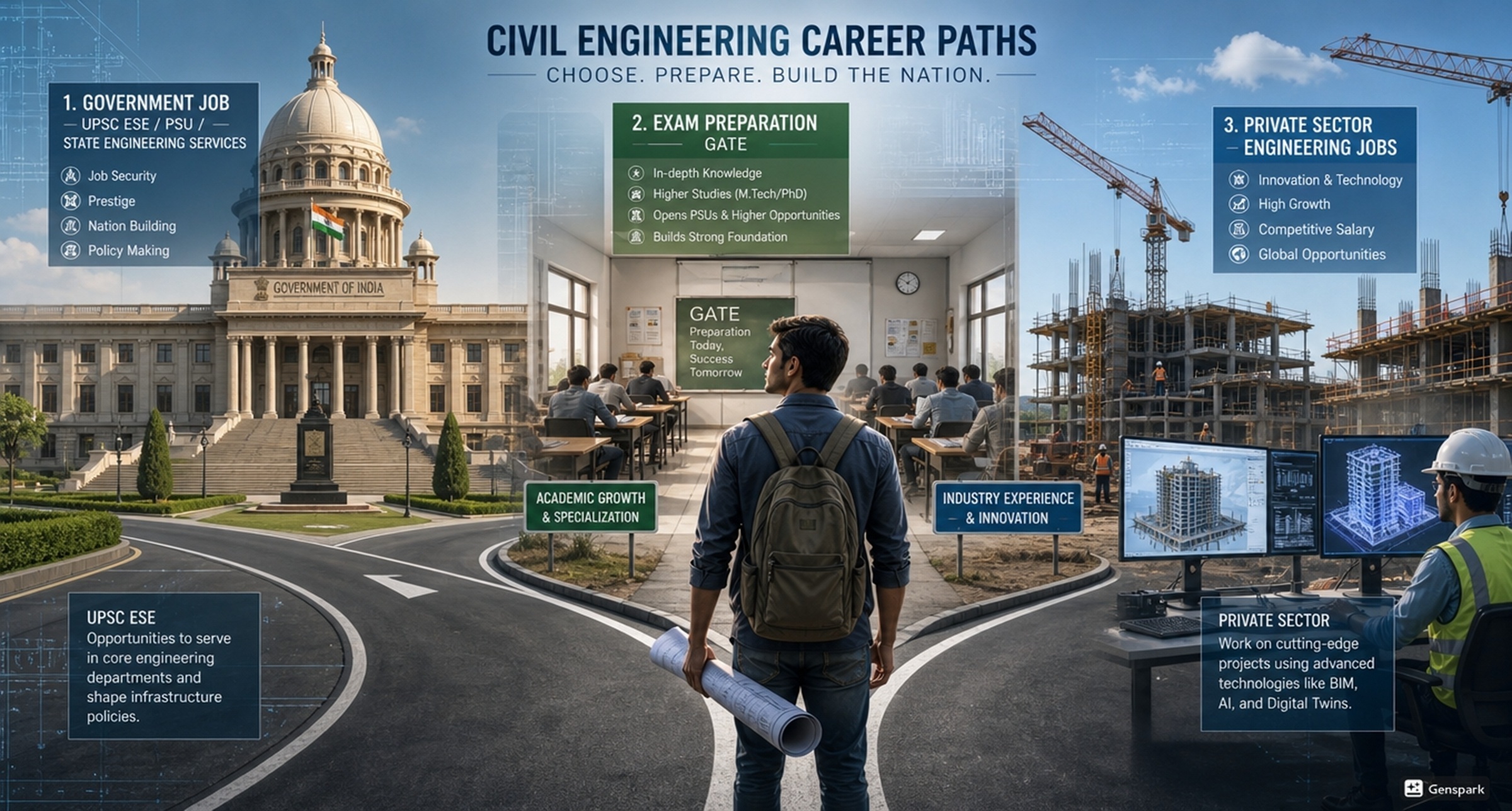

Choosing a career route after Civil Engineering is not really a straightforward thing to do. Before you actually decide, a lot of students end up comparing government exams like ESE and GATE with the kind of work you’d get in the private sector. UPSC ESE vs Private Jobs is asked again and again, mainly because the stability side, the pay scale, and the long-term growth are kind of different between the two options.
From the newest engineering employment trends, it looks like the sector keeps moving upward at around [6-8%](https://infra.economictimes.indiatimes.com/news/construction/indias-construction-sector-to-rebound-to-68-growth-in-fy27-icra/129893828) every year, in India, especially where infrastructure development is involved, metro projects are on, and digital construction is becoming more common. Also, government engineering positions are pretty competitive and in the major exams, barely under [2%](https://www.pw.live/gate/exams/upsc-ese-success-ratio) of the people manage to get selected.
So in the end, it really helps to understand what each option actually offers before you lock in your decision for a civil engineering career.
Unlock High-Paying Careers With BIM
Master BIM workflows, software and skills on real projects.
Apply Now
\*Limited seats available
## **List of Career Path**
****
### **1. CAT (Common Admission Test)**
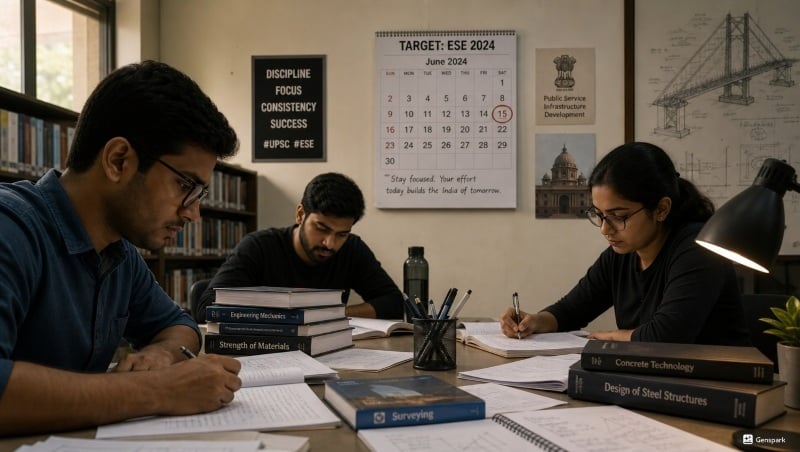
In case you have any queries about **what is upsc ese exam**, it is a competitive exam conducted at the national level to recruit engineers for the Government departments like Railways, CPWD, Defence, etc.
- Highly respected government engineering job
- Organized labor in a specific job.
- Stable salary and benefits.
- Needs extensive preparation and patience
The question of **how to prepare for upsc ese** is asked by many students and it typically takes 1–2 years to prepare for this.
The **upsc ese age limit** is usually between the ages of 21 to 30 (relaxed for reserved categories).
The prelims, mains and interview are the three stages of the **upsc ese exam pattern**.
### **2. GATE Exam Path**
GATE is mainly used for:
- M.Tech admissions in IITs and NITs
- PSU recruitment like ONGC, IOCL
- Research, Academic careers
### **3. Private Sector Jobs**
Private jobs are from construction companies, consultancies, BIM companies and infrastructure developers.
This road is rapidly growing because of:
- Smart city projects
- Digital construction tools
- Design outsourcing worldwide.
## **Comparison: Salary, Growth, Difficulty**
The following is a clear comparison for your understanding:
| **Factor** | **UPSC ESE** | **GATE/PSU** | **Private Jobs** |
| --- | --- | --- | --- |
| Starting Salary | [₹56,100](https://testbook.com/upsc-ies/salary-job-profile) (approx) | [₹50,000 - 1,00,000](https://www.imsindia.com/blog/gate/psu-salary-structure/) | [₹20,000 - 40,000](https://internshala.com/blog/salary-of-a-civil-engineer-in-india/) |
| Growth Speed | Slow but stable | Moderate | Fast on the job!Quick on the job! |
| Job Security | Very High | High | Medium |
| Entry Difficulty | Very High | High | Moderate |
| Work Flexibility | Low | Medium | High |
| Skill Growth | Limited tools | Technical | High (software + tools) |
## **Advantages and Disadvantages of Each Option**
****
### **UPSC ESE**
**Benefits:**
- Job security feels steady and solid
- Usually, you also get government benefits
- It’s a respectable position
**Downsides:**
- That exam is super competitive
- Career growth can be a little slow, at times
- Less exposure to new tools, sometimes for long stretches too
### **GATE Path**
**Benefits:**
- Works really well if you’re aiming for higher studies
- PSU options are there, quite often
- Helps you build a strong technical base
**Downsides:**
- The job guarantee feels limited
- The competition level is high
- You need real depth in the subject area
### **Private Jobs**
**Benefits:**
- Career growth can be fast
- You might work with tools like BIM
- There can be global opportunities as well
**Downsides:**
- Performance pressure tends to stay around
- You have to keep upgrading skills, continuously
## **Which Career is the Right Career for you?**
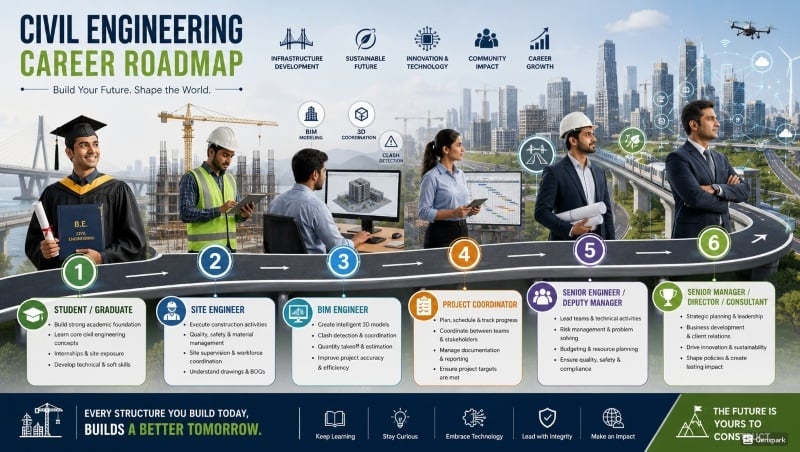
The answer really depends on the objectives you have.
Choose UPSC ESE if:
- You would prefer to have stable jobs first and foremost.
- You like having a work schedule and sticking to it.
Choose GATE if:
- You are looking for further study or a job with PSU
- You have a strong interest in technical subjects
If you select Private Jobs:
- You would prefer more rapid growth.
- You are open to learning software and tools
- You are interested in the current jobs such as **BIM as a career** or **BIM career in india**.
## **Risks and Challenges**
Some of the risks and challenges include:
- There is a lot of competition in the ESE and GATE exams.
- Enough preparation time with no certainty of success.
- Job insecurity among young people in the private sector
- The need for constant learning due to technology changes.
- Not enough knowledge about new fields such as BIM and digital construction
- Early pressure to specialize in your work.
- Compensation is not only based on degree but rather on skill.
## **Skills Required for Private Sector Growth**
Private sector success is not about grades; it's about skills.
Key skills include:
- The knowledge of AutoCAD, Revit and Navisworks is required.
- Understanding BIM workflows
- Data handling and using spreadsheets (Excel).
- Able to communicate with teams and clients.
- Real-world application of problem-solving in a project environment.
- Understanding of construction techniques
For Civil engineering students, **career opportunities after civil engineering** can be improved with the help of learning tools such as BIM.
## **How to Build a Strong Career Outside Exams**
To build an industry-relevant private career, you need to gain industry practiced exposure to software and workflows. Courses such as Novatr's BIM Professional Course enable engineers to enhance their project abilities, automation skills, and digital construction expertise.
Take your civil engineering career to the next level with Novatr’s [BIM Professional Course for Civil Engineers](https://www.novatr.com/us/courses/bim-for-civil-engineers), a project-based program that prepares you to plan, design, and manage construction projects using 12+ industry software and essential BIM plugins.
Learn how to work with Autodesk Revit, Navisworks, construction cloud and key plugins like DiRoots.One, pyRevit, EF-Tools, ProSheets, Issue and Model Checker for Revit to improve automation, accuracy, and project efficiency.
**Here’s what you’ll gain:**
- End-to-end understanding of BIM workflows — modeling, estimation, coordination, sequencing, and documentation.
- Hands-on training aligned with ISO 19650 standards and real residential + commercial projects.
- **Globally recognized certifications**:
After completing the core modules, learners can also choose 2 additional specializations, including:
- **Visual Programming with Dynamo** – for automation and parametric workflows
- **4D, 5D & 6D with BIM** – for time, cost, and facility integration
- **Tekla for RCC Modeling** – for detailed steel and concrete modeling
- **Civil 3D for Infrastructure** – for roadways, railways, and utilities
- **Project Strategy & Optimization with Plannerly -** Plan, structure, and audit BIM execution plans.
This structured approach really does help professionals to build solid BIM skills and then use them in actual projects, not just in theory.
Master BIM and Get Hired Faster
Join a community of 8500+ Architects and Engineers.
Explore Now
\*Limited seats available
## Conclusion
Deciding between UPSC ESE, GATE and private jobs will rely on your own objectives and risk comfort. ESE provides stability, GATE provides academic and PSU career path and private job provides rapid growth with continuous skill enhancement. In today's era, comparing **UPSC ESE vs private jobs** is not only about salary, but it also connects to day-to-day lifestyle, flexibility, and the chances to grow further.
For those looking to pursue a successful career in the industry, [Novatr's](https://www.novatr.com/)[BIM Professional Course for Civil Engineers](https://www.novatr.com/courses/bim-for-civil-engineers?course=bim-for-civil-engineers) could be the right choice. It enables you to acquire practical project skills, automation tools and a worldwide workflow.
Visit our[Resource Page](https://www.novatr.com/learning-hub) to learn more about the various learning paths and career options, and make the most of your future.
Was this content helpful to you
Like Yes
Dislike No

TABLE OF CONTENTS
BIM Is The New Standard. Are You Certified?
Get Certified in BIM
SHARE ON YOUR SOCIALS
Link Copied Successfully
Related articles
[ BIM Civil What If You Don’t Crack ESE? Best Career Options for Engineers 11 June 2026 9 min read](https://blog.novatr.com/blog/what-if-you-dont-crack-ese-best-career-options-for-engineers) [ BIM Civil BIM in Public vs Private Sector Adoption, Challenges & Skills 5 June 2026 6 min read](https://blog.novatr.com/blog/bim-in-public-vs-private-sector-adoption-challenges-skills) [ BIM Civil UPSC ESE Salary, Job Roles & Career Growth Explained 11 June 2026 7 min read](https://blog.novatr.com/blog/upsc-ese-salary-job-roles-career-growth-explained) [ BIM Civil How to Become a 4D BIM Engineer: Skills, Salary, and Career Path 30 April 2026 6 min read](https://blog.novatr.com/blog/how-to-become-a-4d-bim-engineer-skills-salary-and-career-path)
Download Syllabus
## BIM Professional Program
Next Cohort
June 2026
Program Duration
7 Months
Premium Program benefits
8 Credentials from Autodesk, NSDC, Novatr
1 program. 10 career paths. Infinite Growth.
40+ ISO 19650 & RIBA real-world projects to practice
1-on-1 guidance. Access 400+ industry experts.
Access the biggest AEC-Tech community on the planet. 8500+ and counting
Curated for you by 100+ global BIM leaders.
Lifelong access to course content
Enter your details to download the program syllabus.
##### BIM Professional Program
June 2026, 7 Months
Your Name Invalid name.
Phone Number Enter a valid phone number
Email Please enter a valid email address.
Select years of experience\* Currently studying 0-1 years 1-2 years 2-4 years 4-8 years 8-10 years 10-12 years 12+ years Invalid selection.
Specialisation Select your background\* Architecture Civil Engineering Mechanical Engineering Electrical Engineering Invalid selection.
Are you professionally trained in interior design?
Yes
No
I agree to the [Terms of Use](https://www.novatr.com/terms-and-conditions) and [Privacy Policy](https://www.novatr.com/privacy-policy), and consent to be contacted by Email, Call, WhatsApp, or SMS.
Submit
Ready to skyrocket your career?
Begin your next chapter in AEC
with Novatr!
We are here to help you take the industry by storm with advanced, tech-first skills.
[Explore Courses](https://www.novatr.com/#courses)
Join our newsletter
Submit
Thank you for signing up.
We’ll send you a nice letter once per week. No spam.

Dare to Disrupt.
Join thousands of people who organise
work and life with Novatr.
Company
- [About Us](https://www.novatr.com/about)
- [BIM Professional Program v.2026](https://www.novatr.com/courses/bim-professional-program)
- [Masters Computational Design](https://www.novatr.com/courses/computational-design)
- [Become a Mentor](https://www.novatr.com/apply-as-mentor)
- [Hiring from Us](https://www.novatr.com/hire-from-us)
- [Careers at Novatr](https://www.novatr.com/career)
Resources
- [Blog](https://www.novatr.com/learning-hub)
- [Media Room](https://www.novatr.com/media-room-home-page)
- [Career Builder](https://www.novatr.com/career-navigator)
- [Events & Webinars](https://www.novatr.com/webinars)
- [FAQs & Support Center](https://www.novatr.com/contact-us)
- [Contact Us](https://www.novatr.com/contact-us)
- [Privacy Policy](https://www.novatr.com/privacy-policy)
- [Terms of Use](https://www.novatr.com/terms-and-conditions)
©2023 Oneistox Network Pvt. Ltd.
All Rights Reserved
```json
{
"@context" : "https://schema.org",
"@type" : "BlogPosting",
"author" : {
"@type" : "Person",
"name" : "Deependra Dobriyal",
"url" : "https://blog.novatr.com/blog/author/deependra-dobriyal"
},
"dateModified" : "2026-06-11T08:33:38.659Z",
"datePublished" : "2026-06-11T08:33:03.000Z",
"headline" : "UPSC ESE vs GATE vs Private Jobs: Which Career Path is Better?",
"image" : [ "https://blog.novatr.com/hubfs/Civil%20engineering%20student%20choosing%20between%20UPSC%20ESE%2c%20GATE%2c%20and%20private%20jobs%20career%20paths..jpg" ],
"mainEntityOfPage" : {
"@id" : "https://blog.novatr.com/blog/upsc-ese-vs-gate-vs-private-jobs-which-career-path-is-better",
"@type" : "WebPage"
},
"publisher" : {
"@type" : "Organization",
"logo" : {
"@type" : "ImageObject",
"url" : "https://blog.novatr.com/hubfs/Novatr%20Prev%20OX-2.svg"
}
}
}
```