---
title: "State of BIM in 2026: Adoption Trends, Market Insights & Future Outlook"
description: Learn how BIM is gaining traction around the world. Explore market insights, adoption trends, career opportunities, and future industry growth.
image: https://blog.novatr.com/hubfs/State%20of%20BIM%20in%202026%20Adoption%20Trends%2c%20Market%20Insights%20%26%20Future%20Outlook.jpg
---
[Blogs](https://www.novatr.com/learning-hub)
- [Architecture & Construction](https://www.novatr.com/learning-hub?category=Architecture+%26+Construction)
- [BIM](https://www.novatr.com/learning-hub?category=BIM)
- [Computational Design](https://www.novatr.com/learning-hub?category=Computational+Design)
- [Company News](https://www.novatr.com/learning-hub?category=Company+News)
- [Expert Talks](https://www.novatr.com/learning-hub?category=Expert+Talks)
Explore Courses
[Just Launched  BIM Professional Program v.2026 Take your career to the next level by mastering the real-world application of BIM. Know More](https://www.novatr.com/courses/bim-professional-program)
[ Master Computational Design Course Break into an advanced career by learning to apply the power of computation to the art of design. Know More](https://www.novatr.com/courses/computational-design)
[Blogs](https://www.novatr.com/learning-hub)
Explore Blogs
- [Architecture & Construction](https://www.novatr.com/learning-hub?category=Architecture+%26+Construction)
- [BIM](https://www.novatr.com/learning-hub?category=BIM)
- [Computational Design](https://www.novatr.com/learning-hub?category=Computational+Design)
- [Company News](https://www.novatr.com/learning-hub?category=Company+News)
- [Expert Talks](https://www.novatr.com/learning-hub?category=Expert+Talks)
Courses
- [BIM Professional Program v.2026](https://www.novatr.com/courses/bim-professional-program)
- [Master Computational Design](https://www.novatr.com/courses/computational-design)
- [BIM/](https://www.novatr.com/learning-hub?category=BIM)
Featured Article
# State of BIM in 2026: Adoption Trends, Market Insights & Future Outlook

Pragya Sharma
June 22, 2026
8 min read
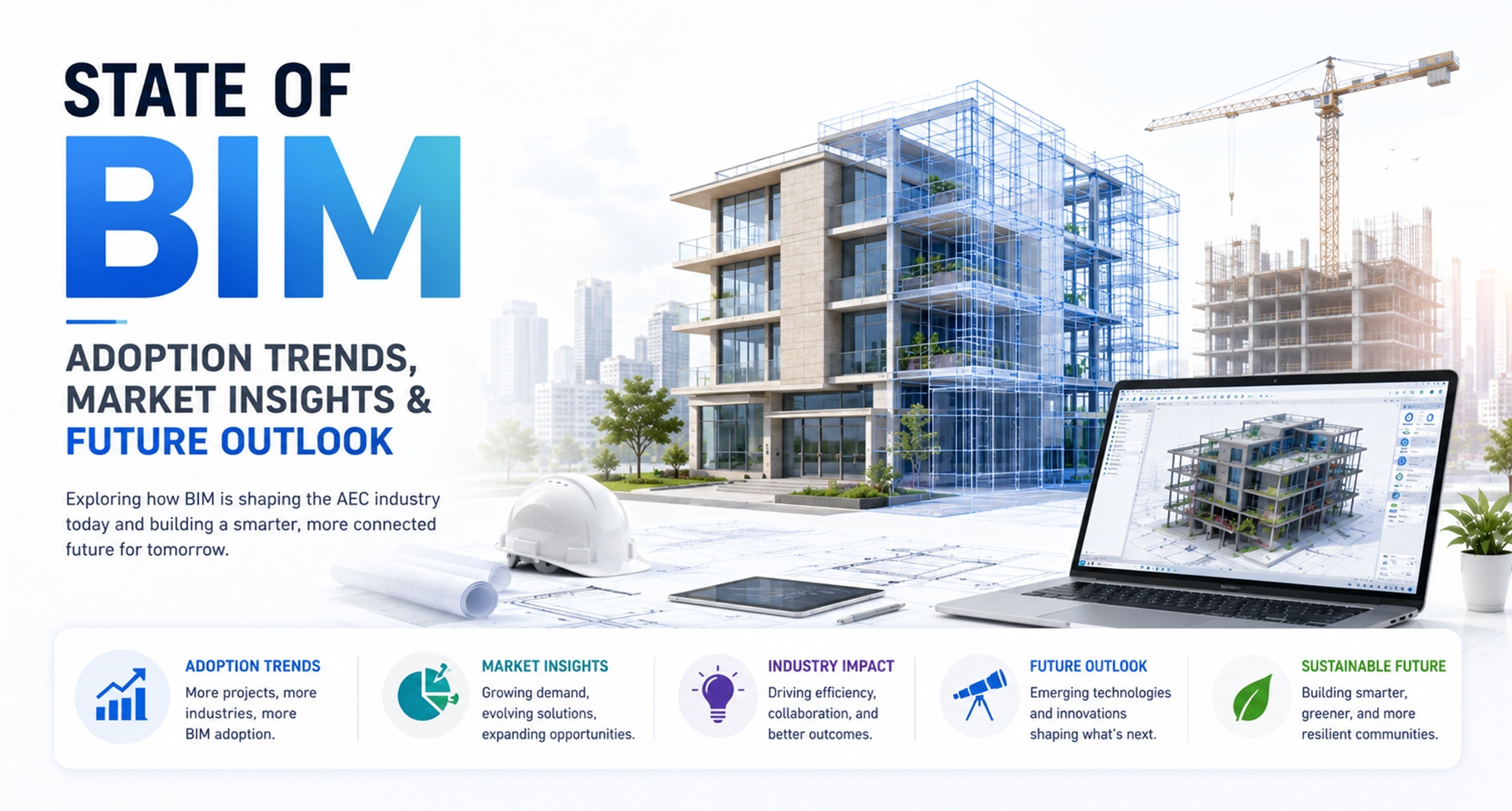

Building Information Modelling (BIM) is having a moment in the Architecture, Engineering, and Construction (AEC) domain. It is fast becoming an industry favourite, delivering the promise of greater efficiency and collaboration between the design, build, and maintenance processes. To put this in perspective, here are some noteworthy BIM trends:
- A [study by 360 Research Reports](https://www.360researchreports.com/market-reports/building-information-modelling-market-208618) states that BIM technology usage in new construction projects grew from 25% in 2020 to around 40% in 2025.
- Another [Markets and Markets survey](https://www.marketsandmarkets.com/Market-Reports/building-information-modeling-market-95037387.html) says the global BIM market is projected to grow from $ 9.03 billion in 2025 to $ 15.42 billion in 2030, at a CAGR of 11.3%
- BIM adoption has reached 76% among architects and 61% among engineering firms, claims a [research by Market Reports World](https://www.marketreportsworld.com/market-reports/building-information-modeling-bim-market-14722034).
Concluding from these numbers, it is evident that BIM is evolving as an industry-wide practice.
## **Key Takeaways**
- BIM is reinventing the global building design, construction, and management processes with a more efficient digitalised approach.
- AEC professionals are adopting BIM at an electric speed, given it is steadily becoming an industry-wide standard.
- Individuals who are actively embracing BIM are better positioned to secure high-paying jobs in top AEC firms.
- With Artificial Intelligence (AI) and automation in the picture, BIM trends are evolving to be more intelligent and efficient.
- BIM Modeller, BIM Coordinator, and BIM Manager are some of the key emerging roles for architects and engineers seeking to future-proof their careers.
Unlock High-Paying Careers With BIM
Master BIM workflows, software and skills on real projects.
Apply Now
\*Limited seats available
## **Which countries are using BIM in 2026?**
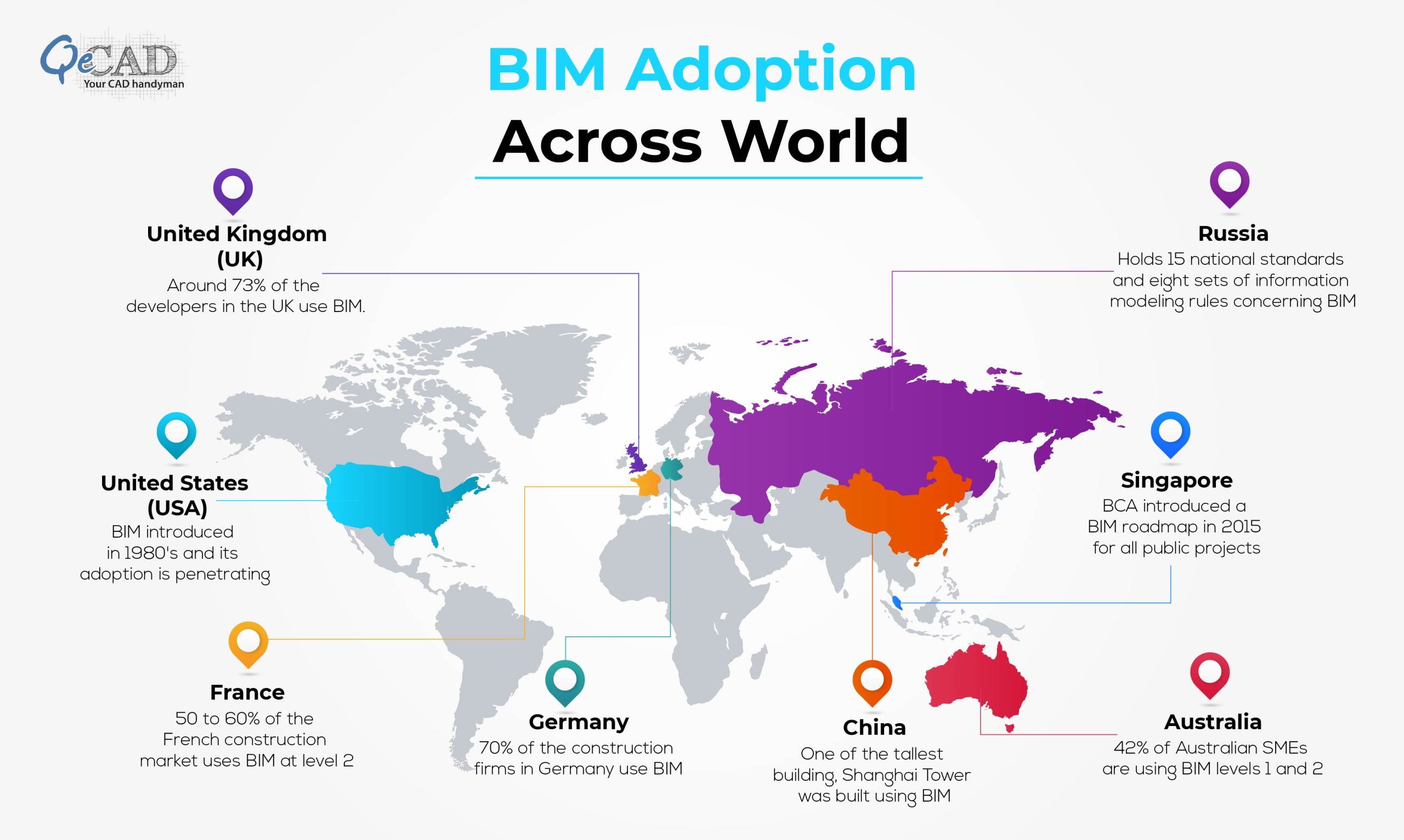
Once viewed as a competitive benefit, [BIM technology](https://www.novatr.com/blog/what-is-building-information-modeling-bim) is becoming an essential for large-scale projects around the world. But before we dive into the list of countries who are now mandating BIM, let’s first understand what is BIM technology.
BIM is a digital process that uses the 3D model of a structure to support design visualization, construction workflows, and predictive maintenance. These comprehensive models contain information about every physical and functional attribute of a building and can be made using BIM software such as [Revit](https://www.novatr.com/blog/what-is-revit-software), ArchiCAD, and Civil 3D.
Governments of various countries are now mandating the use of BIM to enhance their built infrastructure. Here’s the list:
1. **United Kingdom:** Touted as a global leader in BIM adoption, the country has necessitated BIM in construction industry since 2016.
2. **India:** The Central Public Works Department (CPWD) has made BIM integration compulsory for all government projects above the budget of INR 20 crores. Early movers in BIM technology are evidently winning tenders as compared to their unskilled counterparts.
3. **United States:** The American Institute of Architects (AIA) has developed BIM-related resources and tools for AEC professionals. Federal agencies such as the General Services Administration (GSA) have also championed the use of BIM in public projects.
4. **Canada:** Provincial and federal initiatives are supporting BIM adoption across key infrastructure projects.
5. **Australia:** The central and many state government agencies encourage BIM adoption for public projects.
6. **New Zealand:** The government has established the BIM Acceleration Committee to encourage and supervise the incorporation of BIM in AEC projects.
7. **Austria:** ÖNORM A 6241 is the regulatory authority that governs BIM modelling Level 2 and 3 in the country.
8. **France:** While [BIM](https://www.novatr.com/blog/bim-trends-2025) was introduced in the country in the early 2000s, it was the BIM Plan 2022 that actively promoted BIM usage across the AEC industry.
9. **Finland:** Many public projects since 2016 have been designed and constructed using BIM. Also, national guidelines are supporting BIM technology adoption.
10. **Denmark:** Since 2011, the central government has mandated BIM for all state-funded projects.
11. **Lithuania:** "Skaitmeninė Statyba” is the country’s official document for BIM implementation in AEC projects.
12. **Italy:** BIM adoption is essential for public infrastructure projects exceeding an investment of 2 million Euros.
13. **Norway:** BIM usage in the country can be traced back to 2008. Today, the government is pushing for IFC-based models in public projects.
14. **Netherlands:** Thanks to the government’s support, BIM has been widely used in large-scale projects.
15. **Singapore:** The regional Building and Construction Authority (BCA) set up BIM adoption targets for larger projects. From October 2026, CORENET X submissions will become mandatory for all new projects without size exemption.
16. **China:** One of the fastest-growing countries in Asia, BIM adoption has been rapidly growing with government support.
17. **Japan:** The government is supporting BIM technology through various building design and city planning initiatives in [Japan](https://www.novatr.com/blog/bim-projects-in-japan).
18. **South Korea:** Public projects in the country comply with BIM standards and protocols.
19. **Hong Kong:** Since 2014-15, the national Housing Authority has mandated BIM implementation in the country.
20. **United Arab Emirates and Saudi Arabia:** Both countries mandated BIM since 2024, and the bar moved a notch higher in 2026. Nowadays, structured IFC data and ISO 19650 compliance are also checked beforehand.
## **Why are Companies Using BIM?**
**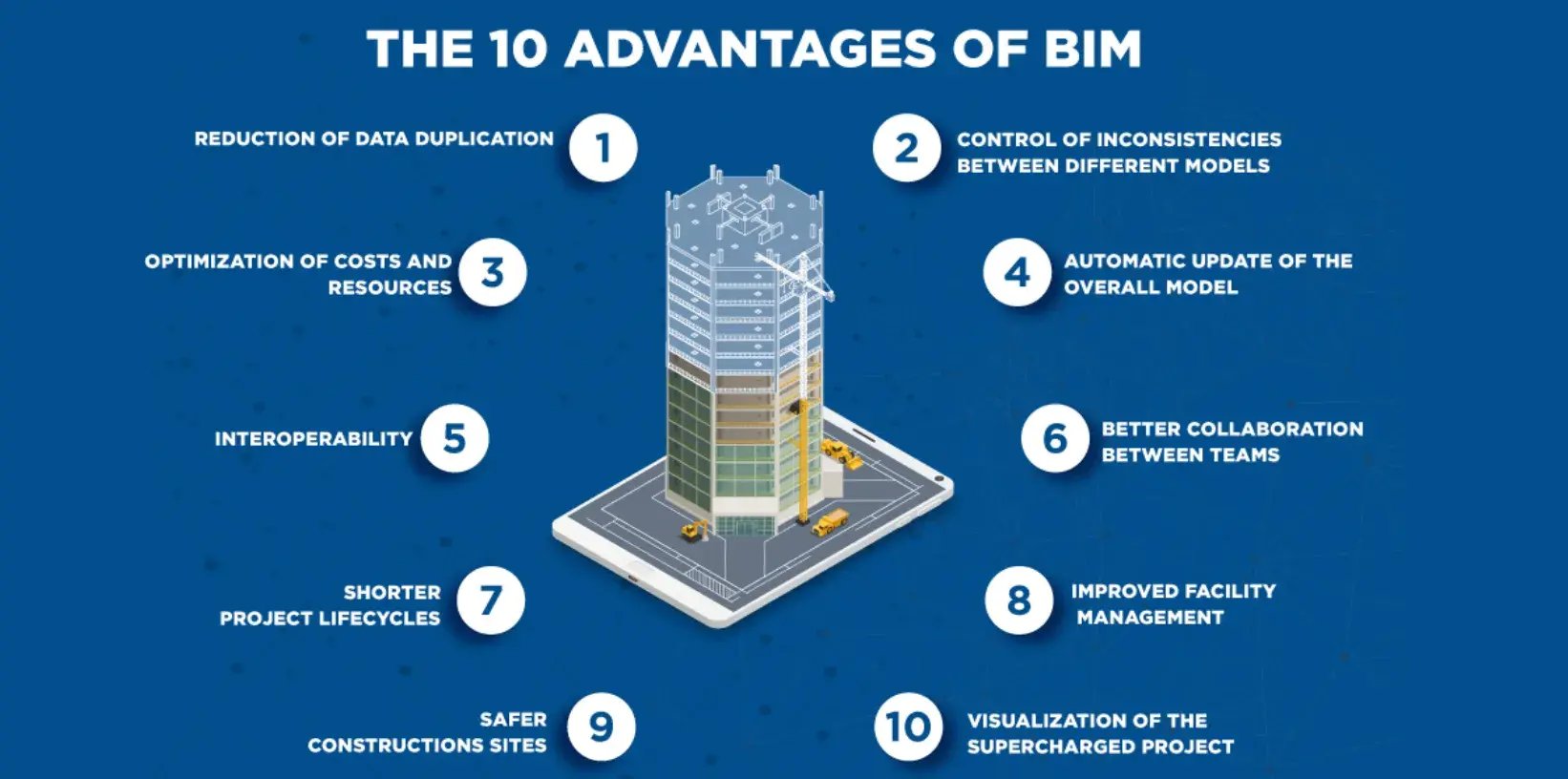**
BIM has simplified digital construction and design by allowing architects and engineers to view every project detail within a unified dashboard. Therefore, leading AEC players are embracing [BIM technology](https://www.novatr.com/blog/most-in-demand-bim-skills-and-how-to-learn-them) as a way to speed up their workflows and deliver high-quality projects.
- **Enhanced Collaboration:** BIM helps architects, engineers, contractors, and consultants to work on a coordinated model through its cloud collaboration system. This eliminates confusion by ensuring that all project stakeholders have access to the same information.
- **Reduced Rework and Costs:** Through clash detection and early design coordination, BIM helps identify potential conflicts before construction begins. This minimises costly on-site modifications and delays.
- **Improved Project Visualisation:** Detailed [3D models](https://www.novatr.com/blog/everything-about-3d-modelling-in-construction) allow teams and clients to better understand the design intent, evaluate different options, and make confident decisions early in the process.
- **Data-Driven Decision Making:** BIM models contain information about materials, quantities, performance, and specifications. Therefore, companies can make more accurate decisions related to budgeting, procurement, and operations.
- **Greater Efficiency and Productivity:** Automated schedules, quantity take-offs, and documentation reduce repetitive tasks. This allows teams to focus on higher-value activities and deliver projects faster.
- **Better Facility Management:** The advantages of [BIM technology](https://www.novatr.com/blog/faqs-on-bim-for-architects) extend beyond construction. The information embedded within BIM models can support maintenance planning, asset tracking, and building operations long after project completion.
- **Competitive Advantage:** As governments and clients increasingly prioritise digital delivery, organisations that embrace BIM are better positioned to win projects, meet evolving industry standards, and remain competitive in the market.
## **Which Technologies are Changing BIM?**
Digitalization is rapidly evolving the AEC landscape. From sketching to computer-aided drafting and now BIM, the industry has come a long way refining its way of work. But, with new-age tools and technologies like Artificial Intelligence (AI), Machine Learning (ML), and 3D printing, BIM is further enhancing its capabilities. Let’s have a closer look at the key BIM trends:
### **1. Artificial Intelligence:**
Integrating AI in BIM workflows helps analyse large datasets, identify design patterns, optimise layouts, and predict potential project risks. It can support tasks such as generative design, clash prioritisation, and performance analysis, enabling teams to make smarter decisions in less time.
### **2. Automation:**
Repetitive tasks such as quantity take-offs, documentation, and data validation can be automated using scripts and tools for BIM automation. As one of the key BIM industry trends, automation improves efficiency, reduces manual errors, and allows professionals to focus on more strategic aspects of a project.
### **3.** [**Scan-to-BIM**](https://www.novatr.com/blog/scan-to-bim-guide)**:**
Technologies such as laser scanning and photogrammetry capture accurate representations of existing buildings and site conditions. This data is then converted into intelligent BIM models, making renovation, retrofit, and heritage conservation projects more precise and efficient.
### **4. Internet of Things (IoT):**
IoT devices embedded within buildings collect data related to occupancy, energy consumption, temperature, equipment performance, and more. When integrated with BIM technology, this information provides insights that support building optimisation throughout its operational lifecycle.
### **5. Digital Twins:**
A digital twin is a dynamic virtual representation of a physical asset that is continuously updated using real-world data. By combining BIM with operational information from sensors, digital twins enable predictive maintenance, performance monitoring, and informed facility management decisions.
### **6. Extended Reality (XR):**
Augmented Reality (AR), Virtual Reality (VR), and Mixed Reality (MR) are enhancing the way stakeholders interact with BIM models. These technologies enable immersive design reviews, on-site visualisation, safety training, and improved communication between project teams and clients.
### **7. Robotics:**
This BIM construction technology is increasingly being used alongside to improve precision, safety, and productivity on construction sites. BIM models can provide the data required to guide [robotic systems](https://www.novatr.com/blog/robotics-in-prefabricated-mep-construction) for tasks such as bricklaying, concrete printing, site layout, welding, and automated inspections.
## **How is BIM Changing Careers?**
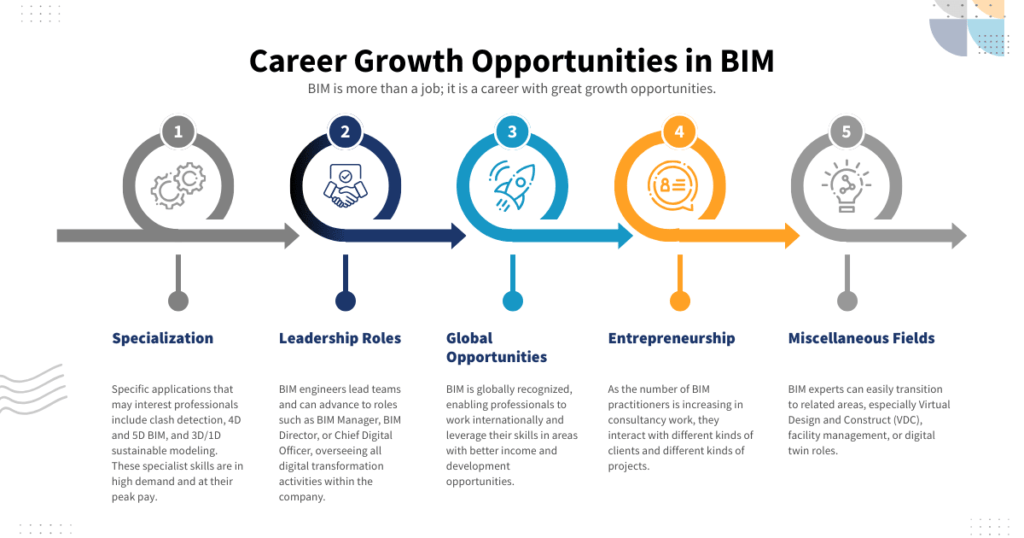
BIM is empowering architects and engineers by levelling up their existing skillset. It is allowing them to think, work, and anlalyse better. Consequently, new roles are emerging in the industry.
Here are the most promising BIM careers:
### **1. BIM Modeller/ Engineer/ Architect:**
This is an entry-level job for BIM professionals. In this role, the scope of work involves creating detailed 3D models using software such as Revit. The pay in this job can vary based on the organization and its location. It typically ranges from USD 60 thousand to 70 thousand annually.
### **2.** [**BIM Coordinator**](https://www.novatr.com/blog/bim-coordination-workflow-explained-stages-tools-and-standards)**:**
In this job, professionals oversee the integration of models developed by different disciplines such as design and engineering. They conduct clash detection, maintain modelling standards, facilitate communication between teams, and ensure that project information remains accurate and coordinated. The average salary in this role is USD 75,000 to USD 90,000 per year.
### **3. BIM Manager:**
They develop and implement BIM strategies within organisations and projects. It is their job to establish workflows, create BIM execution plans, train teams, and manage technology adoption in the firm. Individuals can expect to earn between USD 100,000 to USD 130,000 annually.
### **4. BIM Consultant:**
BIM Consultants advise companies on BIM implementation, process optimisation, standards development, and digital transformation initiatives. They help companies maximise the value of BIM by tailoring strategies to specific project and organisational needs. In this role, people can expect a remuneration of USD 90,000 to USD 1,20,000 per year.
### 5. [**Construction Manager**](https://www.novatr.com/blog/what-does-a-construction-project-manager-do-job-roles-skills-top-software)**:**
These professionals use models to support project planning, sequencing, resource allocation, and coordination during the construction phase. They leverage 4D and 5D BIM workflows to improve efficiency, reduce risks, and monitor project progress. The average pay in this role is USD 95,000 to USD 1,20,000 per year.
### **6. Parametric Designer:**
They use computational design tools such as Dynamo and Grasshopper to create rule-based, data-driven design solutions. Their work involves automating repetitive design tasks, generating multiple design options, and optimising project outcomes through algorithmic thinking. Individuals can earn USD 80,000 to USD 1,05,000 per year in this job.
### **7. Facility Manager:**
Facility Managers use BIM data during the operational phase of a building's lifecycle. They oversee maintenance planning, asset management, space utilisation, and building performance, ensuring that facilities operate efficiently long after construction is complete. The median salary in this job ranges between USD 75,000 to USD 95,000 an year.
Master BIM and Get Hired Faster
Join a community of 8500+ Architects and Engineers.
Explore Now
\*Limited seats available
## **Conclusion**
BIM technology is dawing a new era of work in the AEC industry. Professionals who understand this shift and are agile enough to adapt themselves are better positioned to gain the first-movers advantage. These individuals can bag the opportunity to work on projects on global significance while also securing lucrative salaries.
To be a part of that cohort, we suggest you consider enrolling in the [BIM Professional Program](https://www.novatr.com/courses/bim-professional-program?utm_source=organic_search&utm_medium=blog&utm_campaign=state-of-bim-adoption-trends-market-insights-future-outlook) by [Novatr](https://www.novatr.com/). It is a one-of-a-kind course that teaches learners about BIM fundamentals, software, coordination hacks, and workflows. Through the 7-month program, participants also get to work on capstone projects, learn from case studies, and take from real-world experiences of industry professionals. Moreover, this certification program supports learners with 1:1 mentorship along with mock-interview preparation and placement assistance. This emables students to become job-ready and lay the foundation of their career.
Explore the couse today!
Visit our [Resources Page](https://www.novatr.com/learning-hub) to learn about the latest trends in architecture and engineering.
## **FAQs**
### **1. Is BIM growing in India? **
Yes, BIM adoption is increasing in India. The government along with infrastructure developers and multinational firms are actively embracing the technology to improve their project outcomes.
### **2. Which countries use BIM the most?**
Countries such as the United Kingdom, the United States, Singapore, the Nordic nations, and several Middle Eastern countries are among the global leaders in BIM implementation.
### **3. Why are companies adopting BIM?**
Organizations are adopting BIM to enhance collaboration, reduce errors and rework, improve project efficiency, and make more informed decisions throughout the building lifecycle.
### **4. How is AI changing BIM?**
AI is transforming BIM by automating repetitive tasks, enabling predictive analysis, supporting generative design, and helping teams identify potential issues earlier in the project process.
### **5. What industries use BIM?**
BIM is widely used across architecture, engineering, construction, infrastructure, real estate development, manufacturing, and facility management industries.
### **6. Is BIM creating new career opportunities?**
Yes, the growing demand for BIM expertise is creating diverse career opportunities in modelling, coordination, management, computational design, and digital construction.
### **7. What are the biggest BIM challenges?**
Some of the biggest BIM challenges include high implementation costs, resistance to change, interoperability issues between software platforms, and the need for continuous upskilling.
Was this content helpful to you
Like Yes
Dislike No

TABLE OF CONTENTS
BIM Is The New Standard. Are You Certified?
Get Certified in BIM
SHARE ON YOUR SOCIALS
Link Copied Successfully
Related articles
[ BIM Civil The BIM Revolution: Building India's Iconic Statue of Unity 9 June 2026 6 min read](https://blog.novatr.com/blog/the-bim-revolution-building-indias-iconic-statue-of-unity) [ BIM Civil How BIM is Used in Metro Projects (Nagpur, Chennai, Ahmedabad)? 28 May 2026 6 min read](https://blog.novatr.com/blog/bim-in-mеtro-projеcts-dеsign-bеnеfits-construction-usе) [ BIM Top Industry Applications for BIM: Where is BIM Used in Construction? 22 June 2026 7 min read](https://blog.novatr.com/blog/top-industry-applications-for-bim-where-is-bim-used-in-construction) [ BIM M.Tech vs BIM Certification: Which Offers Better Career Growth? 22 June 2026 3 min read](https://blog.novatr.com/blog/m.tech-vs-bim-certification-civil-career-guide)
Download Syllabus
## BIM Professional Program
Next Cohort
June 2026
Program Duration
7 Months
Premium Program benefits
8 Credentials from Autodesk, NSDC, Novatr
1 program. 10 career paths. Infinite Growth.
40+ ISO 19650 & RIBA real-world projects to practice
1-on-1 guidance. Access 400+ industry experts.
Access the biggest AEC-Tech community on the planet. 8500+ and counting
Curated for you by 100+ global BIM leaders.
Lifelong access to course content
Enter your details to download the program syllabus.
##### BIM Professional Program
June 2026, 7 Months
Your Name Invalid name.
Phone Number Enter a valid phone number
Email Please enter a valid email address.
Select years of experience\* Currently studying 0-1 years 1-2 years 2-4 years 4-8 years 8-10 years 10-12 years 12+ years Invalid selection.
Specialisation Select your background\* Architecture Civil Engineering Mechanical Engineering Electrical Engineering Invalid selection.
Are you professionally trained in interior design?
Yes
No
I agree to the [Terms of Use](https://www.novatr.com/terms-and-conditions) and [Privacy Policy](https://www.novatr.com/privacy-policy), and consent to be contacted by Email, Call, WhatsApp, or SMS.
Submit
Ready to skyrocket your career?
Begin your next chapter in AEC
with Novatr!
We are here to help you take the industry by storm with advanced, tech-first skills.
[Explore Courses](https://www.novatr.com/#courses)
Join our newsletter
Submit
Thank you for signing up.
We’ll send you a nice letter once per week. No spam.

Dare to Disrupt.
Join thousands of people who organise
work and life with Novatr.
Company
- [About Us](https://www.novatr.com/about)
- [BIM Professional Program v.2026](https://www.novatr.com/courses/bim-professional-program)
- [Masters Computational Design](https://www.novatr.com/courses/computational-design)
- [Become a Mentor](https://www.novatr.com/apply-as-mentor)
- [Hiring from Us](https://www.novatr.com/hire-from-us)
- [Careers at Novatr](https://www.novatr.com/career)
Resources
- [Blog](https://www.novatr.com/learning-hub)
- [Media Room](https://www.novatr.com/media-room-home-page)
- [Career Builder](https://www.novatr.com/career-navigator)
- [Events & Webinars](https://www.novatr.com/webinars)
- [FAQs & Support Center](https://www.novatr.com/contact-us)
- [Contact Us](https://www.novatr.com/contact-us)
- [Privacy Policy](https://www.novatr.com/privacy-policy)
- [Terms of Use](https://www.novatr.com/terms-and-conditions)
©2023 Oneistox Network Pvt. Ltd.
All Rights Reserved
```json
{
"@context" : "https://schema.org",
"@type" : "BlogPosting",
"author" : {
"@type" : "Person",
"name" : "Pragya Sharma",
"url" : "https://blog.novatr.com/blog/author/pragya-sharma"
},
"dateModified" : "2026-06-22T11:08:51.471Z",
"datePublished" : "2026-06-22T11:03:15.000Z",
"headline" : "State of BIM in {{year}}: Adoption Trends, Market Insights & Future Outlook",
"image" : [ "https://blog.novatr.com/hubfs/State%20of%20BIM%20in%202026%20Adoption%20Trends%2c%20Market%20Insights%20&%20Future%20Outlook.jpg" ],
"mainEntityOfPage" : {
"@id" : "https://blog.novatr.com/blog/state-of-bim-adoption-trends-market-insights-future-outlook",
"@type" : "WebPage"
},
"publisher" : {
"@type" : "Organization",
"logo" : {
"@type" : "ImageObject",
"url" : "https://blog.novatr.com/hubfs/Novatr%20Prev%20OX-2.svg"
}
}
}
```