



Role of BIM in India's New Parliament House
The construction of the new Parliament House is one of the most significant Infrastructure Projects of India. It is a part of the Central Vista redevelopment, embodying contemporary construction with cultural design.
Often asked is the new parliament building built by which company? It was executed by the Tata Projects with design led by the architect of new parliament, Bimal Patel. There are also some symbolic items such as the ashok stambh new parliament which needed careful detailing and placement.
BIM was a major contributor to the management of this complexity. BIM developed a digital shared space for all project data to be accessed and updated in real-time, rather than separate teams working on their own.
In this project, BIM has played a few important roles such as:
- Developing a 3D shared model for the whole building
- Control of design data in the architectural, structural, and MEP teams
- Preliminary clash checking during design
- There is a need to improve communication with stakeholders
- Supporting the tracking of change in the new parliament design
How BIM Helped in Design and Coordination?
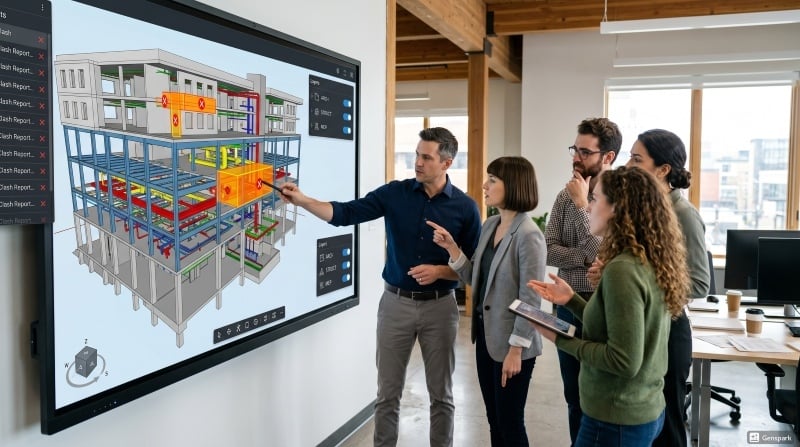
The design of the new Parliament House isn't easy to create because it contains three architectural components. The building design includes a triangular shape, which combines with complex interior spaces and various symbolic elements that require precise execution throughout the entire project. Here, BIM enabled teams to deal with this complexity in an organized manner.
BIM was used in the design and coordination in the following ways:
- Integrated Design Models: The same design model had to be used by the teams. This enabled the architectural, structural and service designs to play into each other.
- Clash Detection: Using BIM systems to detect clashes between systems before construction begins. This reduced the work of re-entering the site.
- Clear Visualization: The 3D model helped stakeholders to have a clearer visualization of the final output. This was useful to them in their decision-making process.
- Data-Driven Updates: All designs and models updated in real time.
- Improved collaboration: The team will be able to maintain a clear view of the work they have done. Improvements in workflow.
This type of coordination is essential for big infrastructure projects. This is where BIM for infrastructure is gaining traction in projects and programs from both the government and the private sector.
Benefits of Using BIM in India's New Parliament House
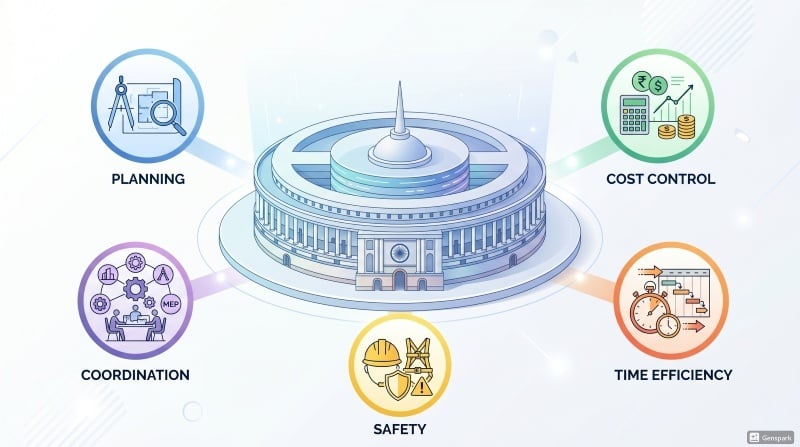
There were many practical benefits in this project to implement BIM. The benefits of these were discernible in the planning, execution, and coordination.
|
Benefit |
Explanation |
|
Better Planning |
Teams might create digital models to be used in advance to plan construction stages. |
|
Improved Accuracy |
Fewer design problems and rework. |
|
Faster Coordination |
The different teams were assigned to the same platform. |
|
Cost Control |
Supported the tracking of materials and minimized waste. |
|
Time Efficiency |
Better scheduling and decision-making. |
|
Enhanced Visualization |
Stakeholders were able to view the final design prior to construction. |
|
Risk Reduction |
The early identification of design conflicts led to better safety. |
The advantages demonstrate the significance of the use of BIM in new Parliament House building, and how it is expected to become a standard practice in the future.
BIM Challenges in India's New Parliament House
There were significant challenges to be faced too, although BIM had a great deal of advantages to offer, particularly at this scale and the importance of the work.
The following were some of the major issues that arose:
- Handling Large Data Sets
The project required the handling of complex models with large amounts of data, demanding high system performance. - Coordination Between Multiple Teams
There was a need for careful coordination between multiple teams, even when using BIM. - Skill Gap
Some of the professionals were not equally skilled in the use of BIM skills, causing delays in some processes. - Software Integration Issues
The problem existed because multiple software systems needed to establish communication links between them. - Tight Timelines
The project faced implementation challenges because it operated under strict time constraints, which complicated the seamless execution of BIM processes. - Change Management
Frequent design changes require frequent changes to the BIM model.
How to Learn BIM?

To become proficient in BIM, it is essential to understand the project workflow, coordination, and modeling. The professionals need to become skilled with various tools and plugins within actual construction projects and industry standards.
Take your civil engineering career to the next level with Novatr’s BIM Professional Course for Civil Engineers, a project-based program that prepares you to plan, design, and manage construction projects using 12+ industry software and essential BIM plugins.
Learn how to work with Autodesk Revit, Navisworks, Construction Cloud, and key plugins like DiRoots.One, pyRevit, EF-Tools, ProSheets, Issue and Model Checker for Revit to improve automation, accuracy, and project efficiency.
Here’s what you’ll gain:
- End-to-end understanding of BIM workflows — modeling, estimation, coordination, sequencing, and documentation.
- Hands-on training aligned with ISO 19650 standards and real residential + commercial projects.
- Globally recognized certifications:
- Novatr Course Certificate
- Autodesk User Certification
- NSDC Skill Certificate
- Novatr Specialization Certificate, if opted
After completing the core modules, learners can also choose 2 additional specializations, including:
- Visual Programming with Dynamo – for automation and parametric workflows
- 4D, 5D & 6D with BIM – for time, cost, and facility integration
- Tekla for RCC Modeling – for detailed steel and concrete modeling
- Civil 3D for Infrastructure – for roadways, railways, and utilities
- Project Strategy & Optimization with Plannerly - Plan, structure, and audit BIM execution plans.
The checklist provides a structured way to develop effective BIM skills and to use BIM in practical projects.