---
title: How AEC Firms Structure High-Performing BIM Teams? 2026
description: Learn how leading AEC firms structure high-performing BIM teams, define roles and manage workflows for better coordination and project delivery.
image: https://blog.novatr.com/hubfs/BIM%20Teams%20in%20AEC%20Firms.webp
---
[Blogs](https://www.novatr.com/learning-hub)
- [Architecture & Construction](https://www.novatr.com/learning-hub?category=Architecture+%26+Construction)
- [BIM](https://www.novatr.com/learning-hub?category=BIM)
- [Computational Design](https://www.novatr.com/learning-hub?category=Computational+Design)
- [Company News](https://www.novatr.com/learning-hub?category=Company+News)
- [Expert Talks](https://www.novatr.com/learning-hub?category=Expert+Talks)
Explore Courses
[Just Launched  BIM Professional Program v.2026 Take your career to the next level by mastering the real-world application of BIM. Know More](https://www.novatr.com/courses/bim-professional-program)
[ Master Computational Design Course Break into an advanced career by learning to apply the power of computation to the art of design. Know More](https://www.novatr.com/courses/computational-design)
[Blogs](https://www.novatr.com/learning-hub)
Explore Blogs
- [Architecture & Construction](https://www.novatr.com/learning-hub?category=Architecture+%26+Construction)
- [BIM](https://www.novatr.com/learning-hub?category=BIM)
- [Computational Design](https://www.novatr.com/learning-hub?category=Computational+Design)
- [Company News](https://www.novatr.com/learning-hub?category=Company+News)
- [Expert Talks](https://www.novatr.com/learning-hub?category=Expert+Talks)
Courses
- [BIM Professional Program v.2026](https://www.novatr.com/courses/bim-professional-program)
- [Master Computational Design](https://www.novatr.com/courses/computational-design)
- [BIM/](https://www.novatr.com/learning-hub?category=BIM)
Featured Article
# How Do Leading AEC Firms Structure High-Performing BIM Teams?

Bandana Singh
August 26, 2026
10 min read
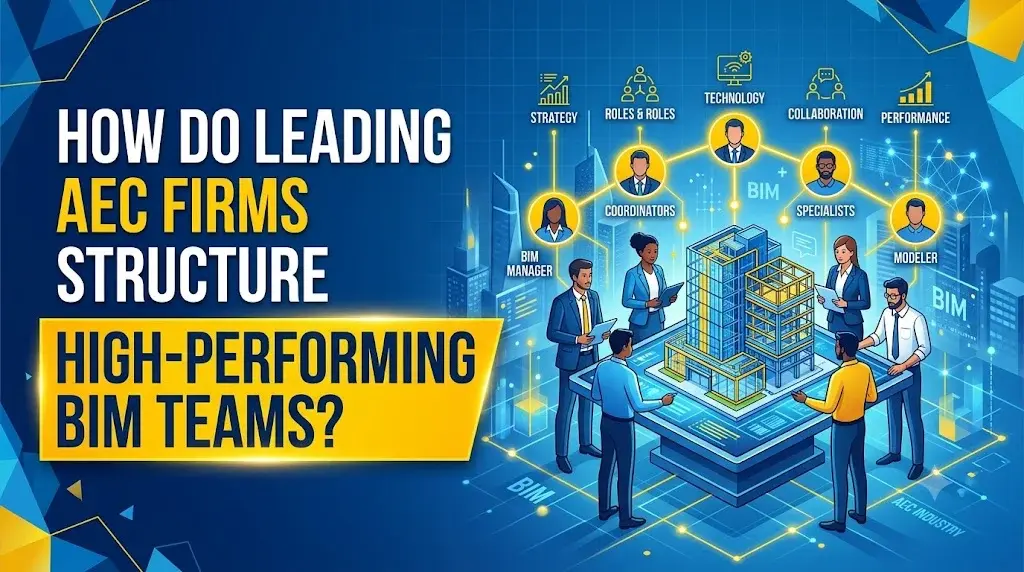

A successful BIM project depends on more than having skilled people or advanced software. It requires a clear structure in which modelling, coordination, information management and project decisions connect at the right time. This becomes increasingly important as AEC projects involve more disciplines, consultants and digital platforms.
[Autodesk’s construction research](https://www.autodesk.com/blogs/construction/construction-without-interruption/) found that a typical construction project involves an average of 42 external collaborators from design through handover, making organised information sharing essential.
This guide explains how high-performing teams divide responsibilities, manage information, coordinate disciplines and measure results without creating unnecessary layers of approval.
## **Key Takeaways**
- A clear BIM team structure connects technical modelling with project-level decision-making.
- Each role in BIM jobs has defined responsibilities, deliverables and communication channels.
- CDE, BEP and ISO 19650-based workflows help teams manage information consistently.
- Performance should be measured through model quality, issue resolution, coordination and delivery outcomes.
- Continuous improvement, automation and stronger [BIM skills](https://www.novatr.com/blog/top-bim-skills-for-career-growth) can help teams take on increasingly complex projects.
Master BIM Before You Fall Behind
Join 8500+ AEC professionals building BIM careers.
Explore the Program
## **Why Does BIM Team Structure Matter for Project Success?**
[Building Information Modeling](https://www.novatr.com/blog/complete-bim-guide-for-aec-professionals) works best when teams understand not only what they need to produce, but when, why and for whom. On complex projects, architects, engineers, contractors, subcontractors, clients and project managers all contribute information. Without a clear structure, teams may follow different standards, duplicate work or miss coordination issues.
A well-defined BIM workflow creates accountability across roles. Modellers focus on accurate production, coordinators bring disciplines together, while management teams align digital processes with project objectives.
As BIM expands into digital engineering, information management, and digital construction, structured processes become increasingly important. A CDEprovides a controlled environment for sharing information, while ISO 19650-aligned workflows help teams manage requirements, approvals and information status. The result is a more coordinated, predictable and efficient way of delivering projects.
## **What Does a High-Performing BIM Team Look Like?**
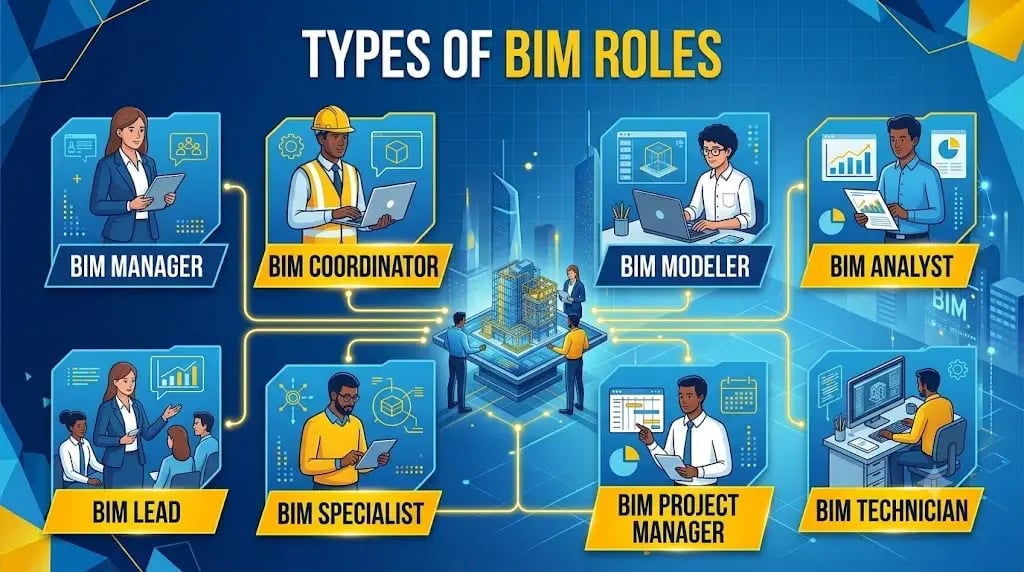
There is no universal structure that works for every project. A small commercial development may need only a few specialist roles, while a major infrastructure or healthcare project may require several layers of technical and information leadership. A typical structure can include:
- ### [**BIM Modellers**](https://www.novatr.com/blog/bim-modeler-career-guide)
Responsible for creating and updating discipline-specific models according to project standards. BIM Modellers’ work includes accurate geometry, parameters, families, documentation and model information. Their output becomes the foundation for coordination, documentation and downstream project activities. Strong modelling therefore requires more than software knowledge. It requires an understanding of construction technology methods, discipline requirements and design intent.
- ### **BIM Coordinators**
Coordinators connect different discipline models and identify problems before they affect construction. They manage model federation, clash detection, coordination reviews and issue resolution.They also communicate with discipline teams when a problem requires design changes. Their role sits between technical production and wider project collaboration, making communication as important as modelling expertise.
- ### **BIM Managers**
The [BIM Manager](https://www.novatr.com/blog/guide-to-become-bim-manager) oversees the overall implementation strategy. Responsibilities can include defining standards, establishing workflows, supporting the BEP, monitoring model quality and ensuring teams follow agreed processes. Rather than resolving every technical issue personally, an effective manager creates a system in which the right people can resolve issues efficiently.
- ### **Information Managers**
Their responsibility includes focusing on the quality, organisation and controlled exchange of project information. This includes information requirements, naming conventions, approval processes, status codes and information exchanges. Information Managers become especially important on projects following structured information management practices aligned with ISO 19650.
- ### **Digital Delivery Managers**
Digital Delivery Managers take a broader view of how technology supports integrated project delivery. They may oversee digital standards, platforms, automation, data workflows and integration between project teams. Their focus is often less about individual models and more about improving how digital information moves through the project lifecycle.
- ### **Discipline Leads**
Architectural, structural, MEP, civil and other discipline leads remain essential. They bring professional knowledge that technology cannot replace. They review model outputs, make technical decisions and ensure that digital information reflects sound design and engineering judgement.
- ### **Project Stakeholders**
Clients, [project managers](https://www.novatr.com/blog/what-does-a-construction-project-manager-do-job-roles-skills-top-software), contractors, consultants and specialist subcontractors also influence the BIM process. Their requirements determine what information is needed and when it must be delivered. A high-performing structure therefore does not isolate BIM professionals from the wider project team. It connects them.
## **How Do Leading AEC Firms Structure Roles, Collaboration, and BIM Workflows?**
A well-structured BIM workflow clearly defines who is responsible for each stage, from setting project requirements to model production, coordination and information delivery. This helps teams collaborate efficiently and keeps project information organised and accountable.
| **BIM Workflow Stage** | **Role / Process** | **Responsibilities & Key Details** | **Typical Deliverables / Outcomes** |
| --- | --- | --- | --- |
| Stage 1: Define Project Requirements | Project Stakeholders | Establish project goals, information requirements, design expectations and construction inputs. | Briefs, approvals, feedback and project requirements |
| Stage 2: Set Up BIM Strategy | BIM Manager | Establish the project-wide BIM implementation strategy, standards, responsibilities and performance requirements. | BEP, [BIM standards](https://www.novatr.com/blog/bim-standards-and-best-practices-for-architect), audits and performance reviews |
| Stage 3: Establish Information Management | Information Manager | Define how project information will be created, reviewed, shared, approved and updated within the CDE. | CDE workflows, information exchanges and approvals |
| Stage 4: Develop Discipline Models | BIM Modeller + Discipline Lead | Produce and technically review discipline-specific models while maintaining modelling standards and design intent. | Models, families, drawings, schedules and discipline checks |
| Stage 5: Coordinate Disciplines | BIM Coordinator | Combine discipline models, identify conflicts and coordinate design information across teams. | Federated models, clash reports and issue logs |
| Stage 6: Track & Resolve Issues | BIM Coordinator + Discipline Teams | Assign issues, establish priorities and track each problem through to resolution. | Issue assignments, responses, updated models and resolution records |
| Stage 7: Review & Approve Information | BIM Manager + Discipline Leads | Review model quality beyond clashes, including completeness, naming, coordinates, information requirements, constructability and compliance. | Model reviews, approvals and quality checks |
| Stage 8: Support Digital Delivery | Digital Delivery Manager | Improve project delivery through automation, platforms, dashboards and digital standards. | Automated workflows, dashboards and digital delivery improvements |
| Stage 9: Integrate with Project Delivery | All Project Teams | Connect BIM coordination with design, construction and decision-making processes to improve collaboration and accountability. | Predictable workflows, clearer ownership and better construction management |
## **How Can High-Performing BIM Teams Measure and Improve Project Outcomes?**
****
A team cannot improve what it never measures. However, measuring performance does not mean creating dozens of complicated metrics. The most useful measures connect digital activity with project outcomes.
- **Model Quality:** Track issues such as missing information, incorrect modelling, naming inconsistencies and failed quality checks. Fewer recurring errors indicate that the team's standards and review processes are working.
- **Clash Reduction:** The number of clashes matters, but the trend matters more. A high number of clashes during an early design review may be expected. What matters is whether significant issues are reducing as the project develops.
- **Coordination Efficiency:** Teams can monitor how quickly issues are identified, assigned and closed. Repeated delays may indicate unclear ownership, poor communication or inefficient review processes.
- **Stakeholder Collaboration:** Good digital delivery should make it easier for consultants, contractors and clients to access and understand relevant information. Feedback from project stakeholders can reveal where the workflow is helping and where additional support is needed.
- **Project Delivery:** Ultimately, digital processes should contribute to tangible project outcomes such as fewer errors, reduced rework, better schedule control and more predictable delivery.
- **Technical Expertise and Automation:** High-performing teams continually assess whether repetitive work can be automated. Tools such as Dynamo, APIs, scripts and data dashboards can reduce manual effort and allow professionals to focus on coordination and decision-making.
- **Quality Assurance and Continuous Improvement:** After each major project stage, teams can review what worked, what caused delays and which issues appeared repeatedly. These findings can then inform templates, standards, training and future workflows.
This is where developing stronger BIM skills becomes valuable for professionals as well as organisations. Learning should not stop at software commands. Professionals increasingly need to understand coordination, information management, digital delivery and how technology connects with real project requirements.
For professionals looking to build these capabilities systematically, as Novatr's BIM Professional Program can provide a pathway from technical skills towards BIM consulting and more [advanced project](https://www.novatr.com/blog/example-of-bim-projects-globally) and coordination responsibilities. The objective should be to build skills that can be applied to real project workflows, not simply add another software certificate to a CV.
BIM is Advancing. Are You?
Get BIM certified and open doors to a better career.
Join the Program
## **Conclusion**
A high-performing digital project needs more than well-managed models; it needs professionals who can coordinate people, information and technology effectively. As BIM workflows become more integrated across the AEC industry, building these capabilities can help professionals move towards greater technical and project responsibilities.
For those looking to develop these skills, [BIM Professional Program](https://www.novatr.com/courses/bim-professional-program?utm_source=organic_search&utm_medium=blog&utm_campaign=) by [Novatr](https://www.novatr.com/) is curated to offer practical, industry-focused learning designed around real project workflows and professional growth. It can be a useful step for professionals aiming to strengthen their BIM expertise and progress into advanced BIM careers roles.
For additional industry insights and learning resources, join us on our [WhatsApp channel](https://whatsapp.com/channel/0029Vb7Gy2LBFLgMx79j7B1b) or visit our [Resources Page](https://www.novatr.com/learning-hub) to learn about the latest trends in architecture and engineering.
## **FAQs**
### **1. How are BIM teams structured in leading AEC firms?**
Leading AEC firms usually structure BIM teams around clear responsibilities across modelling, coordination, information management and digital delivery. BIM Managers oversee standards and implementation, while Coordinators, Modellers, Information Managers and discipline leads handle technical delivery and collaboration.
### **2. What does a typical BIM team structure look like?**
A typical structure includes BIM Managers, BIM Coordinators, BIM Modellers, Information Managers, discipline leads and project stakeholders. The exact setup varies by project size, but roles are connected through defined workflows, CDE processes, coordination reviews and the BIM Execution Plan.
### **3. Who are the key members of a BIM team?**
Key members include BIM Modellers for model production, BIM Coordinators for multidisciplinary coordination, BIM Managers for project-wide BIM management, and Information Managers for information workflows. Discipline leads and project stakeholders provide technical direction, requirements and approvals.
Was this content helpful to you
Like Yes
Dislike No

TABLE OF CONTENTS
BIM Is The New Standard. Are You Certified?
Get Certified in BIM
SHARE ON YOUR SOCIALS
Link Copied Successfully
Related articles
[ BIM Cohort-Based Learning vs Self-Paced Learning for Career Advancement 17 August 2026 11 min read](https://blog.novatr.com/blog/cohort-based-vs-self-paced-learning-for-bim) [ BIM Why Project-Based Learning Produces Better Career Outcomes in AEC Education? 19 August 2026 8 min read](https://blog.novatr.com/blog/project-based-learning-for-better-career-outcomes) [ BIM Civil How BIM is Used in India’s New Parliament House? 9 June 2026 7 min read](https://blog.novatr.com/blog/how-bim-is-used-in-india-new-parliament-house) [ BIM Civil How Construction Sequencing Works in BIM: A Practical Guide 30 April 2026 6 min read](https://blog.novatr.com/blog/how-construction-sequencing-works-in-bim-a-practical-guide)
Download Syllabus
## BIM Professional Program
Next Cohort
June 2026
Program Duration
7 Months
Premium Program benefits
8 Credentials from Autodesk, NSDC, Novatr
1 program. 10 career paths. Infinite Growth.
40+ ISO 19650 & RIBA real-world projects to practice
1-on-1 guidance. Access 400+ industry experts.
Access the biggest AEC-Tech community on the planet. 8500+ and counting
Curated for you by 100+ global BIM leaders.
Lifelong access to course content
Enter your details to download the program syllabus.
##### BIM Professional Program
June 2026, 7 Months
Your Name Invalid name.
Phone Number Enter a valid phone number
Email Please enter a valid email address.
Select years of experience\* Currently studying 0-1 years 1-2 years 2-4 years 4-8 years 8-10 years 10-12 years 12+ years Invalid selection.
Specialisation Select your background\* Architecture Civil Engineering Mechanical Engineering Electrical Engineering Invalid selection.
Are you professionally trained in interior design?
Yes
No
I agree to the [Terms of Use](https://www.novatr.com/terms-and-conditions) and [Privacy Policy](https://www.novatr.com/privacy-policy), and consent to be contacted by Email, Call, WhatsApp, or SMS.
Submit
Ready to skyrocket your career?
Begin your next chapter in AEC
with Novatr!
We are here to help you take the industry by storm with advanced, tech-first skills.
[Explore Courses](https://www.novatr.com/#courses)
Join our newsletter
Submit
Thank you for signing up.
We’ll send you a nice letter once per week. No spam.

Dare to Disrupt.
Join thousands of people who organise
work and life with Novatr.
Company
- [About Us](https://www.novatr.com/about)
- [BIM Professional Program v.2026](https://www.novatr.com/courses/bim-professional-program)
- [Masters Computational Design](https://www.novatr.com/courses/computational-design)
- [Become a Mentor](https://www.novatr.com/apply-as-mentor)
- [Hiring from Us](https://www.novatr.com/hire-from-us)
- [Careers at Novatr](https://www.novatr.com/career)
Resources
- [Blog](https://www.novatr.com/learning-hub)
- [Media Room](https://www.novatr.com/media-room-home-page)
- [Career Builder](https://www.novatr.com/career-navigator)
- [Events & Webinars](https://www.novatr.com/webinars)
- [FAQs & Support Center](https://www.novatr.com/contact-us)
- [Contact Us](https://www.novatr.com/contact-us)
- [Privacy Policy](https://www.novatr.com/privacy-policy)
- [Terms of Use](https://www.novatr.com/terms-and-conditions)
©2023 Oneistox Network Pvt. Ltd.
All Rights Reserved
```json
{
"@context" : "https://schema.org",
"@type" : "BlogPosting",
"author" : {
"@type" : "Person",
"name" : "Bandana Singh",
"url" : "https://blog.novatr.com/blog/author/bandana-singh"
},
"dateModified" : "2026-08-26T05:28:41.152Z",
"datePublished" : "2026-08-26T05:11:36.000Z",
"headline" : "How AEC Firms Structure High-Performing BIM Teams? {{year}}",
"image" : [ "https://blog.novatr.com/hubfs/BIM%20Teams%20in%20AEC%20Firms.webp" ],
"mainEntityOfPage" : {
"@id" : "https://blog.novatr.com/blog/how-aec-firms-structure-high-performing-bim-teams",
"@type" : "WebPage"
},
"publisher" : {
"@type" : "Organization",
"logo" : {
"@type" : "ImageObject",
"url" : "https://blog.novatr.com/hubfs/Novatr%20Prev%20OX-2.svg"
}
}
}
```