---
title: Emerging BIM Roles in Digital Construction in 2026
description: Discover the BIM roles emerging with digital construction, from BIM engineers and coordinators to managers and digital construction specialists.
image: https://blog.novatr.com/hubfs/BIM%20roles%20in%20digital%20construction.webp
---
[Blogs](https://www.novatr.com/learning-hub)
- [Architecture & Construction](https://www.novatr.com/learning-hub?category=Architecture+%26+Construction)
- [BIM](https://www.novatr.com/learning-hub?category=BIM)
- [Computational Design](https://www.novatr.com/learning-hub?category=Computational+Design)
- [Company News](https://www.novatr.com/learning-hub?category=Company+News)
- [Expert Talks](https://www.novatr.com/learning-hub?category=Expert+Talks)
Explore Courses
[Just Launched  BIM Professional Program v.2026 Take your career to the next level by mastering the real-world application of BIM. Know More](https://www.novatr.com/courses/bim-professional-program)
[ Master Computational Design Course Break into an advanced career by learning to apply the power of computation to the art of design. Know More](https://www.novatr.com/courses/computational-design)
[Blogs](https://www.novatr.com/learning-hub)
Explore Blogs
- [Architecture & Construction](https://www.novatr.com/learning-hub?category=Architecture+%26+Construction)
- [BIM](https://www.novatr.com/learning-hub?category=BIM)
- [Computational Design](https://www.novatr.com/learning-hub?category=Computational+Design)
- [Company News](https://www.novatr.com/learning-hub?category=Company+News)
- [Expert Talks](https://www.novatr.com/learning-hub?category=Expert+Talks)
Courses
- [BIM Professional Program v.2026](https://www.novatr.com/courses/bim-professional-program)
- [Master Computational Design](https://www.novatr.com/courses/computational-design)
- [BIM/](https://www.novatr.com/learning-hub?category=BIM)
Featured Article
# Which BIM Roles are Emerging as Digital Construction Expands?

Bandana Singh
August 26, 2026
8 min read
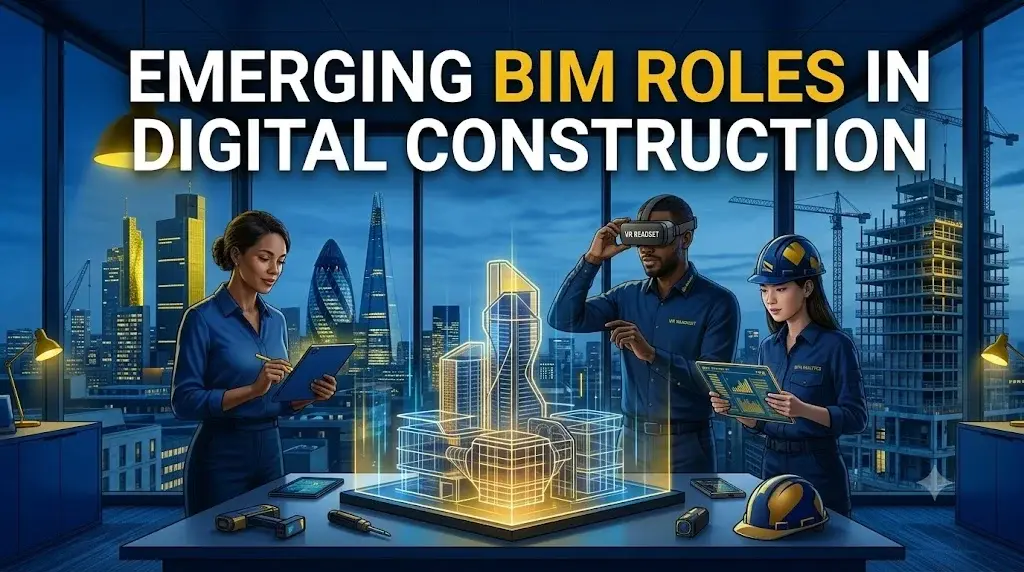

Digital construction is changing what AEC teams expect from BIM professionals. The focus is moving beyond modelling towards coordination, information management, automation and data-led project delivery. [Deloitte](https://www.deloitte.com/us/en/insights/industry/engineering-and-construction/ec-workforce-development-strategy.html) reports that 91% of construction industry respondents believe employees increasingly need digital skills to succeed in their firms. This shift is also influencing how companies build teams and define responsibilities across projects.
As BIM becomes more connected with other digital tools, professionals need to understand how information moves from design through construction and into operations. For those planning their BIM careers, this means looking beyond software proficiency and developing skills that support real project workflows.
With the right combination of AEC experience and digital capabilities, BIM professionals can prepare themselves for the changing opportunities within the construction industry.
## **Key Takeaways**
- [Building Information Modeling](https://www.novatr.com/blog/what-is-building-information-modeling-bim) is evolving beyond 3D modelling into coordination, data management and digital project delivery.
- New BIM jobs are emerging as digital construction becomes more connected and technology-driven.
- Growing demand spans infrastructure, healthcare, transportation, commercial buildings and smart cities.
- Professionals can strengthen their careers by developing practical BIM skills alongside their existing AEC experience.
- BIM professionals who understand digital workflows, automation and information management can prepare for the industry’s changing needs.
Master BIM Before You Fall Behind
Join 8500+ AEC professionals building BIM careers.
Explore the Program
## **How is the Role of BIM Evolving Beyond 3D Modelling?**
BIM started with the idea of creating detailed digital models, but its role has grown considerably. Today, the value of BIM lies in how teams use information to coordinate work, improve decisions and manage assets throughout their lifecycle. This shift is changing BIM from a modelling function into a broader digital project capability.
- ### **From Modelling to Coordination**
A BIM model is only useful when different teams can work with it effectively. BIM professionals now spend more time coordinating architectural, structural and MEP information, identifying clashes and helping teams resolve design issues before they reach the site. This makes coordination a key part of modern BIM work, particularly on large and complex projects.
- ### **Managing Information, Not Just Models**
Modern projects generate large amounts of information, from design data and specifications to quantities, schedules and asset details. Professionals need to understand how this information is created, organised, checked and shared. This is where information management becomes increasingly important. A well-managed model should provide reliable information that project teams can actually use.
- ### **Growing Role in Infrastructure Projects**
The change is particularly visible in major infrastructure projects, where information needs to move between multiple disciplines, contractors, locations and project stages. Roads, railways, airports and utilities can involve thousands of interconnected assets. BIM helps teams maintain consistency while supporting better coordination and information exchange throughout delivery.
- ### **Connecting Design and Construction**
BIM is increasingly being used to connect what happens during design with what happens on site. Model information can support construction sequencing, quantity planning, procurement and site coordination. This allows project teams to identify potential problems earlier and make decisions using a shared view of the project.
- ### **Moving Towards Lifecycle Management**
The [role of BIM](https://www.novatr.com/blog/bim-in-india) does not necessarily end when construction is complete. Asset information can support facilities teams with maintenance, inspections, upgrades and operational planning. This broader lifecycle approach means BIM professionals need to understand how information created during design and construction can remain useful after handover.
- ### **Building Digital Engineering Skills**
As BIM expands, professionals need a wider mix of technical and project skills. Understanding modelling remains important, but so are coordination, data management, communication, automation and digital workflows. Developing these capabilities can help professionals move from producing models to taking greater responsibility for project information and delivery.
The future of construction is likely to involve increasingly connected digital systems, making BIM knowledge relevant well beyond traditional modelling. Professionals who can combine AEC experience with strong digital engineering and information management skills will be better placed to adapt as BIM continues to evolve.

## **Which New BIM Roles and Skills are Emerging Across the AEC Industry?**
As BIM becomes more connected to project delivery, its career paths are widening too. [BIM companies](https://www.novatr.com/blog/top-bim-companies-hiring-in-india) are looking for professionals who can coordinate information, manage digital workflows and use technology to solve practical project problems. The table below shows how key BIM roles are evolving and where their skills are most useful.
| **Role** | **Primary Responsibilities** | **Key Skills** | **Typical Employers** |
| --- | --- | --- | --- |
| **BIM Engineer** | Develops and manages technical models while supporting design coordination and project delivery. | Revit, multidisciplinary coordination, clash detection, automation, data management and engineering knowledge. | Engineering consultancies, contractors, infrastructure firms and design practices. |
| **BIM Architect** | Develops coordinated architectural models and supports design development, documentation and collaboration. | [Revit](https://www.novatr.com/blog/revit-modeling-for-aec-professionals), architectural modelling, design coordination, interoperability and understanding of project standards. | Architecture practices, multidisciplinary consultancies and property developers. |
| **BIM Coordinator** | Coordinates models across disciplines, manages clashes and helps teams follow agreed BIM processes. | BIM coordination, [Navisworks](https://www.novatr.com/blog/navisworks-type), CDE workflows, model checking, communication and ISO 19650principles. | Contractors, consultants, architecture and engineering firms. |
| [**BIM Consultant**](https://www.novatr.com/blog/how-to-become-bim-consultant) | Helps organisations improve BIM implementation, workflows and information management practices. | BIM strategy, BEP development, ISO 19650, process improvement, training and interoperability. | BIM consultancies, technology providers and large AEC organisations. |
| **BIM Manager** | Oversees BIM standards, project workflows, teams and information delivery across projects. | Leadership, ISO 19650, BEP, CDE management, data governance, coordination and project management. | Contractors, developers, infrastructure organisations and major consultancies. |
| **Digital Construction Specialist** | Connects BIM with emerging technologies to improve project planning, delivery and asset management. | ACC, automation, Digital Twins, reality capture, cloud collaboration, data management and software integration. | Technology-led contractors, digital construction teams, infrastructure firms and developers. |
## **Which Industries are Driving Demand for Emerging BIM Professionals?**
BIM is no longer limited to building design. Its growing use across different sectors is creating opportunities for professionals who can combine AEC knowledge with digital project delivery skills.
- **Infrastructure:** Large infrastructure programmes need BIM professionals to coordinate complex information across design, engineering and construction teams.
- **Commercial Buildings:** Developers and consultants use BIM to improve coordination, documentation and project delivery, supporting new architecture careers.
- **Healthcare:** Hospitals require detailed coordination of architecture, structure and building services, increasing the need for specialised BIM expertise.
- **Manufacturing:** BIM supports the planning of facilities, equipment layouts and building services, creating opportunities for professionals with technical skills.
- **Industrial Facilities:** Complex industrial projects rely on coordinated digital information, opening pathways for BIM specialists and engineering careers.
- **Transportation:** Airports, railways, metros and highways require multidisciplinary coordination, increasing demand for BIM expertise.
- **Smart Cities:** Connected infrastructure is creating demand for professionals who can manage digital information across buildings, utilities and urban systems.

## **How Can Existing AEC Professionals Transition Into Emerging BIM Roles?**
Moving into BIM does not mean starting your career again. Existing experience can become more valuable when paired with the right digital capabilities and an understanding of how BIM is changing project delivery.
- **Architects:** Add digital workflows and information management to existing design knowledge to strengthen their position within the AEC industry.
- **Civil and Structural Engineers:** Combine engineering experience with BIM coordination, modelling and data-based project workflows.
- **MEP Engineers:** Build stronger digital capabilities around coordinated services, model-based working and information exchange.
- **Construction Professionals:** Connect construction management experience with digital planning, coordination and information workflows.
- **Build BIM Skills:** Focus on practical construction tools, industry standards and [real project applications](https://www.novatr.com/blog/how-real-construction-projects-are-using-bim-with-ai-and-ar) rather than learning software in isolation.
A structured and reputed course from a relevant place can make this transition more focused. Novatr’s BIM Professional Program provides project-based learning that helps professionals build relevant BIM skills while continuing to build on their existing AEC experience.
BIM is Advancing. Are You?
Get BIM certified and open doors to a better career.
Join the Program
## **Conclusion**
The growth of digital construction is opening up new paths for professionals who want to build a career in BIM. As project workflows become more connected, having practical skills and a clear understanding of how BIM is used can help professionals stay relevant and take on greater responsibilities.
For aspiring BIM professionals, choosing the right learning programme can make that transition easier. [Novatr’s](https://www.novatr.com/) 7-month [BIM Professional Program](https://www.novatr.com/courses/bim-professional-program?utm_source=organic_search&utm_medium=blog&utm_campaign=) combines industry-focused learning, hands-on projects and practical exposure to help learners build skills that match real AEC workflows. It is designed for those who want to move beyond basic software training and develop a stronger foundation for long-term BIM jobs.
For additional industry insights and learning resources, join us on our [WhatsApp channel](https://whatsapp.com/channel/0029Vb7Gy2LBFLgMx79j7B1b) or visit our [Resources Page](https://www.novatr.com/learning-hub) to learn about the latest trends in architecture and engineering.
## **FAQs**
### **1. How is digital construction creating new BIM jobs?**
Digital workflows are increasing demand for professionals who can manage BIM models, project data, coordination and technology across the construction lifecycle.
### **2. Which BIM roles are most in demand today?**
BIM Engineer, BIM Coordinator, BIM Manager, BIM Architect, BIM Consultant and Digital Construction Specialist are among the key roles gaining demand.
### **3. What does a BIM coordinator do?**
A BIM Coordinator manages multidisciplinary models, checks for clashes, coordinates design information and helps project teams resolve issues before construction.
Was this content helpful to you
Like Yes
Dislike No

TABLE OF CONTENTS
BIM Is The New Standard. Are You Certified?
Get Certified in BIM
SHARE ON YOUR SOCIALS
Link Copied Successfully
Related articles
[ CIVIL 10 Best Online Courses To Upskill as a Construction Project Engineer in the USA (2026) 18 August 2025 5 min read](https://blog.novatr.com/blog/10-best-online-courses-to-upskill-as-a-construction-project-engineer-in-the-usa) [ BIM Archi 13th Annual Urban Rail India Conference - BIM and Digital Engineering in the Spotlight 12 May 2026 3 min read](https://blog.novatr.com/blog/13th-annual-urban-rail-india-conference) [ BIM Exploring the Most Innovative BIM Projects in Europe } 23 March 2023 7 min read](https://blog.novatr.com/blog/bim-projects-europe) [.jpg) BIM Archi How CPWD is Embracing Digital Construction in 2026 22 May 2026 5 min read](https://blog.novatr.com/blog/digital-construction-shift-with-cpwd)
Download Syllabus
## BIM Professional Program
Next Cohort
June 2026
Program Duration
7 Months
Premium Program benefits
8 Credentials from Autodesk, NSDC, Novatr
1 program. 10 career paths. Infinite Growth.
40+ ISO 19650 & RIBA real-world projects to practice
1-on-1 guidance. Access 400+ industry experts.
Access the biggest AEC-Tech community on the planet. 8500+ and counting
Curated for you by 100+ global BIM leaders.
Lifelong access to course content
Enter your details to download the program syllabus.
##### BIM Professional Program
June 2026, 7 Months
Your Name Invalid name.
Phone Number Enter a valid phone number
Email Please enter a valid email address.
Select years of experience\* Currently studying 0-1 years 1-2 years 2-4 years 4-8 years 8-10 years 10-12 years 12+ years Invalid selection.
Specialisation Select your background\* Architecture Civil Engineering Mechanical Engineering Electrical Engineering Invalid selection.
Are you professionally trained in interior design?
Yes
No
I agree to the [Terms of Use](https://www.novatr.com/terms-and-conditions) and [Privacy Policy](https://www.novatr.com/privacy-policy), and consent to be contacted by Email, Call, WhatsApp, or SMS.
Submit
Ready to skyrocket your career?
Begin your next chapter in AEC
with Novatr!
We are here to help you take the industry by storm with advanced, tech-first skills.
[Explore Courses](https://www.novatr.com/#courses)
Join our newsletter
Submit
Thank you for signing up.
We’ll send you a nice letter once per week. No spam.

Dare to Disrupt.
Join thousands of people who organise
work and life with Novatr.
Company
- [About Us](https://www.novatr.com/about)
- [BIM Professional Program v.2026](https://www.novatr.com/courses/bim-professional-program)
- [Masters Computational Design](https://www.novatr.com/courses/computational-design)
- [Become a Mentor](https://www.novatr.com/apply-as-mentor)
- [Hiring from Us](https://www.novatr.com/hire-from-us)
- [Careers at Novatr](https://www.novatr.com/career)
Resources
- [Blog](https://www.novatr.com/learning-hub)
- [Media Room](https://www.novatr.com/media-room-home-page)
- [Career Builder](https://www.novatr.com/career-navigator)
- [Events & Webinars](https://www.novatr.com/webinars)
- [FAQs & Support Center](https://www.novatr.com/contact-us)
- [Contact Us](https://www.novatr.com/contact-us)
- [Privacy Policy](https://www.novatr.com/privacy-policy)
- [Terms of Use](https://www.novatr.com/terms-and-conditions)
©2023 Oneistox Network Pvt. Ltd.
All Rights Reserved
```json
{
"@context" : "https://schema.org",
"@type" : "BlogPosting",
"author" : {
"@type" : "Person",
"name" : "Bandana Singh",
"url" : "https://blog.novatr.com/blog/author/bandana-singh"
},
"dateModified" : "2026-08-26T04:55:44.763Z",
"datePublished" : "2026-08-26T04:37:15.000Z",
"headline" : "Emerging BIM Roles in Digital Construction in {{year}}",
"image" : [ "https://blog.novatr.com/hubfs/BIM%20roles%20in%20digital%20construction.webp" ],
"mainEntityOfPage" : {
"@id" : "https://blog.novatr.com/blog/emerging-bim-roles-in-digital-construction",
"@type" : "WebPage"
},
"publisher" : {
"@type" : "Organization",
"logo" : {
"@type" : "ImageObject",
"url" : "https://blog.novatr.com/hubfs/Novatr%20Prev%20OX-2.svg"
}
}
}
```