---
title: 10 Best Civil Engineering Certification to Pursue in 2026
description: Boost your career with top civil engineering certification courses. Explore benefits and growth opportunities of professional certifications for civil engineers in 2026
image: https://blog.novatr.com/hubfs/Civil%20engineers%20discussing%20a%20design.png
---
[Blogs](https://www.novatr.com/learning-hub)
- [Architecture & Construction](https://www.novatr.com/learning-hub?category=Architecture+%26+Construction)
- [BIM](https://www.novatr.com/learning-hub?category=BIM)
- [Computational Design](https://www.novatr.com/learning-hub?category=Computational+Design)
- [Company News](https://www.novatr.com/learning-hub?category=Company+News)
- [Expert Talks](https://www.novatr.com/learning-hub?category=Expert+Talks)
Explore Courses
[Just Launched  BIM Professional Program v.2026 Take your career to the next level by mastering the real-world application of BIM. Know More](https://www.novatr.com/courses/bim-professional-program)
[ Master Computational Design Course Break into an advanced career by learning to apply the power of computation to the art of design. Know More](https://www.novatr.com/courses/computational-design)
[Blogs](https://www.novatr.com/learning-hub)
Explore Blogs
- [Architecture & Construction](https://www.novatr.com/learning-hub?category=Architecture+%26+Construction)
- [BIM](https://www.novatr.com/learning-hub?category=BIM)
- [Computational Design](https://www.novatr.com/learning-hub?category=Computational+Design)
- [Company News](https://www.novatr.com/learning-hub?category=Company+News)
- [Expert Talks](https://www.novatr.com/learning-hub?category=Expert+Talks)
Courses
- [BIM Professional Program v.2026](https://www.novatr.com/courses/bim-professional-program)
- [Master Computational Design](https://www.novatr.com/courses/computational-design)
- [BIM/](https://www.novatr.com/learning-hub?category=BIM) [BIM/](https://www.novatr.com/learning-hub?category=BIM)
Featured Article
# Top 10 Certification Courses for Civil Engineers for Career Growth

Rashi
October 5, 2023
13 min read


Civil engineering plays a crucial role in shaping the built environment. Civil engineers enable civilisation's progress, from planning, designing, and constructing infrastructure to ensuring sustainability. The global demand for infrastructure projects is soaring, and the opportunities for civil engineers to excel in their careers are endless. Having said that, civil engineering is a competitive field and staying ahead is equally crucial. The best way to do that is to enhance skills and knowledge.
Enrolling for **certification courses for civil engineers** is the best way towards career growth. Upskilling through courses helps enhance expertise and provides a competitive advantage in the crowded job market. Whether you are a recent graduate or a seasoned professional, opting for these offline and **online certificate courses for civil engineers** is a great option for you.
This blog will help you understand how you can choose the right civil engineering certificate course and the top 10 offline and online certificate courses that you can consider.
> Read more : [Top 10 BIM Software for Civil Engineers](https://www.novatr.com/blog/bim-software-for-civil-engineers)
Unlock High-Paying Careers With BIM
Master BIM workflows, software and skills on real projects.
Apply Now
\*Limited seats available
## Importance of Certification in Civil Engineering
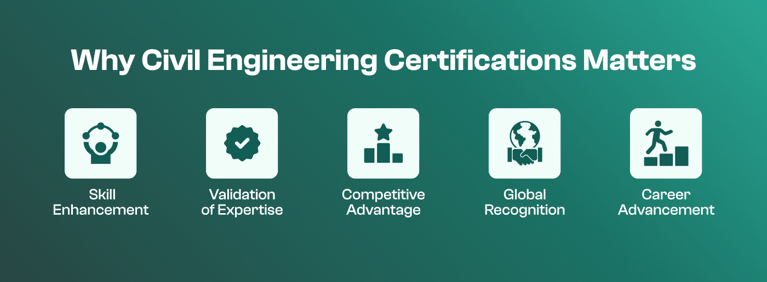
As the industry adopts new tools, materials, and digital workflows, **civil engineering certification courses** help professionals stay updated and competitive. Here’s how they support your career:
### 1. Skill Enhancement
Many offline and online certificate courses for civil engineers focus on practical, job-ready skills such as BIM, project management, structural design, QA/QC, and construction management. These programs help you go beyond theory and apply concepts to real-world projects.
### 2. Validation of Expertise
Certifications prove that you have mastered specific tools or domains. For freshers, they show potential employers that you have industry-ready capabilities. For experienced engineers, they formally reinforce existing skills and specialization.
### 3. Competitive Advantage
In a crowded job market, certified engineers stand out. A recognized civil engineering certification signals initiative, awareness of new technologies, and commitment to growth, factors hiring managers value highly.
### 4. Global Recognition
Some civil engineering certifications are accepted worldwide. These help you apply for roles in multinational firms and on international infrastructure projects.
### 5. Career Advancement
Certifications can support your transition into roles such as project manager, design specialist, BIM lead, or construction manager. They add weight to your resume when you apply for senior or leadership positions.
> Read more : [What is BIM in Civil Engineering & Why do Civil engineers love it?](https://www.novatr.com/blog/bim-in-civil-engineering-explained)
## How to Choose the Best Certification for Civil Engineers?

Choosing the best civil engineering certification can significantly enhance your skills, boost career prospects, and provide a high level of knowledge to succeed in leadership positions, increasing your potential for higher salaries. With so many offline and online civil engineering certificate courses available, zeroing in on the right one can be a difficult task. Read below a few factors that will help you make an informed decision:
### 1. Consider Your Career Goals
Several **civil engineering certifications** come with specialisations to help you delve into a specific civil engineering field.We’ll look at some of these civil engineering certificate programs as we move ahead in this blog. You can opt for specialisation courses as per your career aspirations to land your dream job***. ***
### 2. Look for Industry Demand
Research the job market to understand which skills and specialisations are in demand. For instance, BIM is very much in demand in the industry with many architect and civil engineering firms hiring candidates with cutting-edge BIM skills. Talk to professionals and industry veterans in your field to gain insights to better understand what the industry demands at the moment. Look for industry trends and attend industry webinars to know more about industry happenings.
### 3. Research the Options
Research the various civil engineering certifications from credible organisations. Check whether a particular certification is popular among other civil engineers. If yes, then you can also opt for it to remain competitive in the industry. You can also reach out to your colleagues to inquire more about the certifications and know their value.
### 4. Check Accreditation and Review Prerequisites
Ensure that the certification course for civil engineers you are choosing is accredited and recognised in the industry. Also, the institutes offering courses have specific eligibility criteria, so ensure that you meet all these requirements.
### 5. Networking Opportunities
Some certifications and courses come with networking opportunities, which you can utilise to access resources that can aid in building your career. For example, [**Novatr**](https://www.novatr.com/) offers you an opportunity to network with hiring partners via a placement team.Such courses can help you network with industry professionals and get ahead in the industry for a successful career.
## 5 Best Civil Engineering Certifications to Advance Your Career
Several **valuable certification courses for civil engineers** are available in the market that can enhance your skills and advance your career. You must keep in mind the popularity and relevance of [**certification courses for civil engineers**](https://www.novatr.com/courses/bim-for-civil-engineers) can change over time, so it’s imperative to research the latest trends in the industry before opting for any course. Take a look at the top offline and **online certificate courses for civil engineering**:
| Course Name | Duration | Preferable For | Fees | Certification |
| --- | --- | --- | --- | --- |
| BIM Professional Course for Civil Engineers – Novatr | 7 months | Both beginner and experienced Civil Engineers | ₹ 2,75,000 | Yes |
| Structural Engineering: Building Design – Michigan Technological University | 1 or 2 semesters | Both beginner and experienced Civil Engineers | $32,345 / ₹ 2,800,030 | Yes |
| Project Management Professional (PMP) Course – Simplilearn | 3 months | Beginners | $699 | Yes |
| Certified Construction Manager (CCM) – CMAA | Not defined | Both beginner and experienced Civil Engineers | Not specified | Yes |
| Civil 3D for Infrastructure Design – Autodesk | Not defined | Experienced Civil Engineers | Not specified | Yes |
### **1. BIM Professional Course for Civil Engineers – Novatr**
**Duration**: Seven months
**Mode**: Online
[Building Information Modelling (BIM)](https://www.novatr.com/courses/bim-for-civil-engineers) is the new buzzword in the market. It is reforming the civil engineering field and is quickly becoming the most-demand skill in the construction industry. Exposing you to modern technologies, BIM facilitates the designing of intricate 3D models for visualisation and problem-solving. Enrolling on a BIM course in civil engineering will reap long-term benefits for your career.
[**Novatr**](https://novatr.com/) offers an **online BIM course in civil engineering** taught by top industry leaders. The course has an industry-specific curriculum, and an ISO-verified capstone project to help you gain hands-on experience in designing. Once you complete Novatr programme, you'll get industry recognized most valuable AutoCAD and NSDC certification. Novatr also offers guaranteed career assistance with portfolio feedback and LinkedIn profile optimisation.
**Here’s what you’ll learn:**
- 5+ industry softwares, including Autodesk Revit, Navisworks, Autodesk Construction Cloud: Docs, Coordination & Collaboration.
- Master essential plugins such as EF-Tools, DiRoots.One, pyRevit, ProSheets, Issue and Model Checker for Revit to automate documentation and improve precision.
- Learn complete BIM workflows, from digital design development, estimation & BOQ, and information modeling to clash detection, sequencing, and multidisciplinary coordination.
- Get hands-on experience working on real commercial and residential projects following ISO 19650 standards, guided by mentors from the global AEC industry.
- Develop professional construction documentation, audits, and deliverables aligned with international BIM practices.
**Earn globally recognized certifications:**
- **Novatr Course Certificate**, signed by the Academic Director.
- **Autodesk User Certification**, validating your command over Autodesk tools.
- **NSDC Certificate**, officially recognizing your BIM expertise.
- **Optional Specialization Certificates**, for learners who wish to deepen their skills in niche BIM applications.
### **2. Structural Engineering: Building Design – Michigan Technological University**
**Duration**: One-two semesters
**Mode**: Online
Michigan Technological University offers an online certificate course in Structural Engineering: Building Design that prepares you for a wide range of careers in industries like architecture, building design, construction, and government. This course covers topics like structural analysis and how to work with different materials like concrete, steel, and timber. The course opens the gate for career opportunities in fields like Architecture, Interior Design, Building Inspection, Construction Management, and Project Management.
**Key Learnings:**
**Group A:**
- Structural Concrete Design
- Steel Design I
- Structural Timber Design
- Loads of Civil Structures
**Group B:**
- Advanced Structural Analysis
- Pre-stressed Concrete Design
- Concrete and Masonry Building Systems
- Steel Design II
- Advanced Structural Timber Design
Notably, you can design a custom program using elective courses, i.e., one course from Group A and two courses from Group B.
### **3. Project Management Professional (PMP) Course – Simplilearn**
**Duration**: Three months
**Mode**: Online
Simplilearn offers an online certificate course that covers core topics vital for a project management professional (PMP). In this course, you get access to 90 days of flexible online classes taught by top instructors and practitioners. The PMP training course covers topics crucial for project management professionals like emerging trends, new technologies, and core competencies.
**Key Learnings:**
- Work Breakdown Structure
- Resource Allocation
- Gantt Charts
- Mathematical Project Scheduling Models
- Project Cost Estimation
- Cost Management
- Engineering Economics
- Leadership
> Read more : [Top In-Demand Civil Engineering Specialisations](https://www.novatr.com/blog/civil-engineering-specialisation)
**4. Certified Construction Manager (CCM) – CMAA**
**Duration**: Not defined
**Mode**: Not defined
The Construction Manager Certification Institute, the administrative arm of the Construction Management Association of America offers a CCM certification valid for three years. This **certification course for civil engineers** is specially designed for individuals who want to achieve greater heights in the construction industry. To enrol for the course, you need to have a college degree in the relevant field. However, in case you don’t have a college degree, minimum of four years of construction management experience will also work. Potential careers with this certificate course include Construction Manager, Sustainability Consultant, and Field Engineer.
**Key Learnings**:
- Program & Project Management
- Safety Management
- Cost Management
- Risk Management
- Time Management
- Professional Practice
- Contract Administration
- Sustainability
- Quality Management
- Technology
### **5. Civil 3D for Infrastructure Design – Autodesk**
**Duration**: Not defined
**Mode**: Online
The CIVIL 3D Infrastructure Design skills certification from [Autodesk](https://www.autodesk.com/campaigns/building-engineer) demonstrates your advanced skills in solving complex challenges in design and workflow. This certification requires a minimum of 12,00 hours of civil 3D software experience and is valid for three years. The exam length is two hours and the potential career options after completing the certification course by Autodesk include Senior Civil Design Engineer, Senior Civil Engineer, and Civil Engineering Technician
### 6. Certified QA QC Course – SMEC
Duration: 1 month
Mode: Online/Offline/Hybrid
Another popular certification for Civil Engineers is offered by SMEC. This certified QA QC course is specifically designed for working professionals. With this course, civil engineers can get a deeper understanding of Quality Assurance, Quality Control, and safety management in construction. This course is beneficial for civil engineers as it helps them prevent project delays and reworks. Also, it allows civil engineers to ensure they meet the industry standards and regulations.
**Key Learnings:**
- QA/QC Documentation
- Quality Control Plan
- QC Checklist for Construction
- Process and Approval Construction
- Project Management
- Safety Management System
- Project Specifications
### **7. Professional Certificate in Construction Management– edX**
Duration: 4 months
Mode: Not Defined
This professional certificate in construction management by edX enhances your proficiency in delivering successful construction projects. This self-paced course covers topics like project delivery methods, the use of BIM to support project design and future trends in sustainable construction management. Divided into four skill-building courses, each course is a step towards enhancing your skillset in construction management. Potential career prospects include construction manager, product manager, sustainability consultant, to name a few.
**Key Learnings:**
- Construction Management
- Project Delivery Methods
- Cost Estimation
- Project Planning
- Administrative Tools in Construction Management
- Sustainable Management
### **8. Fundamentals of Structural Analysis - Udemy**
Duration: 3 hours 11 minutes
Mode: Online
This course by Udemy is conducted by Dr. Sean Carroll, a senior lecturer in structural engineering at the University of Exeter in the UK. Covering the fundamental concepts in static structural it highlights the distinction between model prediction and real-world structural behaviour. This course focuses on the link between theory and practice and how the model of structural behaviour map in the real world.
**Key Learnings: **
- Use of Joint Resolution Method
- Use of Method of Section
- Difference between Simplified Analysis Model and Behaviour of Real-world Structure
- Support reactions for structures subject to a range of loading conditions
### **9. Civil Infrastructure Construction Certificate Program - ASCE**
Duration: Not Specified
Mode: Online
The Civil Infrastructure Construction Certificate Program by American Society of Civil Engineers prepares the professionals in a variety of construction related roles to effectively manage contracts and plan and schedule heavy civil infrastructure projects with specialized knowledge for working in unit pricing models. This program focuses on providing practical knowledge of construction engineering.
### **10. Civil Engineering Programs - RICE USA**
**Duration:** Not specified
**Mode:** Online/Offline
From construction practice and procedure to advanced concrete technology, this course from Royal Institute of Chartered Engineers is a comprehensive program for civil engineers especially for the ones interested in Structural Engineering. This certification demonstrates your specialisation in the field of engineering as RICE is one of the largest engineering institutions in the world.
## Conclusion
Choosing the right **civil engineering certification** can be a turning point in your career. Certifications help you build in-demand skills, prove your expertise to employers, and access better roles in areas like BIM, structural design, QA/QC, and construction management. In a fast-changing industry, targeted upskilling is one of the most effective ways to stay ahead.
If you want to grow in digital construction and stand out in the job market, the [**BIM Professional Course for Civil Engineers**](https://www.novatr.com/courses/bim-for-civil-engineers) by[**Novatr**](https://www.novatr.com/) is a strong starting point. It combines software mastery, practical BIM workflows, and placement support to help you move into high-value roles in the AEC industry.
For more industry updates and career guides, you can visit our [**resource page**](https://www.novatr.com/learning-hub)!
## **Frequently Asked Questions**
### 1. Which are the most valuable certifications for civil engineers?
Building Information Modelling BIM) adds significant value to a Civil Enineer’s resume. Certification of LEED Accreditation is also one of the best certifications for Civil Engineers. However, Chartered Engineer (CE), Civil Engineering Certification CEC) and Professional Engineer License (PE) are some of the certifications that add value to civil engineer’s skills.
## 2. How do certifications help experienced civil professionals?
Certifications showcase a higher level of expertise, validating the civil engineer’s skills and knowledge. It also helps in enhancing their credibility in the market leading them to higher salaries. Along with career advancement, it also helps in building professional network for civil professionals.
### 3. Are certifications necessary for fresh graduates in civil engineering?
Although, there are several benefits of having a certification in civil engineering, fresh graduates do not need it necessarily.
### 4. Which certification offers the highest salary growth in civil engineering?
Certifications related to project management (PMP), BIM, and construction management often lead to higher salary growth because they align with leadership, coordination, and digital project delivery roles.
5. Is BIM certification useful for civil engineers?
Yes, BIM certification for civil engineers is highly useful as more firms adopt BIM for design, coordination, and construction. It opens up roles such as BIM Engineer, BIM Coordinator, and BIM Manager across global markets.
Master BIM and Get Hired Faster
Join a community of 8500+ Architects and Engineers.
Explore Now
\*Limited seats available
Was this content helpful to you
Like Yes
Dislike No

TABLE OF CONTENTS
BIM Is The New Standard. Are You Certified?
Get Certified in BIM
SHARE ON YOUR SOCIALS
Link Copied Successfully
Related articles
[ 8 Best Online Civil 3D Courses for Civil Engineers (2026) 20 November 2023 15 min read](https://blog.novatr.com/blog/online-courses-to-learn-civil-3d-as-civil-engineers) [ Architecture and Construction Master's vs. Certificate Courses: Which Is Best for Civil Engineers in 2026? 20 March 2024 15 min read](https://blog.novatr.com/blog/masters-vs-certificate-courses-for-civil-engineers) [ 10 Best Revit Structure Courses to Enrol in India in 2026 1 May 2024 16 min read](https://blog.novatr.com/blog/online-revit-structure-courses) [ 5 Best Online Courses To Learn Tekla (For Civil Engineers) 19 November 2023 12 min read](https://blog.novatr.com/blog/learn-tekla-software-online-as-civil-engineer)
Download Syllabus
## BIM Professional Program
Next Cohort
June 2026
Program Duration
7 Months
Premium Program benefits
8 Credentials from Autodesk, NSDC, Novatr
1 program. 10 career paths. Infinite Growth.
40+ ISO 19650 & RIBA real-world projects to practice
1-on-1 guidance. Access 400+ industry experts.
Access the biggest AEC-Tech community on the planet. 8500+ and counting
Curated for you by 100+ global BIM leaders.
Lifelong access to course content
Enter your details to download the program syllabus.
##### BIM Professional Program
June 2026, 7 Months
Your Name Invalid name.
Phone Number Enter a valid phone number
Email Please enter a valid email address.
Select years of experience\* Currently studying 0-1 years 1-2 years 2-4 years 4-8 years 8-10 years 10-12 years 12+ years Invalid selection.
Specialisation Select your background\* Architecture Civil Engineering Mechanical Engineering Electrical Engineering Invalid selection.
Are you professionally trained in interior design?
Yes
No
I agree to the [Terms of Use](https://www.novatr.com/terms-and-conditions) and [Privacy Policy](https://www.novatr.com/privacy-policy), and consent to be contacted by Email, Call, WhatsApp, or SMS.
Submit
Ready to skyrocket your career?
Begin your next chapter in AEC
with Novatr!
We are here to help you take the industry by storm with advanced, tech-first skills.
[Explore Courses](https://www.novatr.com/#courses)
Join our newsletter
Submit
Thank you for signing up.
We’ll send you a nice letter once per week. No spam.

Dare to Disrupt.
Join thousands of people who organise
work and life with Novatr.
Company
- [About Us](https://www.novatr.com/about)
- [BIM Professional Program v.2026](https://www.novatr.com/courses/bim-professional-program)
- [Masters Computational Design](https://www.novatr.com/courses/computational-design)
- [Become a Mentor](https://www.novatr.com/apply-as-mentor)
- [Hiring from Us](https://www.novatr.com/hire-from-us)
- [Careers at Novatr](https://www.novatr.com/career)
Resources
- [Blog](https://www.novatr.com/learning-hub)
- [Media Room](https://www.novatr.com/media-room-home-page)
- [Career Builder](https://www.novatr.com/career-navigator)
- [Events & Webinars](https://www.novatr.com/webinars)
- [FAQs & Support Center](https://www.novatr.com/contact-us)
- [Contact Us](https://www.novatr.com/contact-us)
- [Privacy Policy](https://www.novatr.com/privacy-policy)
- [Terms of Use](https://www.novatr.com/terms-and-conditions)
©2023 Oneistox Network Pvt. Ltd.
All Rights Reserved
```json
{
"@context" : "https://schema.org",
"@type" : "BlogPosting",
"author" : {
"@type" : "Person",
"name" : "Rashi",
"url" : "https://blog.novatr.com/blog/author/rashi"
},
"dateModified" : "2025-12-15T06:14:37.407Z",
"datePublished" : "2023-10-05T05:30:26.000Z",
"headline" : "10 Best Civil Engineering Certification to Pursue in {{year}}",
"image" : [ "https://blog.novatr.com/hubfs/Civil%20engineers%20discussing%20a%20design.png" ],
"mainEntityOfPage" : {
"@id" : "https://blog.novatr.com/blog/certification-courses-for-civil-engineers",
"@type" : "WebPage"
},
"publisher" : {
"@type" : "Organization",
"logo" : {
"@type" : "ImageObject",
"url" : "https://blog.novatr.com/hubfs/Novatr%20Prev%20OX-2.svg"
}
}
}
```