---
title: Career Roadmap for Aspiring MEP Engineers in 2026
description: Explore the career roadmap for MEP engineers in 2026, including required skills, certifications, software tools, job trends, and growth opportunities.
image: https://blog.novatr.com/hubfs/Career%20Roadmap%20for%20Aspiring%20MEP%20Engineer.png
---
[Blogs](https://www.novatr.com/learning-hub)
- [Architecture & Construction](https://www.novatr.com/learning-hub?category=Architecture+%26+Construction)
- [BIM](https://www.novatr.com/learning-hub?category=BIM)
- [Computational Design](https://www.novatr.com/learning-hub?category=Computational+Design)
- [Company News](https://www.novatr.com/learning-hub?category=Company+News)
- [Expert Talks](https://www.novatr.com/learning-hub?category=Expert+Talks)
Explore Courses
[Just Launched  BIM Professional Program v.2026 Take your career to the next level by mastering the real-world application of BIM. Know More](https://www.novatr.com/courses/bim-professional-program)
[ Master Computational Design Course Break into an advanced career by learning to apply the power of computation to the art of design. Know More](https://www.novatr.com/courses/computational-design)
[Blogs](https://www.novatr.com/learning-hub)
Explore Blogs
- [Architecture & Construction](https://www.novatr.com/learning-hub?category=Architecture+%26+Construction)
- [BIM](https://www.novatr.com/learning-hub?category=BIM)
- [Computational Design](https://www.novatr.com/learning-hub?category=Computational+Design)
- [Company News](https://www.novatr.com/learning-hub?category=Company+News)
- [Expert Talks](https://www.novatr.com/learning-hub?category=Expert+Talks)
Courses
- [BIM Professional Program v.2026](https://www.novatr.com/courses/bim-professional-program)
- [Master Computational Design](https://www.novatr.com/courses/computational-design)
- [MEP/](https://www.novatr.com/learning-hub?category=BIM)
Featured Article
# Career Roadmap for Aspiring MEP Engineers in 2026

Neha Singh
February 10, 2026
6 min read
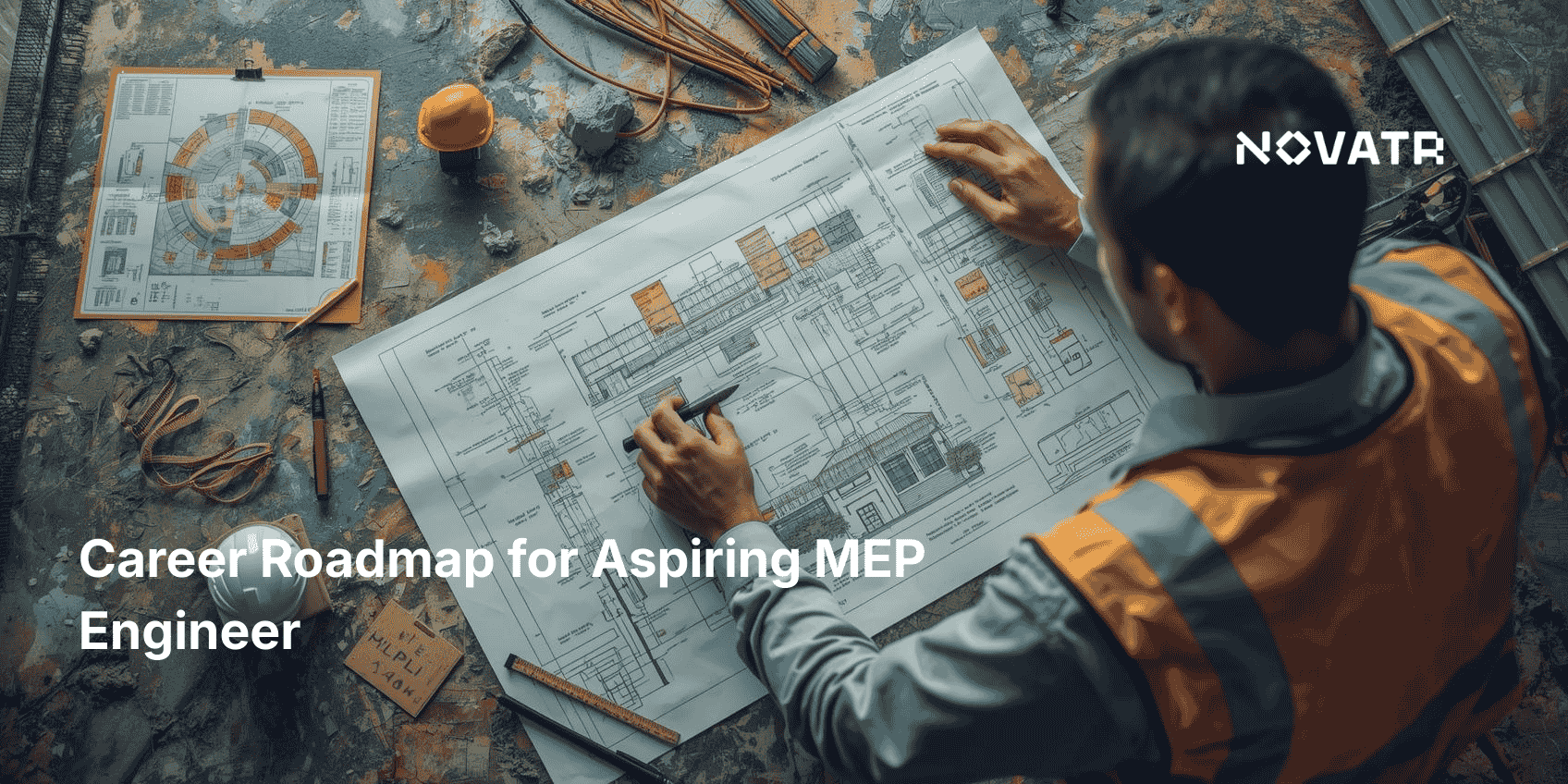

If you have wondered what it takes to build a strong career as an MEP engineer, you are not alone. The construction industry depends on mechanical, electrical, and plumbing engineering as essential components of its work. The industry requires more skilled workers. According to[Construction Placements](https://www.constructionplacements.com/complete-mep-engineer-career-guide/), employment growth in this field significantly outpaces national averages. Mechanical engineers are seeing 11% growth and electrical engineers 9% from 2023 to 2033.
This guide provides recent graduates and current professionals with information about their career paths and essential learning resources and required certifications and global trends that are changing MEP job opportunities.
Unlock High-Paying Careers With BIM
Master BIM workflows, software and skills on real projects.
Apply Now
\*Limited seats available
## **What Does the Career Path of a MEP Engineer Look Like in 2026?**
The MEP engineer career path has become more interesting in recent years. It is no longer a straight line from degree to drafting desk. Today, there are multiple directions you can take based on your interests and strengths.
Here is how a typical progression looks:
- **Entry Level (0–2 years)**: Assisting senior engineers with system design, running calculations, and learning building codes. Roles like MEP Draftsman or Junior Design Engineer are common here.
- **Mid-Career (3–6 years)**: Coordinating with architects and contractors, managing parts of a project, and starting to specialize in HVAC, electrical, or plumbing.
- **Senior Level (7+ years)**: Leading teams, making design decisions, and moving into roles like Senior MEP Engineer, MEP Consultant, or Project Manager.
Career growth in construction for MEP professionals is stronger than in most other engineering disciplines.
## **What Qualifications and Skills Are Needed to Start a Career in MEP Engineering?**
****
Getting into an MEP engineer career does not follow a single rigid path, but successful professionals usually share a strong technical foundation combined with practical, site-ready skills.
### **Educational Qualifications**
Most entry-level roles in MEP engineering require one of the following:
- A bachelor’s degree in Mechanical Engineering, Electrical Engineering, or Building Services Engineering
- A three-year engineering diploma supplemented with MEP engineering courses or industry certifications, which is common in India and the Middle East
- Specialised short-term programs focused on MEP systems design, BIM workflows, and construction documentation
### **Core Technical Skills for MEP Engineers**
To succeed in MEP engineering, candidates need hands-on technical competencies across building systems:
- **HVAC design fundamentals** including load calculations, duct sizing, and equipment selection
- **Electrical systems knowledge** covering lighting layouts, power distribution, earthing, and safety standards
- **Plumbing and fire-fighting systems design** such as water supply networks, drainage layouts, and fire protection codes
- **Understanding of international and local building codes** including NBC, ASHRAE, NFPA, and IEC standards
- **Quantity take-offs and basic cost estimation** to support project planning and coordination
### **BIM, Digital, and Software Skills**
Key software and digital skills include:
- Revit MEP for BIM-based modelling and coordination
- AutoCAD MEP for 2D drawings and legacy project work
- Navisworks for clash detection and interdisciplinary coordination
- MagiCAD or similar plugins for system sizing and performance analysis
- Basic BIM standards knowledge, including LOD, clash resolution workflows, and model coordination protocols
### **Essential Soft Skills and Site Readiness**
Technical knowledge alone is not enough. Successful MEP engineers consistently demonstrate:
- **Problem-solving ability** to resolve design clashes and site constraints
- **Clear communication skills** for working with architects, contractors, and project managers
- **Attention to detail**, particularly in drawings, schedules, and compliance documentation
- **Adaptability** to fast-changing site conditions and evolving project requirements
This combination builds long-term career stability and opens doors to global MEP engineering career opportunities and growth.
## **Which Software Tools and Technologies Should Aspiring Engineers Learn?**
****
**MEP software** proficiency is now a baseline expectation. Here are the tools that matter most:
- **Autodesk Revit MEP**: The go-to for BIM-based MEP design. Revit is now standard for large, coordinated projects, and firms are hiring for it specifically.
- **AutoCAD MEP**: Still widely used for 2D drafting and smaller projects. It is a solid foundational skill.
- **Navisworks**: Used for clash detection and project coordination on large-scale work.
- **MagiCAD**: A Revit plugin offering detailed component libraries and system performance modeling.
BIM and digital skills for MEP engineers are growing fast. Professionals who can work within BIM workflows are in much higher demand, and learning these tools early is one of the smartest career moves you can make.
## **How Do Certifications and Specialized Courses Boost MEP Careers?**
Certifications are one of the clearest ways to advance in MEP engineering. Here are the ones worth focusing on:
- **Professional Engineer (PE) License**: The gold standard. A PE license typically adds $5,000–$15,000 to your salary right away, with that premium growing in senior roles.
- **LEED Accredited Professional (LEED AP)**: Essential for sustainable and green building projects, which are becoming the norm.
- **ASHRAE Certifications**: Useful for HVAC and energy system specialists. They target high-growth practice areas.
- **PMP (Project Management Professional)**: Worth pursuing if you are moving toward a management track.
Enrolling in MEP training programs and courses that cover BIM, sustainability, and smart building technologies will set you apart. Novatr offers industry-aligned programs built around real projects and mentorship from professionals, providing structured learning that translates directly into on-the-job skills.
## **What Global Job Opportunities and Emerging Trends Are Shaping the MEP Field?**
A career in MEP engineering is increasingly global. Here is where the industry is heading and where real opportunities are opening up:
- **Data centers**: One of the fastest-growing segments, with each large facility creating over 1,700 construction jobs driven by AI and cloud computing demand.
- **Smart buildings and IoT**: IoT sensors and data tools are making MEP systems more intuitive and efficient. Engineers with this knowledge are in high demand.
- **The Middle East**: The UAE, Saudi Arabia, and Qatar are pouring investment into mega-projects. Saudi Arabia's Vision 2030 and NEOM are creating a surge in MEP talent demand.
- **Sustainability:** Energy-efficient and green building design is accelerating globally. MEP engineers with sustainability expertise are becoming increasingly valuable.
For those thinking about career advancement in MEP, the advice is straightforward: specialize in a growing area, get certified, and stay current. The MEP engineering career opportunities and growth available today reward exactly that.
Master BIM and Get Hired Faster
Join a community of 8500+ Architects and Engineers.
Explore Now
\*Limited seats available
## **Conclusion**
The MEP engineer career in 2026 is one of the most promising paths in construction and engineering. Demand is strong, pay is competitive, and technology keeps the work interesting. To build a strong portfolio as an MEP engineer, focus on hands-on projects, invest in BIM skills, and pursue certifications that matter. The global market is creating real opportunities in smart buildings, data centers, and sustainable design.
If you are serious about accelerating your career, enrolling in a structured program like the [BIM Course for MEP Engineers](https://www.novatr.com/us/courses/bim-for-mep-engineers) by [Novatr](https://www.novatr.com/us) can give you hands-on project experience, expert mentorship, and industry-ready skills that help you move confidently into higher-paying roles.
Visit our [resource page](https://www.novatr.com/learning-hub) for recent industry insights and receive expert guidance on advancing your career.
## **FAQs**
### **1. Which software skills are essential for MEP engineers in 2026?**
Revit MEP is essential for BIM projects, while AutoCAD MEP, Navisworks, and MagiCAD support drafting, coordination, and system modelling.
### **2. How can fresh graduates start their careers in the MEP industry?**
Fresh graduates should begin with internships or drafting roles, gain Revit skills, and build hands-on exposure to real MEP systems.
### **3. What certifications help boost an MEP engineer's career prospects?**
Professional Engineer licensing enables senior design roles, LEED supports green buildings, ASHRAE builds HVAC expertise, and PMP prepares engineers for project management.
Was this content helpful to you
Like Yes
Dislike No

TABLE OF CONTENTS
BIM Is The New Standard. Are You Certified?
Get Certified in BIM
SHARE ON YOUR SOCIALS
Link Copied Successfully
Related articles
[ Online vs Offline MEP Courses: A Complete Guide for Professionals 18 September 2025 7 min read](https://blog.novatr.com/blog/online-or-offline-mep-courses) [ How to transition from Electrical Technician to BIM Technician 6 March 2025 23 min read](https://blog.novatr.com/blog/electrical-technician-to-bim-technician-transition-guide) [ Top MEP Course In Thrissur in 2026 4 February 2025 13 min read](https://blog.novatr.com/blog/top-mep-course-in-thrissur) [.png) Top MEP Consultants in Hyderabad 2026 12 September 2025 6 min read](https://blog.novatr.com/blog/top-mep-consultants-in-hyderabad)
Download Syllabus
## BIM Professional Program
Next Cohort
June 2026
Program Duration
7 Months
Premium Program benefits
8 Credentials from Autodesk, NSDC, Novatr
1 program. 10 career paths. Infinite Growth.
40+ ISO 19650 & RIBA real-world projects to practice
1-on-1 guidance. Access 400+ industry experts.
Access the biggest AEC-Tech community on the planet. 8500+ and counting
Curated for you by 100+ global BIM leaders.
Lifelong access to course content
Enter your details to download the program syllabus.
##### BIM Professional Program
June 2026, 7 Months
Your Name Invalid name.
Phone Number Enter a valid phone number
Email Please enter a valid email address.
Select years of experience\* Currently studying 0-1 years 1-2 years 2-4 years 4-8 years 8-10 years 10-12 years 12+ years Invalid selection.
Specialisation Select your background\* Architecture Civil Engineering Mechanical Engineering Electrical Engineering Invalid selection.
Are you professionally trained in interior design?
Yes
No
I agree to the [Terms of Use](https://www.novatr.com/terms-and-conditions) and [Privacy Policy](https://www.novatr.com/privacy-policy), and consent to be contacted by Email, Call, WhatsApp, or SMS.
Submit
Ready to skyrocket your career?
Begin your next chapter in AEC
with Novatr!
We are here to help you take the industry by storm with advanced, tech-first skills.
[Explore Courses](https://www.novatr.com/#courses)
Join our newsletter
Submit
Thank you for signing up.
We’ll send you a nice letter once per week. No spam.

Dare to Disrupt.
Join thousands of people who organise
work and life with Novatr.
Company
- [About Us](https://www.novatr.com/about)
- [BIM Professional Program v.2026](https://www.novatr.com/courses/bim-professional-program)
- [Masters Computational Design](https://www.novatr.com/courses/computational-design)
- [Become a Mentor](https://www.novatr.com/apply-as-mentor)
- [Hiring from Us](https://www.novatr.com/hire-from-us)
- [Careers at Novatr](https://www.novatr.com/career)
Resources
- [Blog](https://www.novatr.com/learning-hub)
- [Media Room](https://www.novatr.com/media-room-home-page)
- [Career Builder](https://www.novatr.com/career-navigator)
- [Events & Webinars](https://www.novatr.com/webinars)
- [FAQs & Support Center](https://www.novatr.com/contact-us)
- [Contact Us](https://www.novatr.com/contact-us)
- [Privacy Policy](https://www.novatr.com/privacy-policy)
- [Terms of Use](https://www.novatr.com/terms-and-conditions)
©2023 Oneistox Network Pvt. Ltd.
All Rights Reserved
```json
{
"@context" : "https://schema.org",
"@type" : "BlogPosting",
"author" : {
"@type" : "Person",
"name" : "Neha Singh",
"url" : "https://blog.novatr.com/blog/author/neha-singh"
},
"dateModified" : "2026-02-10T09:29:02.006Z",
"datePublished" : "2026-02-10T09:24:56.000Z",
"headline" : "Career Roadmap for Aspiring MEP Engineers in {{year}}",
"image" : [ "https://blog.novatr.com/hubfs/Career%20Roadmap%20for%20Aspiring%20MEP%20Engineer.png" ],
"mainEntityOfPage" : {
"@id" : "https://blog.novatr.com/blog/career-roadmap-for-mep-engineers",
"@type" : "WebPage"
},
"publisher" : {
"@type" : "Organization",
"logo" : {
"@type" : "ImageObject",
"url" : "https://blog.novatr.com/hubfs/Novatr%20Prev%20OX-2.svg"
}
}
}
```