---
title: "BIM Career Path in India: Best BIM Specializations, Salaries & Future Scope"
description: Explore the best BIM career in India. Compare salary, specializations, skills, and software individuals need to become a top BIM professional.
image: https://blog.novatr.com/hubfs/An%20engineer%20working%20on%20a%20project%20using%20BIM%20software.jpg
---
[Blogs](https://www.novatr.com/learning-hub)
- [Architecture & Construction](https://www.novatr.com/learning-hub?category=Architecture+%26+Construction)
- [BIM](https://www.novatr.com/learning-hub?category=BIM)
- [Computational Design](https://www.novatr.com/learning-hub?category=Computational+Design)
- [Company News](https://www.novatr.com/learning-hub?category=Company+News)
- [Expert Talks](https://www.novatr.com/learning-hub?category=Expert+Talks)
Explore Courses
[Just Launched  BIM Professional Program v.2026 Take your career to the next level by mastering the real-world application of BIM. Know More](https://www.novatr.com/courses/bim-professional-program)
[ Master Computational Design Course Break into an advanced career by learning to apply the power of computation to the art of design. Know More](https://www.novatr.com/courses/computational-design)
[Blogs](https://www.novatr.com/learning-hub)
Explore Blogs
- [Architecture & Construction](https://www.novatr.com/learning-hub?category=Architecture+%26+Construction)
- [BIM](https://www.novatr.com/learning-hub?category=BIM)
- [Computational Design](https://www.novatr.com/learning-hub?category=Computational+Design)
- [Company News](https://www.novatr.com/learning-hub?category=Company+News)
- [Expert Talks](https://www.novatr.com/learning-hub?category=Expert+Talks)
Courses
- [BIM Professional Program v.2026](https://www.novatr.com/courses/bim-professional-program)
- [Master Computational Design](https://www.novatr.com/courses/computational-design)
- [BIM/](https://www.novatr.com/learning-hub?category=BIM)
Featured Article
# BIM Career Path in India: Best BIM Specializations, Salaries & Future Scope

Pragya Sharma
June 22, 2026
11 min read
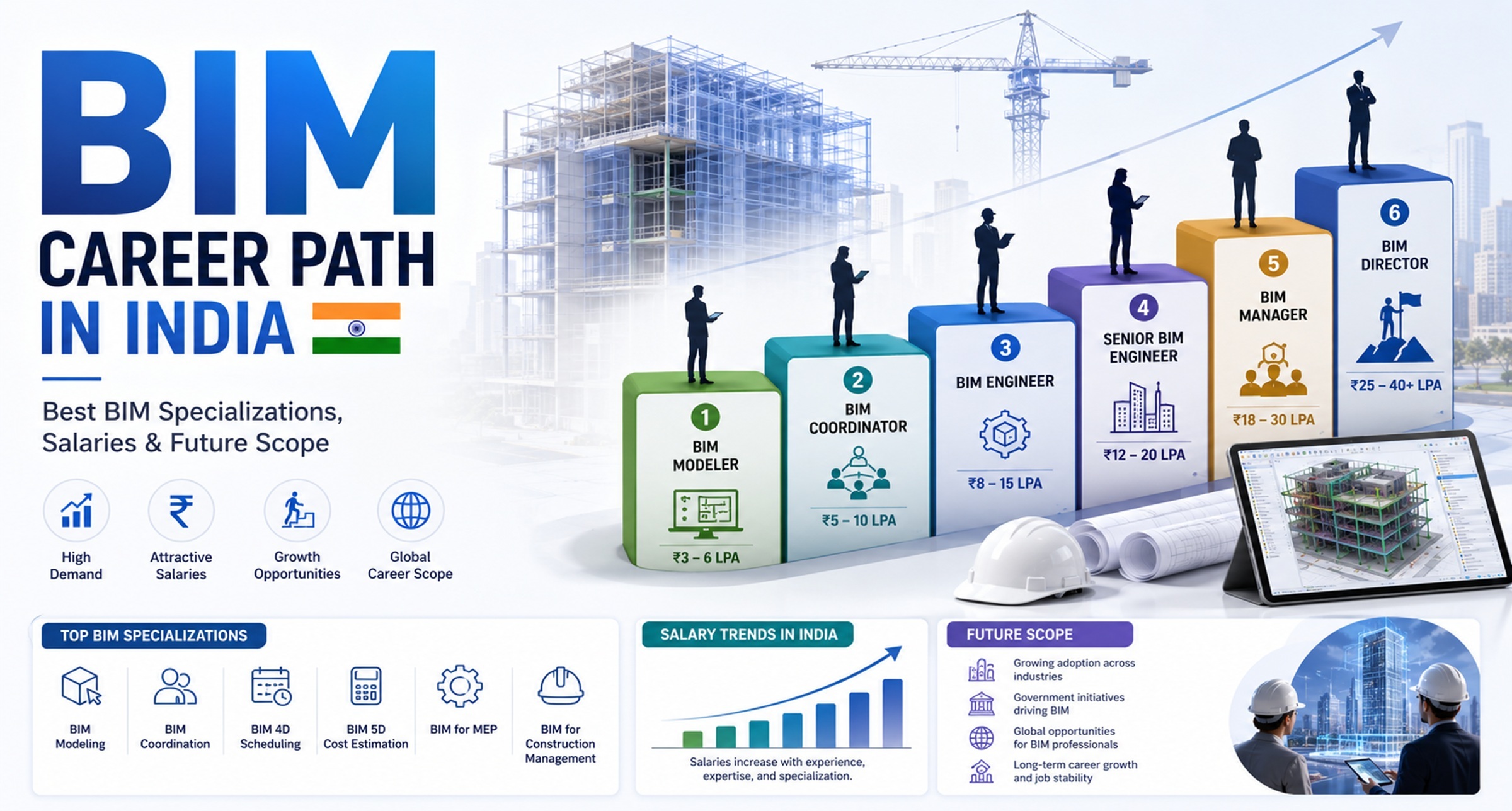

Before digitalisation, the career trajectory of Architecture, Engineering, and Construction (AEC) professionals was fairly linear. It required individuals to go up the career ladder through rigorous training, years of experience, and gradual progression in traditional roles. But the introduction of [Building Information Modelling (BIM)](https://www.novatr.com/blog/complete-bim-guide-for-aec-professionals) changed the game for this industry.
Fundamentally, BIM is a technology that helps create, manage, and analyse holistic 3D models of a structure. This digital process brought along a new skill set that demanded architects and engineers to be agile, tech-savvy, and proficient in data-driven workflows. Soon, having a BIM career in India evolved as a rite of passage to leadership jobs and a higher earning potential.
## **Key Takeaways**
- BIM has opened new career avenues for architects and engineers who want to remain ahead of industry trends and expand their professional opportunities.
- Learning [BIM software](https://www.novatr.com/blog/10-best-bim-software-used-by-aec-firms) such as Revit, Civil 3D, Archicad, and Tekla Structures can be a great start to explore a career in this field.
- BIM Modeller, BIM Coordinator, VDC Specialist, and BIM Manager are some of the most promising new-age job roles.
- Investing in [BIM courses](https://www.novatr.com/blog/top-10-bim-courses) can help individuals master [BIM skills](https://www.novatr.com/blog/high-paying-bim-skills-you-need-to-know) and prepare themselves for professional practice.
Unlock High-Paying Careers With BIM
Master BIM workflows, software and skills on real projects.
Apply Now
\*Limited seats available
## **What are the Different Career Paths Available in BIM?**

Making a career in [BIM](https://www.novatr.com/blog/detailed-bim-guide) demands professionals to learn digital processes. This applies upskilling in new-age software, tools, and workflows. But, those who adapt to these changes are able to secure lucrative roles in the industry.
### **1. BIM Modeller:**
Considered the starting point of a BIM career, this role involves creating and maintaining intelligent 3D models that contain both geometric and project-related information. BIM Modellers work closely with architects, engineers, and consultants to develop accurate project documentation.
### **2. BIM Coordinator:**
Acting as a bridge between multiple disciplines, BIM Coordinators ensure that architectural, structural, and MEP models are integrated seamlessly. They are responsible for clash detection, model reviews, and maintaining BIM standards throughout the project lifecycle.
### **3. BIM Manager:**
With more experience comes the responsibility of managing BIM implementation across projects and teams. [BIM Managers](https://www.novatr.com/blog/guide-to-become-bim-manager) establish workflows, develop execution plans, train team members, and ensure projects meet digital delivery requirements.
### **4. VDC Engineer:**
Virtual Design and Construction (VDC) Engineers use BIM models to simulate construction activities before work begins on site. Within this BIM specialization, the role helps teams optimise schedules, improve constructability, and reduce project delays.
### **5. Digital Construction Manager:**
Combining construction expertise with digital technology, these professionals leverage BIM, project data, and site information to improve planning, coordination, and project execution throughout the construction phase.
### **6. Parametric Designer:**
For professionals interested in computational design, this role focuses on using algorithms and parametric tools to generate innovative design solutions. [Parametric Designers](https://www.novatr.com/blog/why-parametric-designers-are-getting-hired-over-traditional-architects) are often involved in complex geometries, facade systems, and performance-driven architecture.
### **7. Facility Manager:**
BIM models continue to provide value long after construction is complete. Facility Managers use building data to monitor assets, schedule maintenance activities, and improve operational efficiency across a facility's lifecycle.
### **8. BIM Consultant:**
Organisations looking to adopt BIM often rely on BIM Consultants for strategic guidance. These specialists help firms develop implementation roadmaps, establish standards, optimise workflows, and maximise the return on their BIM investments.
## **Which BIM Specializations Have the Highest Demand in India and Globally?**
BIM specializations need individuals to develop expertise in digital design, construction, and maintenance. Here are the key BIM niches that have the highest demand in India and globally.
**Architectural:** From conceptual design to documentation, [architectural BIM specialists](https://www.novatr.com/blog/bim-learning-for-architects) create intelligent building models that improve visualization, coordination, and accuracy throughout a project.
**Structural:** These BIM professionals develop detailed models of foundations, beams, columns, slabs, and other load-bearing elements. Their work helps engineers identify clashes, optimize designs, and improve construction efficiency.
**MEP:** Mechanical, Electrical, and Plumbing (MEP) systems are among the most intricate aspects of a building. Experts in this field coordinate services within tight spaces and ensure seamless integration with architectural and structural components.
**Infrastructure:** Governments and private developers are increasingly using [BIM for roads](https://www.novatr.com/blog/bim-driving-indias-infrastructure-growth), bridges, railways, airports, and utilities. This has created a growing demand for professionals skilled in infrastructure-focused BIM workflows.
**4D BIM (Construction Scheduling):** By linking BIM models with project schedules, 4D BIM specialists help teams visualize construction sequences, improve planning, and reduce delays during project execution.
**5D BIM (Cost Estimation):** Cost-focused BIM professionals integrate quantity take-offs and project costs into digital models. This enables accurate budgeting, procurement planning, and financial forecasting.
[**Digital Twin**](https://www.novatr.com/blog/digital-twin-parametric-buildings-the-future-of-smart-architecture) **Technology:** The rise of smart buildings and smart cities has increased demand for professionals who can create and manage digital replicas of physical assets for real-time monitoring and performance analysis.
**Facility Management:** Trumpeted as one of the most rewarding BIM career in India, facility management helps use data to manage structures. Specialists in this field use 3D models to support building operations, maintenance planning, asset management, and lifecycle optimization.
**Computational Design:** Advanced design projects require algorithm-driven workflows to create complex geometries and optimize building performance. As a result, expertise in parametric design tools is becoming highly sought after worldwide.
## **What Skills and Software Do Companies Expect from BIM Professionals?**
Software is a tool that helps visualize and manage 3D models. However, beyond software skills, architects and engineers should improve their communication, problem-solving, and leadership abilities to unlock new BIM career opportunities. Let’s have a look at them:
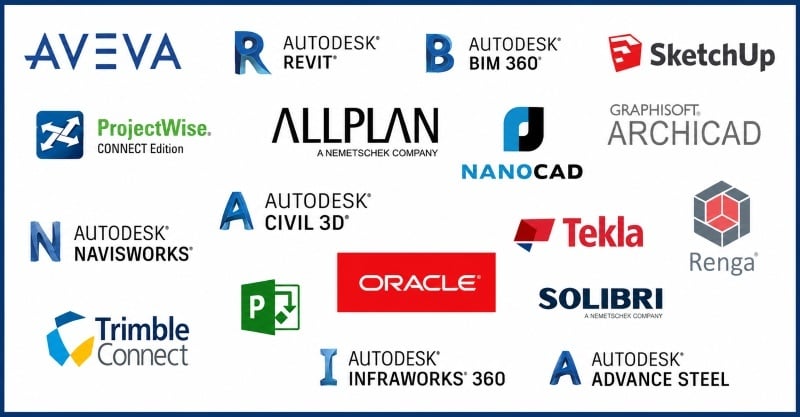
**1. BIM Software Proficiency:** An understanding of [BIM software](https://www.novatr.com/blog/8-popular-bim-software) such as Revit, ArchiCAD, Civil 3D, and Bentley OpenBuildings is often the first requirement for BIM roles. These tools help professionals create, manage, and modify intelligent building models throughout the project lifecycle.
**2. Clash Detection:** Companies expect BIM professionals to identify and resolve design conflicts before construction begins. Tools such as Navisworks and TeklaStructures are commonly used to coordinate multidisciplinary models and improve project accuracy.
**3. Data Management:** BIM workflows involve managing extensive project information. Familiarity with Common Data Environments (CDEs), BIM 360, Autodesk Construction Cloud, and ISO 19650 standards can offer a significant advantage.
**4. Parametric and Generative Design:** BIM specialization in computational design helps firms automate repetitive tasks and develop data-driven solutions. Typically professionals use tools such as Dynamo and Grasshopper for this purpose.
[**5. Collaboration**](https://www.novatr.com/blog/how-mep-engineers-work-with-architects-civil-engineers)**:** BIM projects require architects, engineers, contractors, and consultants to work closely together. The ability to communicate ideas clearly and collaborate across disciplines is often as important as technical expertise.
**6. Critical Thinking:** BIM is frequently used to identify design issues before they reach the construction site. Professionals who can analyse project challenges and develop practical solutions are highly sought after by employers.
## **How to Start a Career in BIM?**

To find relevant BIM job roles, professionals must firstly sign up for comprehensive courses that offer in-depth knowledge of the subject. This helps them understand BIM fundamentals through theoretical knowledge and hands-on experience, essential for industry practice.
### **As an Architect **
A bachelor's degree in architecture is typically sufficient to get started, after which professionals can pursue BIM training through courses. Using BIM software, they can learn model authoring, information management, and collaborative workflows.
### **As a Civil Engineer**
[Civil engineers](https://www.novatr.com/blog/future-ready-career-paths-after-civil-engineering) already possess a foundational knowledge in structural systems, construction methods, and project execution. By enhancing their technical knowledge with BIM training and hands-on software experience, they can adapt to digital project delivery processes and work more effectively in multidisciplinary teams.
### **As an MEP Engineer**
A background in mechanical, electrical, or plumbing engineering provides a solid ground for understanding building services and system coordination. For a BIM career, MEP engineers should focus on developing digital modelling skills and learning how building information is integrated across various disciplines in a project’s lifecycle.
[Novatr’ BIM Professional Program](https://www.novatr.com/courses/bim-professional-program?utm_source=organic_search&utm_medium=blog&utm_campaign=bim-career-path-in-india-best-bim-specializations-salaries-future-scope) is an extensive 7-month course that empowers individuals to build industry-relevant skills. The curriculum is taught by who’s who of the fraternity with years of experience. Learners can further hone their skills through live sessions, capstone projects, and case studies. At the end of the course, participants also receive certificates alongside placement assistance and mock-interview support. You can explore the course here.
## **How much do BIM professionals earn in India, UAE, UK, and other countries?**
BIM-proficient individuals are highly valued not just in India but around the world. Top AEC firms are always seeking candidates who can add more value to their projects through BIM skills. As compared to traditional roles, new-age BIM architect and [BIM engineer](https://www.novatr.com/blog/guide-to-become-bim-engineer) salaries are at least 1.5 to 2 times higher. Here is a comparison of salaries offered in key BIM career paths across the globe.
| **Career Path** | **India (₹ LPA)** | **UAE (AED/Year)** | **UK (£/Year)** | **USA ($/Year)** |
| --- | --- | --- | --- | --- |
| BIM Modeller | ₹ 3-5 LPA | AED 60,000 - 120,000 | £25,000 - £40,000 | $55,000 - $80,000 |
| BIM Coordinator | ₹ 6-15 LPA | AED 120,000 - 220,000 | £40,000 - £60,000 | $75,000 - $110,000 |
| BIM Manager | ₹ 12-30 LPA | AED 220,000 - 400,000 | £55,000 - £90,000 | $100,000 - $150,000 |
| VDC Engineer | ₹ 8-18 LPA | AED 140,000 - 250,000 | £45,000 - £65,000 | $80,000 - $120,000 |
| Parametric Designer | ₹ 6-18 LPA | AED 120,000 - 240,000 | £35,000 - £65,000 | $70,000 - $130,000 |
| BIM Consultant | ₹ 15-40 LPA | AED 250,000 - 500,000 | £60,000 - £100,000 | $110,000 - $180,000 |
| Construction Manager | ₹ 15-35 LPA | AED 250,000 - 450,000 | £60,000 - £95,000 | $110,000 - $170,000 |
Master BIM and Get Hired Faster
Join a community of 8500+ Architects and Engineers.
Explore Now
\*Limited seats available
## Conclusion
BIM use cases in construction and infrastructure projects prove the mettle of this technology. It signifies that the future of the [AEC industry](https://www.novatr.com/blog/top-industry-applications-for-bim-where-is-bim-used-in-construction) is data-driven, collaborative, and efficient. To keep up with this wave of change, professionals need to learn BIM as a skill that makes them more employable and future-relevant.
We suggest you explore the [BIM Professional Program](https://www.novatr.com/courses/bim-professional-program?utm_source=organic_search&utm_medium=blog&utm_campaign=bim-career-path-in-india-best-bim-specializations-salaries-future-scope) by [Novatr](https://www.novatr.com/). This certification course is tailored to equip professionals with BIM skills. What sets it apart is its focus on outcomes rather than software training alone. Through a structured studio-based approach, industry mentorship, and project-led learning, participants gain exposure to the collaborative workflows used by leading AEC firms. The program also connects learners with a broad hiring network, making it a practical pathway for professionals looking to transition into BIM-focused roles or accelerate their career growth.
Explore the [course](https://www.novatr.com/courses/bim-professional-program?utm_source=organic_search&utm_medium=blog&utm_campaign=bim-career-path-in-india-best-bim-specializations-salaries-future-scope) today!
Visit our [Resources Page](https://www.novatr.com/learning-hub) to learn about the latest trends in architecture and engineering.
## **FAQs**
### **1. What are the main applications of BIM?**
BIM is used for 3D modelling, clash detection, quantity take-offs, construction scheduling, cost estimation, and facility management.
### **2. Is BIM used only for buildings?**
No, BIM is also widely used for infrastructure projects such as roads, urban plazas, highways, bridges, railways, airports, and utility networks.
### **3. How is BIM used in infrastructure projects?**
BIM helps infrastructure teams improve planning, design coordination, construction sequencing, and asset management throughout the project lifecycle.
### **4. What is the role of BIM in facility management?**
BIM provides a centralized repository of asset and maintenance data, helping facility managers operate, monitor, and maintain buildings more efficiently.
### **5. How does BIM help reduce construction errors?**
BIM identifies design clashes and coordination issues before construction begins, reducing rework, delays, and costly on-site errors.
### **6. Which industries are adopting BIM the fastest?**
The architecture, engineering, construction, real estate, and infrastructure sectors are among the fastest adopters of BIM technologies.
### **7. Can BIM support smart city projects?**
Yes, BIM can support smart city initiatives by integrating data from buildings, infrastructure, utilities, and digital twins to enable better urban planning and management.
Was this content helpful to you
Like Yes
Dislike No

TABLE OF CONTENTS
BIM Is The New Standard. Are You Certified?
Get Certified in BIM
SHARE ON YOUR SOCIALS
Link Copied Successfully
Related articles
[ BIM Civil Want to Work on Mеtro Projеcts? Lеarn Thеsе BIM Skills 28 May 2026 7 min read](https://blog.novatr.com/blog/bim-skills-for-metro-projects-and-infrastructure-careers) [ BIM Civil How BIM is Used in India’s New Parliament House? 9 June 2026 7 min read](https://blog.novatr.com/blog/how-bim-is-used-in-india-new-parliament-house) [ BIM Zoji-la Tunnel in the Himalayas - Can BIM Solve India's Toughest Construction Challenge? 25 June 2026 4 min read](https://blog.novatr.com/blog/bim-for-zoji-la-tunnel-project) [ BIM Archi 13th Annual Urban Rail India Conference - BIM and Digital Engineering in the Spotlight 12 May 2026 3 min read](https://blog.novatr.com/blog/13th-annual-urban-rail-india-conference)
Download Syllabus
## BIM Professional Program
Next Cohort
June 2026
Program Duration
7 Months
Premium Program benefits
8 Credentials from Autodesk, NSDC, Novatr
1 program. 10 career paths. Infinite Growth.
40+ ISO 19650 & RIBA real-world projects to practice
1-on-1 guidance. Access 400+ industry experts.
Access the biggest AEC-Tech community on the planet. 8500+ and counting
Curated for you by 100+ global BIM leaders.
Lifelong access to course content
Enter your details to download the program syllabus.
##### BIM Professional Program
June 2026, 7 Months
Your Name Invalid name.
Phone Number Enter a valid phone number
Email Please enter a valid email address.
Select years of experience\* Currently studying 0-1 years 1-2 years 2-4 years 4-8 years 8-10 years 10-12 years 12+ years Invalid selection.
Specialisation Select your background\* Architecture Civil Engineering Mechanical Engineering Electrical Engineering Invalid selection.
Are you professionally trained in interior design?
Yes
No
I agree to the [Terms of Use](https://www.novatr.com/terms-and-conditions) and [Privacy Policy](https://www.novatr.com/privacy-policy), and consent to be contacted by Email, Call, WhatsApp, or SMS.
Submit
Ready to skyrocket your career?
Begin your next chapter in AEC
with Novatr!
We are here to help you take the industry by storm with advanced, tech-first skills.
[Explore Courses](https://www.novatr.com/#courses)
Join our newsletter
Submit
Thank you for signing up.
We’ll send you a nice letter once per week. No spam.

Dare to Disrupt.
Join thousands of people who organise
work and life with Novatr.
Company
- [About Us](https://www.novatr.com/about)
- [BIM Professional Program v.2026](https://www.novatr.com/courses/bim-professional-program)
- [Masters Computational Design](https://www.novatr.com/courses/computational-design)
- [Become a Mentor](https://www.novatr.com/apply-as-mentor)
- [Hiring from Us](https://www.novatr.com/hire-from-us)
- [Careers at Novatr](https://www.novatr.com/career)
Resources
- [Blog](https://www.novatr.com/learning-hub)
- [Media Room](https://www.novatr.com/media-room-home-page)
- [Career Builder](https://www.novatr.com/career-navigator)
- [Events & Webinars](https://www.novatr.com/webinars)
- [FAQs & Support Center](https://www.novatr.com/contact-us)
- [Contact Us](https://www.novatr.com/contact-us)
- [Privacy Policy](https://www.novatr.com/privacy-policy)
- [Terms of Use](https://www.novatr.com/terms-and-conditions)
©2023 Oneistox Network Pvt. Ltd.
All Rights Reserved
```json
{
"@context" : "https://schema.org",
"@type" : "BlogPosting",
"author" : {
"@type" : "Person",
"name" : "Pragya Sharma",
"url" : "https://blog.novatr.com/blog/author/pragya-sharma"
},
"dateModified" : "2026-07-07T06:19:17.966Z",
"datePublished" : "2026-06-22T10:34:24.000Z",
"headline" : "BIM Career Path in India: Best BIM Specializations, Salaries & Future Scope",
"image" : [ "https://blog.novatr.com/hubfs/An%20engineer%20working%20on%20a%20project%20using%20BIM%20software.jpg" ],
"mainEntityOfPage" : {
"@id" : "https://blog.novatr.com/blog/bim-career-path-in-india-best-bim-specializations-salaries-future-scope",
"@type" : "WebPage"
},
"publisher" : {
"@type" : "Organization",
"logo" : {
"@type" : "ImageObject",
"url" : "https://blog.novatr.com/hubfs/Novatr%20Prev%20OX-2.svg"
}
}
}
```