---
title: "BIM Architect: Job Role, Salary, Skills & Courses 2026"
description: Learn about the BIM Architect role, key responsibilities, required skills, average salary, career opportunities, and the best BIM courses to get started.
image: https://blog.novatr.com/hubfs/ChatGPT%20Image%20Jul%2022%2c%202026%2c%2012_12_02%20PM.png
---
[Blogs](https://www.novatr.com/learning-hub)
- [Architecture & Construction](https://www.novatr.com/learning-hub?category=Architecture+%26+Construction)
- [BIM](https://www.novatr.com/learning-hub?category=BIM)
- [Computational Design](https://www.novatr.com/learning-hub?category=Computational+Design)
- [Company News](https://www.novatr.com/learning-hub?category=Company+News)
- [Expert Talks](https://www.novatr.com/learning-hub?category=Expert+Talks)
Explore Courses
[Just Launched  BIM Professional Program v.2026 Take your career to the next level by mastering the real-world application of BIM. Know More](https://www.novatr.com/courses/bim-professional-program)
[ Master Computational Design Course Break into an advanced career by learning to apply the power of computation to the art of design. Know More](https://www.novatr.com/courses/computational-design)
[Blogs](https://www.novatr.com/learning-hub)
Explore Blogs
- [Architecture & Construction](https://www.novatr.com/learning-hub?category=Architecture+%26+Construction)
- [BIM](https://www.novatr.com/learning-hub?category=BIM)
- [Computational Design](https://www.novatr.com/learning-hub?category=Computational+Design)
- [Company News](https://www.novatr.com/learning-hub?category=Company+News)
- [Expert Talks](https://www.novatr.com/learning-hub?category=Expert+Talks)
Courses
- [BIM Professional Program v.2026](https://www.novatr.com/courses/bim-professional-program)
- [Master Computational Design](https://www.novatr.com/courses/computational-design)
- [BIM/](https://www.novatr.com/learning-hub?category=BIM)
Featured Article
# BIM Architect: Job Role, Responsibilities, Salary & Courses

Bandana Singh
July 22, 2026
11 min read

Every building starts with an idea, but transforming that idea into a well-planned, buildable project requires more than architectural design. A BIM Architect bridges the gap between design and construction by creating intelligent digital models that improve coordination, reduce errors, and support better decision-making throughout a project's lifecycle.
As the construction industry increasingly embraces digital workflows, BIM jobs are becoming one of the most promising career paths for architects and design professionals. According to [Market Reports World](https://www.marketreportsworld.com/market-reports/building-information-modeling-bim-market-14722034), the global BIM market was valued at USD 8.82 billion in 2024 and is expected to reach USD 24.06 billion by 2032, growing at a 13.4% CAGR.
If you are considering this career path, understanding the role, responsibilities, salary, and suitable BIM courses can help you make an informed career decision.
## **Key Takeaways**
- A BIM Architect combines architectural expertise with BIM modelling to improve project planning, collaboration, and construction outcomes.
- Strong knowledge of BIM software such as Autodesk Revit, Navisworks, and Autodesk Forma is essential for career growth.
- BIM Architects work closely with architectural, structural, and MEP teams to ensure accurate project coordination and clash-free designs.
- Salaries increase with experience, and skilled BIM professionals are in demand across India, the USA, and the UAE.
- Enrolling in a [recognised BIM course](https://www.novatr.com/blog/top-10-bim-courses) with hands-on training and industry exposure can help build the technical skills needed for a successful BIM career.
Master BIM Before You Fall Behind
Join 8500+ AEC professionals building BIM careers.
Explore the Program
## **What does a BIM Architect do?**
A BIM Architect combines architectural knowledge with technology to create accurate digital building models that improve project planning, coordination, and delivery. Their role extends beyond design, helping teams work together more efficiently throughout the project lifecycle.
By managing data-rich models, they enable architects, engineers, and stakeholders to make informed decisions and reduce design conflicts before construction begins. Their work also supports better collaboration, improved project quality, and more efficient use of time and resources.
### **Role Overview of BIM Architect**
A BIM Architect develops and manages intelligent 3D models that support every stage of digital construction. They work closely with architects, engineers, and contractors to ensure designs are accurate, coordinated, and ready for construction. Using strong [BIM skills](https://www.novatr.com/blog/high-paying-bim-skills-you-need-to-know), they identify potential design conflicts, maintain project data, and ensure models meet industry standards, helping projects progress with fewer delays and better collaboration.
### **Day-to-day Job Description of BIM Architect**
- Create and update BIM models using industry-standard software.
- Prepare architectural drawings and construction documentation.
- Coordinate with architectural, structural, and MEP teams.
- Detect and resolve design clashes before construction.
- Review and implement design changes in BIM models.
- Generate schedules, quantities, and project reports.
- Ensure models comply with project and industry standards.
## **Key responsibilities of a BIM Architect**
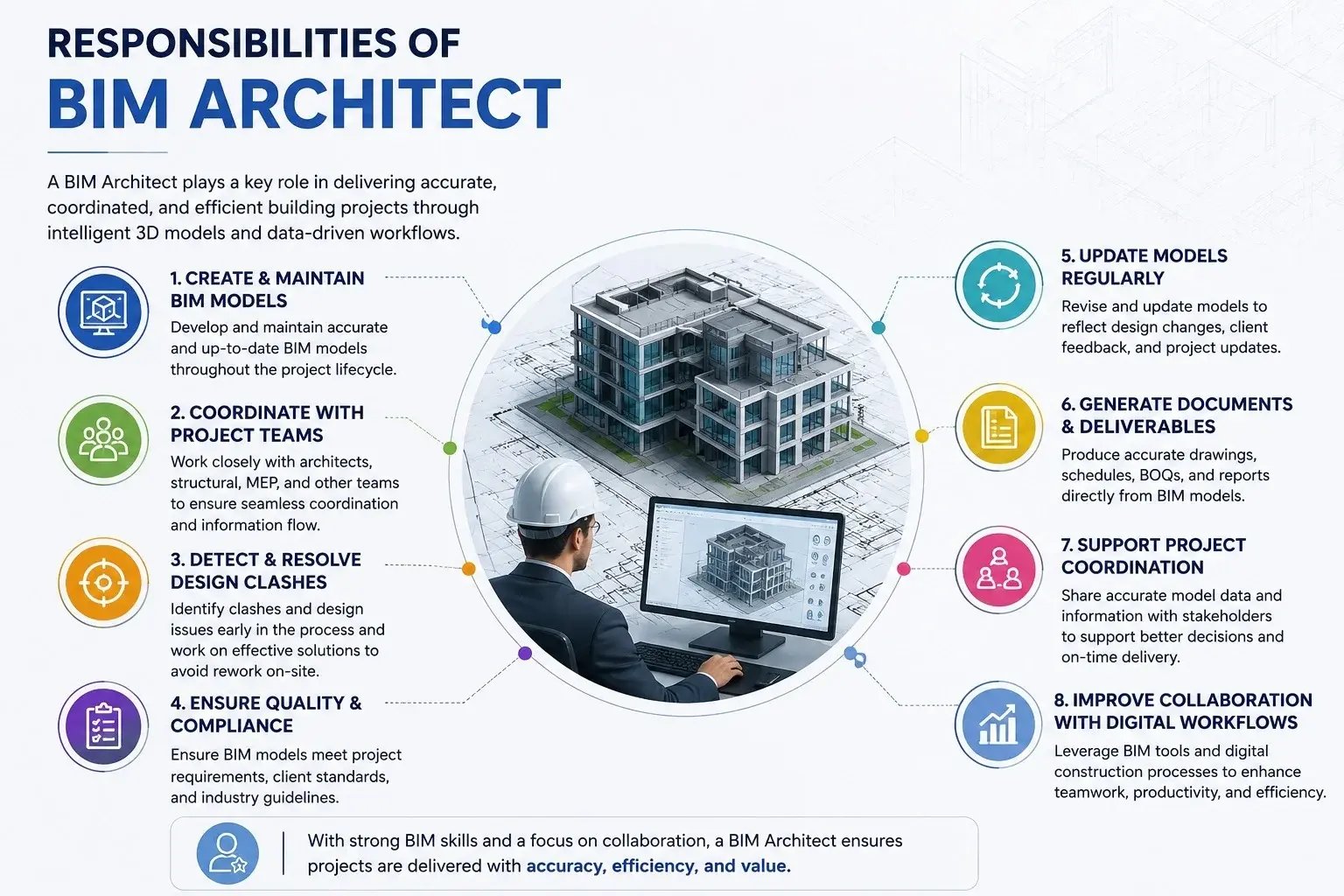
A BIM Architect plays a central role in ensuring projects move smoothly from design to construction. Their responsibilities go beyond creating 3D models, requiring strong BIM skills, effective project coordination, and an understanding of [digital construction workflows](https://www.novatr.com/blog/digital-construction-shift-with-cpwd).
- ### **Create and Manage BIM Models**
Develop, update, and maintain accurate BIM models throughout the project lifecycle. These models serve as a central source of information, helping teams make informed decisions and minimise design errors.
- ### **Coordinate Across Project Teams**
Work closely with architectural, structural, and MEP professionals to ensure all disciplines are aligned. Effective project coordination improves communication and reduces conflicts before construction begins.
- ### **Review Designs and Resolve Clashes**
Identify design inconsistencies using [BIM tools](https://www.novatr.com/blog/bim-modeling-software) and resolve clashes before work starts on-site. This supports smoother digital construction workflows, reduces rework, and helps keep projects on schedule.
- ### **Prepare Project Documentation**
Generate construction drawings, schedules, quantities, and other project documents directly from BIM models. Maintaining accurate documentation ensures that all stakeholders have access to the latest project information.
- ### **Ensure Quality and Compliance**
Review BIM models to ensure they meet project specifications, industry standards, and client requirements. Applying strong BIM skills helps maintain model accuracy while supporting efficient collaboration throughout the construction process.
## **Salary of BIM Architect in India, USA and UAE**
Salaries vary by experience, location, and project complexity. Professionals with expertise in construction technology and growing demand for architect jobs can expect steady salary growth as they progress in their careers.
### **BIM Architect Salary in India**
BIM Architects earn higher salaries with experience and specialised project expertise. According to the [AmbitionBox](https://www.ambitionbox.com/profile/bim-architect-salary/gurgaon-location?utm_source=chatgpt.com), here is the salary breakdown:
| **Experience Level** | **Average Annual Salary** |
| --- | --- |
| Entry-level (0-2 years) | ₹4.7-5.5 LPA |
| Mid-level (3-6 years) | ₹6.4-7.1 LPA |
| Senior (6-9 years) | ₹7.3-10.7+ LPA |
### **BIM Architect Salary in USA**
According to the [ZipRecruiter](https://www.ziprecruiter.com/Salaries/Bim-Architect-Salary), these are salaries BIM Architect receive in the USA:
| **Experience Level** | **Average Annual Salary** |
| --- | --- |
| Entry-level (0-2 years) | $103,828 LPA |
| Mid-level (3-6 years) | $137,000 LPA |
| Senior (6-9 years) | $171,000 LPA |
### **BIM Architect Salary in UAE**
According to the [GulTalent](https://www.gulftalent.com/uae/salaries/bim-architect) these are salaries BIM Architects receive in UAE:
| **Experience Level** | **Average Annual Salary** |
| --- | --- |
| Entry-level (0-2 years) | AED 24,000 |
| Mid-level (3-6 years) | AED 84,000 |
| Senior (6-9 years) | AED 156,000 |

## **3 Best Online Courses To Become BIM Architect**
Choosing the right course is an important step towards building successful architecture careers. A good BIM course should combine practical BIM training, industry-standard software, [real-world projects](https://www.novatr.com/blog/example-of-bim-projects-globally), and a recognised BIM certification that helps you become job-ready.
| **Course** | **Duration** | **Fees** | **Course Highlights** |
| --- | --- | --- | --- |
| **BIM Professional Program by Novatr** | 7 Months | 2,75,000 | Comprehensive BIM programme designed for architects and engineers. Covers Autodesk Revit, [Navisworks](https://www.novatr.com/blog/navisworks-guide), Autodesk Forma, BIM workflows, project coordination, model management, documentation, clash detection, and digital construction. Includes over 25 real-world projects, 1:1 mentorship, portfolio development, career guidance, mock interviews, networking opportunities, and learning from 400+ industry experts. |
| **Master in BIM Management by Zigurat Institute of Technology** | 12 Months | NA | Focuses on BIM management, ISO 19650 standards, digital collaboration, project delivery, and international BIM workflows. |
| **BIM Foundations Course by LinkedIn** | Self-paced | Subscription-based | This self-paced course introduces BIM fundamentals, digital modelling, collaboration, and project workflows, helping learners understand how BIM improves planning, coordination, and decision-making across architecture, engineering, and construction projects. |
## **Top Skills and software required to become a BIM Architect**
Success as a BIM Architect depends on mastering the right digital tools. These industry-standard platforms help professionals create accurate models, improve collaboration, automate repetitive tasks, and deliver projects more efficiently.
- **Autodesk Revit:** The industry's leading [Revit software](https://www.novatr.com/blog/revit-guide-for-beginners) for creating intelligent 3D architectural models, detailed drawings, schedules, and construction documentation.
- **Autodesk Navisworks:** Used for model coordination, clash detection, and project review, helping teams identify conflicts before construction begins.
- **Autodesk Forma:** Supports early-stage design by providing site analysis, environmental insights, and data-driven planning to improve project decisions.
- **DiRoots:** A suite of Revit add-ins that automates repetitive tasks, improves productivity, and simplifies model management.
- **ProSheets:** Streamlines the printing, exporting, and organisation of multiple Revit sheets, saving time on project documentation.
- **EF Tools:** Offers practical utilities that speed up modelling, annotation, and documentation within the Revit environment.
- **Enscape:** Creates real-time visualisations and immersive walkthroughs directly from BIM models, making it easier to present design concepts.
- **pyRevit:** An open-source extension that expands Revit's capabilities through custom tools, automation, and scripting.
- **Autodesk BIM Interoperability Tools:** Improves model quality by validating BIM standards, checking project requirements, and supporting smoother data exchange.
- **McQuay:** Used in HVAC design workflows to assist with equipment selection and system calculations, supporting accurate building services coordination.
BIM is Advancing. Are You?
Get BIM certified and open doors to a better career.
Join the Program
## **Conclusion**
A career as a BIM Architect offers the opportunity to work at the forefront of digital construction, where technical expertise and collaboration go hand in hand. As the demand for skilled BIM professionals continues to grow, building the right foundation through structured learning becomes essential.
[Novatr](https://www.novatr.com/) offers a comprehensive [BIM Professional Program](https://www.novatr.com/courses/bim-professional-program?utm_source=organic_search&utm_medium=blog&utm_campaign=), which equips learners with practical experience in industry-standard tools, real-world projects, expert mentorship, and career support to prepare them for the evolving AEC industry.
Whether you are a student, graduate, or working professional looking to upskill, investing in quality BIM training and earning a recognised BIM certification can help you build a rewarding and future-ready BIM career.
For additional industry insights and learning resources, join us on our **[WhatsApp channel](https://whatsapp.com/channel/0029Vb7Gy2LBFLgMx79j7B1b)** or visit our **[Resources Page](https://www.novatr.com/learning-hub)** to learn about the latest trends in architecture and engineering.
## **FAQs**
### **1. Is BIM Architect a good career?**
Yes. A BIM Architect is a high-demand role with opportunities across architecture, engineering, and construction. It offers competitive salaries, global career prospects, and strong long-term growth.
### **2. What is the difference between Architect and BIM Architect?**
An architect focuses on designing buildings, while a BIM Architect creates and manages intelligent 3D models that improve project coordination, collaboration, and construction planning.
### **3. Which software should a BIM Architect learn?**
A BIM Architect should be proficient in Autodesk Revit, Navisworks, and Autodesk Forma, along with tools such as Enscape, pyRevit, and DiRoots to improve modelling, coordination, visualisation, and project workflows.
Was this content helpful to you
Like Yes
Dislike No

TABLE OF CONTENTS
BIM Is The New Standard. Are You Certified?
Get Certified in BIM
SHARE ON YOUR SOCIALS
Link Copied Successfully
Related articles
[ BIM Top Industry Applications for BIM: Where is BIM Used in Construction? 22 June 2026 7 min read](https://blog.novatr.com/blog/top-industry-applications-for-bim-where-is-bim-used-in-construction) [ BIM How to Become A Successful BIM Technician: Career Guide, Skills & Salary 10 March 2025 13 min read](https://blog.novatr.com/blog/how-to-become-a-bim-technician) [.png) BIM BIM Freelancing Vs Full-Time Career: The Complete Guide 22 July 2026 9 min read](https://blog.novatr.com/blog/bim-freelancing-or-full-time-career) [ BIM Top 10 BIM Software Used in Architecture, Engineering, and Construction Firms in 2026 24 June 2026 11 min read](https://blog.novatr.com/blog/10-best-bim-software-used-by-aec-firms)
Download Syllabus
## BIM Professional Program
Next Cohort
June 2026
Program Duration
7 Months
Premium Program benefits
8 Credentials from Autodesk, NSDC, Novatr
1 program. 10 career paths. Infinite Growth.
40+ ISO 19650 & RIBA real-world projects to practice
1-on-1 guidance. Access 400+ industry experts.
Access the biggest AEC-Tech community on the planet. 8500+ and counting
Curated for you by 100+ global BIM leaders.
Lifelong access to course content
Enter your details to download the program syllabus.
##### BIM Professional Program
June 2026, 7 Months
Your Name Invalid name.
Phone Number Enter a valid phone number
Email Please enter a valid email address.
Select years of experience\* Currently studying 0-1 years 1-2 years 2-4 years 4-8 years 8-10 years 10-12 years 12+ years Invalid selection.
Specialisation Select your background\* Architecture Civil Engineering Mechanical Engineering Electrical Engineering Invalid selection.
Are you professionally trained in interior design?
Yes
No
I agree to the [Terms of Use](https://www.novatr.com/terms-and-conditions) and [Privacy Policy](https://www.novatr.com/privacy-policy), and consent to be contacted by Email, Call, WhatsApp, or SMS.
Submit
Ready to skyrocket your career?
Begin your next chapter in AEC
with Novatr!
We are here to help you take the industry by storm with advanced, tech-first skills.
[Explore Courses](https://www.novatr.com/#courses)
Join our newsletter
Submit
Thank you for signing up.
We’ll send you a nice letter once per week. No spam.

Dare to Disrupt.
Join thousands of people who organise
work and life with Novatr.
Company
- [About Us](https://www.novatr.com/about)
- [BIM Professional Program v.2026](https://www.novatr.com/courses/bim-professional-program)
- [Masters Computational Design](https://www.novatr.com/courses/computational-design)
- [Become a Mentor](https://www.novatr.com/apply-as-mentor)
- [Hiring from Us](https://www.novatr.com/hire-from-us)
- [Careers at Novatr](https://www.novatr.com/career)
Resources
- [Blog](https://www.novatr.com/learning-hub)
- [Media Room](https://www.novatr.com/media-room-home-page)
- [Career Builder](https://www.novatr.com/career-navigator)
- [Events & Webinars](https://www.novatr.com/webinars)
- [FAQs & Support Center](https://www.novatr.com/contact-us)
- [Contact Us](https://www.novatr.com/contact-us)
- [Privacy Policy](https://www.novatr.com/privacy-policy)
- [Terms of Use](https://www.novatr.com/terms-and-conditions)
©2023 Oneistox Network Pvt. Ltd.
All Rights Reserved
```json
{
"@context" : "https://schema.org",
"@type" : "BlogPosting",
"author" : {
"@type" : "Person",
"name" : "Bandana Singh",
"url" : "https://blog.novatr.com/blog/author/bandana-singh"
},
"dateModified" : "2026-07-22T06:46:39.656Z",
"datePublished" : "2026-07-22T06:42:32.000Z",
"headline" : "BIM Architect: Job Role, Salary, Skills & Courses {{year}}",
"image" : [ "https://blog.novatr.com/hubfs/ChatGPT%20Image%20Jul%2022%2c%202026%2c%2012_12_02%20PM.png" ],
"mainEntityOfPage" : {
"@id" : "https://blog.novatr.com/blog/bim-architect-job-role-salary-skills-and-courses",
"@type" : "WebPage"
},
"publisher" : {
"@type" : "Organization",
"logo" : {
"@type" : "ImageObject",
"url" : "https://blog.novatr.com/hubfs/Novatr%20Prev%20OX-2.svg"
}
}
}
```